skip to main |
skip to sidebar
Last night I spelled out the four types of comments we'd likely see in tonight's session. It pretty much fell in line with that demarcation, but I wasn't ready for the considerable intensity of one particular type of comment.I took shorthand of each of the 42 comments and tabulated the totals. Suzanne Chan took her own poll and had it as 8 for, 30 against (!), and 4 neutral, giving the caveat that most of the negative comments were not negative about the project in general, but rather a specific site. I had slightly different numbers. Read 'em and weep: You can see that 20 out of the 42 comments were related to the Warm Springs alternative, in which the ballpark would be decoupled from the village and placed near the future BART station. Opposition was passionate, some parts thoughtful and others hysterical. One resident didn't want a ballpark serving alcohol a half mile or less away from the local elementary school. Another mentioned the twelve traffic light cycles he had to wait through at the Auto Mall/Osgood intersection on Black Friday, as shoppers entered and exited the nearby Fry's parking lot. Two commenters talked about "letting the genie out of the bottle" as the ballpark would start to transform the area from a safe, well-heeled neighborhood into East Oakland around the Coliseum. The addition of the Warm Springs alternative was a response to suggestions by BART and the MTC. The transit agencies and the A's feel that a ballpark could fit into a transit-oriented development design, though the concept is merely in its infancy. Surely they knew what kind of wrath they would encounter if they floated the idea, right? Many of the anti-WS folks were not opposed to the A's or the Pacific Commons site. They were vehemently against having it in their backyard.Had Warm Springs not been included in the Notice of Preparation, tonight's comment distribution would've looked more like this (Other means neutral):
 That's fair when you consider that sessions like these tend to bring out more negative comments.Matt Artz of the Argus (thanks for the shout-out BTW) focused his article on Catellus, who officially came out against the project as it exists in the Notice of Preparation. Catellus is the real estate unit of ProLogis and has been working with the A's and the city to mitigate existing retailers' concerns. Unfortunately, I think Artz left out something. The statement read by Catellus veep Aidan Berry was not so much a general disapproval as it was frustration over where the ballpark was placed in the original plan. The site plan placed the ballpark less than 1/4 mile from the three big box anchors: Costco, Lowe's and Kohl's. Those three have been and always would be the most difficult to deal with because their business models don't mesh with a ballpark. The statement suggested that another site within Pacific Commons would've been more agreeable. The ballpark location hasn't changed since conception, ergo Catellus can't sign off. I can only guess that the A's didn't want to pursue a change because it would require a major change in the EIR, especially with regard to environmental concerns (I could use some expert verification of this, e-mail address in my profile hint-hint), and that would lengthen the process yet again.How difficult is this? The NIMBYs want the project as far away from them as possible, at the expense of environmental and transit concerns. Some business owners and transit advocates want the ballpark at Warm Springs, but had little to say about the NIMBY issues. Meanwhile, there are supporters out there who want either Pacific Commons or Warm Springs or don't care either way. And that, my friends, is why ballot box planning is so problematic. People tend to look only at their own interests. They have every right to do so, but that doesn't make them good planners.
Council member Anu Natarajan chided the crowd at the conclusion by bringing up frequent complaints by Fremont residents that there aren't enough entertainment options in the city, that there isn't enough good retail. She initially supported the plan in an effort to address those quality of life issues. No good deed goes unpunished, eh?
KTVU sent veteran reporter Lloyd LaCuesta to the proceedings tonight and he got the scoop du jour, a letter from Bud Selig urging Lew Wolff to take care of business in Fremont. And if he can't? Alameda County Supervisor Scott Haggerty interpreted that as meaning Selig is encouraging discussions with San Jose. Haggerty, who had a large part in putting the Fremont deal together, is as much in tune with East Bay politics as anyone. Moving over to San Jose, Mayor Chuck Reed was asked for his reaction:
 Basic pol-speak there. He went on to mention that San Jose has an already completed EIR as well as the Diridon South site at fair market value. Fair market value? Previous estimates for the 14-acre site were around $74 million, though that may have dropped somewhat with the flagging real estate market.To keep things in order, this post will be the territorial rights and San Jose thread. The previous post and tomorrow's post will cover Fremont. Any comments straying from the subject matter in any thread will be deleted, you have been warned.I'll say good night posing this question: Why did Selig allow Steve Schott to start discussions with Santa Clara?
Tonight was spent mostly observing various people's responses to the displays and the back-and-forth with representatives of Fremont and LSA Associates, the firm conducting the environmental impact report. Keith Wolff was also in the house. The largest crowd was gathered around the image above, and for good reason. Many of those in attendance were residents of that neighborhood across 680 from Warm Springs. They are going to be there tomorrow, and they will have numbers. The session tomorrow is shaping up to be an interesting contrast of constituent groups. We'll see four types of comments:
- NIMBY types from the Mission San Jose neighborhood. Regardless of which parcel in Warm Springs could be chosen for an alternate ballpark site, many of those residents will protest vigorously.
- Ballpark supporters who prefer the baseball village in its original, whole form.
- Transportation advocates who would like to see the decoupled village/ballpark concept as shown above.
- Environmentalists who don't want to see development endanger the adjacent wetlands.
It's hard to say which group will be more prominent. I'll make an informal tally while I'm there. A warning about that - the session tomorrow is only an hour long, and even if they devote the entire hour to public comments (which they won't), only 30 or so comment slots will be available to speakers. Commenters are encouraged to use either the written comment forms or contact project principals via e-mail. From a process standpoint, public comments all get the same treatment and attention since they are a matter of public record. People tend to feel better about voicing their concerns directly, so if you get there early enough to get in the queue, let er rip!I did learn one thing about the process that is, well, depressing. I mentioned earlier that the Warm Springs Alternative would be included in the EIR, but due to the lack of information about the alternative, additional time-consuming EIR work would be required. Traffic and other impacts would have to be studied in the same detail as the original site. That would conceivably push back the completion of the EIR, which then would delay construction, etc. I struck up a pleasant conversation with LSA's Shannon Allen, who when asked about this possibility said, "It gives me a headache." Me too.
While I was away prepping the Turkey Day feast, I had received an e-mail from the City of Fremont, advising me a City Council work session for the baseball village scheduled for this Tuesday, December 9. This is not a rescheduling of tonight's "open house" type event, it's an additional session to occur prior to the Council's normally scheduled meeting. So here's the complete schedule to avoid any confusion:- Monday, December 8 - General Public Scoping Meeting on the Notice of Preparation for the EIR, 6:30-8:00 p.m. @ Fremont City Hall Council Chambers.
- Tuesday, December 9 - City Council Work Session for Ballpark Village Project, 6:00-7:00 p.m. @ Fremont City Hall Council Chambers.
Fremont City Hall is located at 3300 Capitol Ave.
The Giants and developer Kenwood Investments received an extended deadline, January 15, to present their vision of a retail/entertainment complex across McCovey Cove from AT&T Park.
The Sharks acquired a 10-15% stake in the Earthquakes from the A's for up to $3 million. That's a pretty low figure compared to the reported franchise fee of $20 million (Correction, $3 million is a correct amount. I edited out a reference to the new asking price for an MLS expansion franchise, reportedly $40 million). Franchise values for teams outside of the NFL and MLB could take a hit in the near term, even small market NBA and NHL teams.For SVS+E, the Sharks-related company that manages HP Pavilion, ice rinks in San Jose and Fremont (very close to the Warm Springs BART station site), and the San Jose Civic Auditorium, it's a chance to seal up the large events market in the South Bay. They'll manage the new stadium, which may or may not have a stage to accommodate large concerts. Only Shoreline Amphitheatre, which is run by events giant Live Nation, qualifies as local competition.The agreement appears to be a few steps removed from having SVS+E operate Cisco Field. Given that many of the business-side and money people from both the A's and Sharks tend to rub elbows a lot, such an arrangement is a near formality. But where will that stadium be located?
Despite the recession, the Yankees are positioned to bring in an extra $200 million a year in revenue because of the new Yankee Stadium. Perhaps pinstripes will have a slimming effect on Vallejo native C.C. Sabathia.
We'll start off with a pleasant image, courtesy Google Earth/Panoramio user Typeaux. That's the view east towards the Fremont Hills from what could be considered the northeast corner of the planned Warm Springs BART station. Next, a map (also from Google Earth):
 Pros compared to Pacific Commons:
- BART. Regardless of which parcel is chosen for a ballpark, it will be within a few hundred feet of the Warm Springs BART station, which is expected to start construction next year and open in June 2014. That's two years from the planned opening of Cisco Field, but it's better than not having BART.
- Site relative to freeways. Sandwiched between 880 and 680, 4 different exits are available to service the area. From Oakland/Hayward, 880 South to Auto Mall Pkwy. From Tri-Valley, 680 South to Auto Mall/Durham. From Santa Clara County, either 880 North to Fremont Blvd. or 680 North to Mission Blvd.
Cons compared to Pacific Commons:- Insufficient area road system. 4 different freeway exits are nice until they all funnel into two narrow roads, Warm Springs Blvd. and Grimmer Blvd. Currently, Warm Springs is only a two-lane road near the BART station, which will be widened to 4 lanes in conjunction with the station's construction. If they plan to put the parking on the Westwood parcel, it will be gridlock hell.
- Proximity to NUMMI. That gridlock, which will probably be spelled out in the EIR, won't make NUMMI happy. Grimmer Blvd. in particular is an important surface road that contains an entry into the plant. A NUMMI spokesman talks of a "win-win" for the plant and the team, but it's hard to see that happening unless either major concessions are made to NUMMI or the plant itself closes down. Neither option sounds palatable or cheap.
- Proximity to a local neighborhood. There is a reasonably well-heeled residential neighborhood just east of 680. It's accessible from Grimmer Blvd., a potential source of gridlock. Granted, residents already have to deal with the freeway so noise shouldn't be that big an issue. The ballpark is only going to make it worse. Light pollution from the ballpark could also be a nuisance.
- Proximity to the Hayward Fault. The BART station is only 0.5 miles from a known active trace of the Hayward Fault. The stadium may be even closer.
- Land cost. The Merc has a new editorial that paints the Warm Springs site as a nearly perfect place that will allow A's fans to suddenly ditch cars. Only 15-20% currently take BART to A's games. That means 80% or more drive. They'll continue to drive. It's nice to be able to take some cars off the roads, but let's be realistic. It translates to a reduction of roughly 2,000 cars per game. An improvement, yes, but not paradigm-shifting in the least. For that 80% of fans, around 10,000 spaces will be needed. If they don't build a single garage and rely entirely on surface parking, 78 acres will need to be acquired to accommodate the parking need. That won't be cheap.
I must sound like a nattering nabob. It's not intentional. I point these issues out because when you solve one problem (BART), you open up the possibility of other problems. That's exactly what the Warm Springs site does, given the current situation.
Amidst talks between BART and the A's is a new article by Merc scribe Denis C. Theriault (CBS 5 also picks up the trail). The focus is on a 36-acre parcel near the planned Warm Springs BART station. Being familiar with the area, I wondered which parcel they were talking about. After going through my archives, I found a few things you might want to check out.First, my old Fremont site album from three years ago. The album has both Warm Springs and Pacific Commons in there for reference. Trust me, the area hasn't changed much. From the album is this overhead shot: Next up is a document from Fremont called the Warm Springs Existing Conditions Report, explaining existing and potential land use for the area surrounding the Warm Springs BART station. From that is an important map showing who's who among area landholders (this was from 2004 and may be somewhat outdated, but I doubt it):
 A tiny piece of 880 is at the bottom left corner of the map above.The last bit comes from the good folks at OAFC, who kept parts of the old Oakland HOK study, from which came the original Fremont site study - yes it was Warm Springs.
 Now about those 36 acres under consideration. Based on the information in the Existing Conditions Report, two parcels are that size: the BART station facility and the "Westwood" site, which is east of the station next to 680. The A's couldn't be asking for BART to give up some of its land for the cause, could they? Nah, it's gotta be the Westwood parcel. Then again, two years ago I projected that losing the A's fanbase would drop total BART ridership 1% per year, or $3 million. They may have some incentive to work out a deal.
The Giants are going to experiment with a new pricing scheme for select seats at AT&T Park called dynamic pricing. Prices will vary in the left field corner, upper deck sections could vary as much as $2 from published pricing based on demand. While this is not expected to make a significant difference in attendance or revenue, it's a good way to gauge how responsive area fans are to such an initiative.Regionally, the best analogue comes from State Highway 91 in Orange County, which has so-called "Lexus lanes," otherwise known as high-occupancy toll (HOT) lanes. The toll on the premium lanes varies depending on time of day, and is a model from which more dynamic pricing will be based. Don't like the concept? You might want to get used to it, as it's part of transit planning throughout the urbanized parts of the state in the future.
Despite an additional $25 billion taxpayer bailout, Citigroup will retain its naming rights deal at the Mets' new stadium in Queens. This has caused some angry NYC pols to call for a renaming of the ballpark to "Citi/Taxpayer Field."
Santa Clara County Measure B (BART to Silicon Valley) has passed with the vote certified by the county registrar. A San Francisco judge also struck down an electoral challenge to the results. A partial, manual recount is possible, but it'll cost $400k to whomever is interested.
Bill Simmons, a.k.a. "The Sports Guy" on ESPN.com, wrote a neat article two weeks ago on how the way new football stadiums have been built has largely eliminated home field advantage in the NFL. The lessons? Make the structure as compact as possible, lose the open ends that make for scenic vistas, minimize the impact of luxury suites, and stop forcing Joe Fan to sit in the nosebleeds. 360 architecture, the firm working on Cisco Field and the new Meadowlands Stadium for the Jets/Giants, appears to have taken some of that knowledge to heart.
Last but not least, regarding the rumor of discussions about territorial rights during the winter meetings next week: I received a couple of notes on this prior to the anonymous comment. That said, I'll wait until next week to post on it, lest I go back on my promise not to comment on San Jose rumors.
Update: Matier & Ross report that this week the A's and BART officials will the alternate Fremont site near the planned Warm Springs BART station and NUMMI. Keep in mind that several parties with no relation to BART control the land in the area.
It's time again for our seasonal progress report. Does it feel like the A's are treading water, while everyone else is passing them by? In a sense, other teams are. The greatest solace A's fans can take from the Cisco Field effort comes from the way they're pursuing the ballpark. The three parks opening next year all involve massive amounts of public financing, taxes, or even questionable land acquisitions. Sometimes the more honest slog is the harder one. The funding component has been downgraded due to the delay in housing-related revenues. Should we see more information on the additional commercialization of Cisco Field, the meter can move a little more to the right. The political process remains the same, even though a major milestone was passed in the form of an election. I had not originally factored the election into the equation, only the process of drafting and certifying the EIR plus the business relationship between the A's and Fremont. Site acquisition and construction remain in stasis due to inactivity.
 It looks like the Marlins have gotten the green light to proceed as Norman Braman's lawsuit has been officially struck down, all seven counts of it. Once they get the financing, the race will be on as they'll have about 24 months to complete a retractable roof ballpark. I mentioned earlier that the shortest construction time for such a stadium was 28 months. That stadium was Safeco Field, which you may remember opened in mid-July, 1999. Update: The Marlins announced that they will push back the opening date to 2012. They will either have to figure out a way to extend the lease at Dolphin Stadium one more year, or find another interim venue.
 While I don't like how the Twins and Hennepin County managed to get a county sales tax hike passed without it ever getting to the electorate (a feat that would be impossible in California), I love the location and how they crammed a 40,000-seat stadium into only 8 acres. I'm planning a Midwestern version of the ballpark tour I did earlier this year, and if it happens Target Field will be on the list.
 Citi Field has proven to be the less controversial of the two NYC ballparks, though not quite controversy free. There is some concern that the "Citi" part may not hold up, as Citigroup has taken quite a beating recently. Surely naming rights would be appealing to JP Morgan Chase or Bank of America, right? Maybe not.
 I have a sinking feeling that given the escalating costs to build the stadium and the need for additional financing, the parkland replacement promised for the neighborhood will take far longer to build due to a lack of funds. At least they'll have the new train platform so that my friends from north in the Hudson River Valley can take the train in.That's the last planned update for this month, folks. See y'all in December for the community workshop.
Another 8,520 votes have been counted, and the results are:Yes - 414,308 (66.78%)
No - 206,098 (33.22%)
The margin is now 2,112. Or rather, if 705 additional "No" votes had been registered from the current total, the measure would not pass. 9,800 votes remained to be counted as of Wednesday evening, so this new total may be "final" with a number of ballots thrown out. Opponents have indicated they may demand a recount, one that they would have to pay for.
The big interchange project isn't completely finished, but the bulk of it is. The northbound carpool lane opened today, following onto the opening of the southbound lane earlier in the week. That brings the freeway to at least 8 through lanes, 4 in each direction, plus at least 1 auxiliary lane between exits. Between 237 and there are as many as 12 lanes. Most importantly, the carpool lanes now extend from San Leandro all the way to Milpitas.I had the chance to drive south from Newark to San Jose at 6 p.m., and it was smooth sailing near the ballpark site. We'll see how the northbound commute looks today now that the its widening has been completed. It'll still be fairly congested to be certain, but there should be some alleviation. I'll be checking 511 to note any changes.
Update: 511's Flash-based map shows an incremental improvement in speeds through the area. At 5:30 p.m., the 880 @ Mission was moving northbound at 32 mph, compared to 19 mph yesterday. At 6:30, they were going 47 mph. Going southbound, cars were traveling at the limit or better today.
Early today, the A's submitted their long awaited Notice of Preparation, along with a revised site plan. This time, the site plan is much shorter, as it acts mostly as an addendum to address concerns about traffic and parking:- Parking for fans at The Fountains Business Park (north of Auto Mall Parkway) has been eliminated. Instead, the A's aim to replace 2,600 spaces there with a similar number east of 880. Fans would access the ballpark and village via a pedestrian bridge over the freeway. The purpose is to mitigate congestion at Auto Mall. The parcels haven't been acquired by Wolff/Fisher, instead they intend to work with area businesses and landowners to provide the spaces. The Fountains would still be used for employee parking. The plan provides scenarios in which the "East of 880" parking is used either immediately or in the long term as major development is completed.
- The three primary stadium lots would provide 10,990 spaces. This includes the "Interim Lot" immediately to the south of the ballpark. Given the likely delays in housing development, this lot may be less interim than previously planned. In addition, the "Municipal Lot" along Auto Mall near the railroad tracks is planned to have 2,500 spaces.
- Traffic routing has been designed to direct cars from specific exits to specific lots. Some of the streets would be designed or widened to include center reversible lanes, which would change direction before and after games. Electronic signage from the freeway and arteries and optimized signal timing would help control traffic management, similar to the system used for HP Pavilion.
- The A's would staff a parking monitoring system (tire chalking) which would identify violators, including frequent ones. A sort of soft validation system would be instituted, in which repeat violators would be warned after the second offense, and towed or booted after the third (I am refraining from the obvious sports metaphor).
The deceptively eye-popping takeaway from the plan is that a project alternative will be included that decouples the ballpark from the rest of the development, placing Cisco Field near the planned Warm Springs BART station. This should not be interpreted as a preference, as the whole, contiguous plan is obviously more synergistic. Still, having the alternative should make for some interesting discussion on this site and others - I didn't see it coming. The A's have not bought any of the land surrounding the BART station. It is not clear that any area landowners have any interest in selling to the A's. NUMMI, in particular, may look at the ballpark's location and use as a threat to their operations, for reasons discussed previously.The City of Fremont has scheduled a community workshop for Monday, December 8, from 6:30 to 8 p.m. The session will be held at the usual location, City Hall's Council Chambers.Interested parties can start submitting comments on the Notice of Preparation immediately, they have until December 18 at 4 p.m. to submit comments. Keep in mind that this is not the EIR. Instead the comments will help guide the Draft EIR, which may not be released until early spring.
The Merc has a piece covering the three local stadium projects: Lew Wolff's A's and Quakes stadia, and the 49ers' stadium in Santa Clara. We've discussed at some length the impact of the economic collapse and its impact on Cisco Field. While proceeds from housing sales will have to be pushed back while the market becomes friendly again, Wolff doesn't appear to be appreciably scaling back the vision, as he is with the Quakes' next home. From the article:In a bid to wait out the real estate markets, he'll tap other sources of cash, including private investors, parking fees and naming rights. On Monday, he hired the William Morris Agency to help identify a naming rights sponsor.
Naming rights to the stadium have already been sold, so that's not under consideration. However, just about every other piece of the stadium can be sponsored, from suite concourses to kids' play areas to the press box and broadcast booths. Every vertical surface that could be picked up on camera could have electronic or rotating signage. It wouldn't surprise me if the concourses had numerous interactive displays for sponsors, or a show car parked beyond the outfield fence somewhere. If you're worried that the ballpark itself was going to go mallpark, you have reason. It's important to keep in mind that things have already been trending in this direction for some time. The sad truth is that these days it will take these kinds of efforts to pay for construction and keep the team from carrying a massive mortgage.
It's taking thousands of provisional ballots to do it, but Santa Clara County's Measure B has now passed the two-thirds threshold that is required for it to pass. The current tally with 9,800 ballots remaining to be counted:Yes - 407,932 (66.67%)
No - 203,954 (33.33%)
The margin here is 24 votes, which translates into a true difference of only 9 votes. Or rather, if 9 more voters had voted No instead of Yes, the measure would be losing. I'm starting to wonder what the fate is of my brother's absentee ballot, which may have been rejected because he accidentally circled one of the arrows instead of drawing the line connecting an arrow. Talk about too close to call.
I somehow missed some juicy info on Argus reporter Matthew Artz' Tri-City Beat blog. The news was too good not to make it onto the print edition, so now there's an article as well. As expected, Wolff de-emphasized the housing component of the ballpark's financing, going so far as to finance the construction of the ballpark first. The housing would happen later, though Wolff didn't elaborate.This is where it can get sketchy. Normally, banks will set a stadium construction loan's interest rate based on revenue streams that will be used to pay it off. The more secure the sources, the better the terms. That's a big reason why, when putting together the revenue streams, teams will often move away from in-stadium revenue. Attendance and concession money is far less stable than a sales tax hike (at least normally it is, not so much this year). Wolff indicates that he has backup sources, but won't show his cards. Whatever the mix, the revenue mix will have to be clearly defined before a single dollar of a construction loan is given. It'll be interesting to see who provides the financing now that every investment bank has either folded, been acquired, or converted into a traditional bank. (For more on the death of the I-banks, check out the new piece in Condé Nast Portfolio by Moneyball writer Michael Lewis).The Notice of Preparation for the final project plan is expected in a month. When asked why it was delayed, Wolff cited the election. Shrewd handling of a political football? Sneaky dealings? Given the small percentage of the electorate that actually reads such documents, I believe the impact would've been small in either a positive or negative manner.Artz calls attention to how the ProLogis stock price has dropped from nearly $72 to $5 in only six months. While startling, the decline should be kept in perspective. ProLogis is still going to pay out a dividend to its shareholders, which is more than can be said for a lot of companies. Their main industries are real estate and warehousing. With products generally not moving due to the credit crunch and its cascading effects, ProLogis was going to take a major hit. Growth will be slow as they aren't developing anything on their own in the near term. As the gears of the economy start moving again, ProLogis will as well.I've touched briefly on the idea of the A's moving a major parking lot to an area across 880 from the baseball village. I puzzled at why that would be the case at first. My guess at this point is that they're feeling pressure to move as much traffic away from Auto Mall Parkway as possible, and by moving parking away from Auto Mall, traffic would be siphoned to boot. Problem with this is that by moving parking across the freeway to the east, they get closer to NUMMI. Forget yesterday's report that the plant will cut production in response to the economic downturn, NUMMI will rebound at some point thanks to it being mostly a Toyota plant. NUMMI considers itself a 24/7 operation, so anything that could potentially impact production or product/parts movement is cause for alarm. Considering how infrequent the use of this parking lot would be (90 times per year, half the time between 6 and 11 p.m., one-third on weekends), any concerns would seem to be overblown. Despite this, it's well within NUMMI's right to share their concerns and for the A's and the city to devise a way to mitigate any impacts.On a related note, the pedestrian overpass concept will likely cost at least $10 million depending on its width and load. Cupertino is completing what looks like a miniature version of Boston's Zakim Bunker Hill Bridge over 280.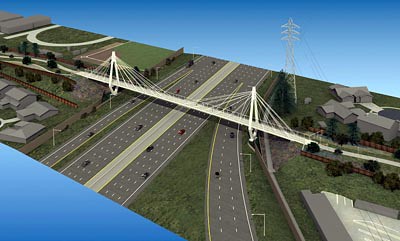 Something tells me the A's might build something more utilitarian, but this one also has one very important design characteristic: it doesn't need a column in the freeway median. They could also choose to make such a bridge wide enough to carry parking trams.
Measure B is mounting a comeback, now at 66.61% in favor with 17,000 provisional ballots remaining to be counted.It looks like Costco may be filling the space at the Oakland Army Base meant for the planned Auto Mall. Nancy Nadel prefers having a large truck stop somewhere on the site to keep diesel trucks from parking in the neighborhood on the other side of 880. Apparently the city and the port haven't yet figured out where that truck stop should go.There's a great Dodger Stadium retrospective at the late Walter O'Malley's website about ideas that didn't quite make it off the drawing board.Five months ahead of Opening Day, the Mets have sold out every single one of their 49 luxury suites at Citi Field. The Yankees have sold 44 of 51 suites at New Yankee Stadium, a number that hasn't budged since August (likely coinciding with the economic crisis).
Lew Wolff did his usual hot stove ballpark update, this time with the Associated Press. We've gotten used to these updates as part of an effort to keep the project in the public's consciousness. While the Fremont mayoral race did this on a local scale, an AP article is much more broad-reaching. No really new news here, as Wolff and new Giants managing partner Bill Neukom reaffirmed their commitments to Fremont and South Bay territorial rights, respectively. Wolff also shot down speculation about Sacramento, saying, "We've investigated pretty thoroughly." Long time readers already know my stance on Sacramento, so it doesn't bear repeating. No mention of any emerging TV or radio deals. Hmmph...
It's over a week after the election, and absentee ballots are still being counted in order to find out the fate of Santa Clara County's Measure B (BART to Silicon Valley). As of Wednesday, here are the totals:Yes - 398222, 66.52%
No - 200430, 33.48%
There can't be more than 20,000 or so votes left to be counted, so it appears that Measure B is heading for defeat. However that doesn't mean BART won't be extended. A new piece by the Merc's Mr. Roadshow indicates that VTA will move to shorten the planned extension. To do this, they would stop short of downtown, avoiding the costly tunnel that would run from just west of 101 to the train station before heading up to San Jose Airport. What isn't certain is how truncated the extension will be. BART could stop only in Milpitas at the Great Mall, or it could head into San Jose and terminate at Berryessa (the old flea market). One last option is to end the line at the planned Alum Rock station, which is just short of downtown (1.5 miles east). Without the money to cover operations that would come from Measure B's sales tax hike, VTA will have to look at existing sources (2000's Measure A tax increase). They'll have to balance this with money for other projects, which may or may not be there because of lower consumption (sales tax revenue) or infrastructure money that the incoming Obama administration may or may not push in the extension's direction.My hope is that the extension is built all the way to Alum Rock. Only a small amount of tunneling would be required, and it would allow VTA to properly pursue a BRT/LRT line linking downtown and the east side. The Alum Rock station would act as a major transit hub, and with the decidedly middle/working class neighborhoods in the area, could be a vital anchor for future transit planning. While BART would stop short of linking up with Caltrain and a new high speed rail line at Diridon Station, a simple transfer could be arranged between the two lines. While it's possible for the full extension to be built in phases, it will only take longer to complete and become far more expensive in the process. The good news is that Warm Springs won't be affected by VTA's decision. It will still be built, with bids starting in February. The Warm Springs station is expected to open in 2014, two years after Cisco Field is expected to be completed. The San Jose extension could occur in another 3 years, though it remains to be seen if shortening the extension will also shorten the development time.
Before I get into the credit scene, a word about the Holliday trade. Regardless of what the final outgoing pieces of the trade are, and regardless of how long Holliday stays (unless he's immediately traded), this move can be attributed to one factor: relevance. The A's, despite having been in the ALCS only two years ago, are in danger of becoming irrelevant on both the local and national sports scenes. Having traded away much of its young star core, something needed to be done to excite the fanbase and keep some level of buzz with the team until its next phase, which presumably would be Cisco Field. I don't doubt that the move is being made to make the team competitive - heck, when was the last time the A's had a really good, in-his-prime, righty slugger?It's also nice to know that the team, according to Ken Rosenthal, might raise payroll considerably. The 2007 payroll was around $78 million, and this year's edition could reach $80 million. That's an indicator that even in the tough economic times, they could field a decent team, with $80 million as the ceiling if - and this is a big if - attendance is good. Of course, the glue that will hold a high-payroll A's team together is its performance. If they're 7+ games behind the Angels in mid-June, the fire sale will likely begin. Until then, we can remain optimistic. Unfortunately, it's been proven time and time again that a good record doesn't automatically correlate with great attendance for the A's. It might take bringing in a great player at the beginning of the season to jumpstart attendance, instead of the usual lag during the first couple of months before bigger crowds in the summer.
In Miami, where pols rammed through a stadium deal and waited out legal wrangling, the Marlins and Miami-Dade County have decided to delay seeking financing for the retractable roof ballpark until next spring. County officials have admitted that the delay is due to the credit crunch and market's inherent instability. In addition, several votes are slated to occur before the end of the year to approve an adjacent parking garage, among other ancillary issues.Delaying the financing piece puts the Marlins in a bit of a crunch time-wise. Their final season at Dolphin Stadium is 2010, so they have to move into new digs by April 2011. If they get financing in the spring, they'll have less than 24 months to get the ballpark completed - and that includes the retractable roof. To date, no retractable roof ballpark has taken less than 28 months to complete. The Marlins are helped by the fact that the Orange Bowl, which previously sat on the site, has already been demolished, so the site is clear and ready to build. Yet they haven't even released renderings of the stadium, choosing instead to tease the public about the field's new dimensions. If they can get it done in time, more power to them.Even big market teams are facing the credit crunch. The Yankees just received clearance from the IRS to seek up to $336 million in tax-free bonds. Bruce Ratner's Nets will benefit from the same loophole if they ever get the Barclays Center/Atlantic Yards project off the ground. In the past, tax-free bonds were simply a good way to save money for teams. But for the Yanks , who are in the middle of construction and actually need the funds to complete, government sources are effectively the only source as banks have been stuffing their mattresses. Jerry Jones' new Taj Mahal of a football stadium may be the bellwether for the industry, according to Sports Business Journal. The Cowboys are looking to get $350 million in new bonds to complete their successor to Texas Stadium, and they want it by December 1. The NFL decided to bankroll themselves to the tune of a $1.4 billion loan, though this may be more related to possible labor strife in 2011. Perhaps only the NFL, with its unified revenue structure, has the ability to insulate themselves in this fashion.Considering all of the turmoil we've heard about lately, it's not altogether a bad thing that the A's have pushed back their opening date to 2012. They won't have to get financing until spring 2010. That 18 months might be just what the market needs to correct back to real stability.
I've been checking on Santa Clara County's Measure B (BART-to-Silicon Valley) since Election Night, and it has been inching closer to the magic two-thirds mark with each update. The Merc's Mr. Roadshow (Gary Richards) reported yesterday that some 164,000 absentee and provisional ballots remain to be counted, a vast number that could certainly prove to be a game changer.As of today at 4:19 p.m., these are the results:Santa Clara County Measure B (Two-thirds majority required to pass, 1142 of 1142 precincts reporting)
Yes - 345132, 66.41%
No - 174528, 33.59%
That's a bit higher than last night's tally:Yes - 305729, 66.27%
No - 155582, 33.73%
That leaves roughly another 100,000 votes to be counted. So far, the additional voters have been coming in at a 67.53% Yes/32.47% No clip. I'll put my Nate Silver hat on and project the remaining 100,000 votes, based on the new distribution:Yes - 412662, 66.59%
No - 206998, 33.41%
Oh, missed it by that much. Assuming that there are 100,000 votes outstanding, Measure B will require a 68% Yes/32% No clip for it to pass. That would put the results as:Yes - 413132, 66.67%
No - 206528, 33.33%
The difference between passing and EPIC FAIL would be 470 votes. Who said a single vote didn't count for much?
12:06 a.m.: Three issues potentially have some effect on the A's future in the Bay Area. They are the Fremont mayoral and city council races, as well as Santa Clara County's Measure B, which would finance operating costs for the county's BART extension.
1:24 a.m.: Mayor Wasserman is keeping his job, along with Councilman Wieckowski. There is no runoff in Fremont elections, so the candidate(s) with respective plurality win their seats. That makes the second council member Suzanne Chan, who will replace the outgoing Steve Cho (who placed second in the mayoral race).
- Fremont Mayor (96 of 96 precincts reporting)
Robert "Bob" Wasserman - 20406 votes, 42.67%
Steve Cho - 15429, 32.26%
Gus Morrison - 9875, 20.65%
Paul Reeder - 1953, 4.08%
Write-in - 165, 0.34% - Fremont City Council (2 seats, 96 of 96 precincts reporting)
Bob Wieckowski - 22223, 27.47%
Suzanne Chan - 16709, 20.81%
Vinnie Bacon - 12735, 15.86%
Trisha Tahmasbi - 11773, 14.66%
Larry Montgomery - 3922, 4.88%
Hou Leong - 3873, 4.82%
Linda Susoev - 2934, 3.65%
Charles Bartlett - 2256, 2.81%
Alan Stirling - 1815, 2.26%
Fazlur Khan - 1813, 2.26%
Write-in - 248, 0.31% - Santa Clara County Measure B (Two-thirds majority required to pass, 1142 of 1142 precincts reporting)
Yes - 305729, 66.27%
No - 155582, 33.73%
The Measure B tally went deep into the wee hours and based on the numbers has fallen short by about 5000 votes so far. Absentee and provisional ballots are still being counted. If the count holds up, BART proponents would once again have to go back to the drawing board to figure out the length of the extension and its construction schedule. The tax was necessary in order for the extension to be eligible to receive federal matching funds. It's possible that the extension would have to be pulled back, perhaps stopping at Berryessa instead of downtown San Jose.
Incredibly, the results paint a rather favorable picture for the A's and their hopes to get the baseball village built. Several potential obstacles in Fremont have been removed. Incumbent mayor Wasserman, who has been the staunchest public proponent of the project, will stick around to see it through the EIR process at the very least. Wieckowski, also a supporter, will be there as well. They'll be joined by Chan, who is also a project supporter. Neither of the project's biggest critics, former mayor Gus Morrison and Sierra Club chapter leader Vinnie Bacon, placed higher than third in their races.
Is it smooth sailing from here on out? Not quite. Wasserman may have violated election laws in recuiting students from local high schools to campaign on his behalf. The fallout from that is unknown. The EIR still has to pass muster. The council has lobbied hard for concessions and so far the city and the A's have been able to find common ground. There remain issues to work out with private parties such as nearby businesses and landowners, but those are very doable. The upshot from tonight is that there won't be obstructionists making the decisions. That's not to say that the council are yes-men - far from it, in fact. Instead, the governing body should be of an open-minded view to make a deal that works for Fremont's residents, not one that derails it in service of a narrow agenda.
Towards the end of Susan Slusser's Chronicle article about the A's hiring Mike Gallego as third base coach is a blurb about the A's opting out of their current deal with KICU. This appears to be another step towards the rumored deal with Comcast SportsNet California (formerly CSN West). KICU had been broadcasting A's game for over a decade, and while the team is leaving the door open to returning to KICU, the writing's on the wall. In 2008, 45 games were on the KICU part of the schedule, supplemented by 66 on CSNBA. All signs point to an exclusive deal with CSNCA, which will hopefully lead to at least 140 games, perhaps 150. No, that's not the complete schedule, but it creates allowances for national broadcasts (Fox, ESPN, TBS, and the fledgling MLB Network). Depending on how the CSNCA deal is done, the A's may have more control over advertising revenue.The unspoken rationale for such a move is the digital TV transition, which is scheduled to occur next February 17. As it stands, only 6% of the Bay Area audience watches analog TV only via an antenna. The rest watch primarily through cable, satellite, or broadband connections. That 6% is almost guaranteed to drop once the digital switch occurs. The FCC's traveling band of commissioners visited Oakland last month to educate and survey area residents. The live demo didn't exactly go smoothly. Many over-the-air viewers will get fewer channels due to their locations, which brings up two issues. The Bay Area is pretty well spread out thanks to some big body of water in the middle, and here OTA transmissions start to peter out after a few dozen miles. That means if you're in San Jose and want to watch a digital World Series broadcast from KTVU, you'll have trouble unless you use a well-powered outdoor antenna that is properly aimed at San Francisco. Ironically, some residents in the various valley neighborhoods of SF have complained of not being able to get OTA digital reception even though they geographically in the transmitter's backyard.KICU, which has long been a San Jose-based station, moved their transmitter a few years back from Loma Prieta to Monument Peak near the Milpitas-Fremont border. It's not a terrible location, but there have been complaints from North Bay A's fans about the signal. Moreover, the A's and KICU chose not to do HD broadcasts due to cost. That won't be such an issue on a regional sports network. With uncertainty about OTA digital coverage on the horizon, it's not hard to see why the A's might look at something more predictable.The flipside of a change to CSNCA is CSNCA's own carriage. CSNBA has a long legacy of being carried on local cable systems, going back to its days as Fox Sports Net Bay Area and previously SportsChannel Bay Area. That, and the broadcasts of both baseball teams, Warriors, Sharks, and Pac-10 sports, made carriage of CSNBA throughout Northern California/Nevada and Southern Oregon a no-brainer. On the other hand, CSNCA is a relative newcomer. CSNCA only has the Kings right now, and they're blacked out in the Bay Area. CSNCA has struggled to get carried on non-Comcast cable systems throughout Northern California. While inking the A's would make CSNCA a more compelling channel, having the A's would also boost the channel's subscriber fee, especially if the channel were on basic cable as the A's are requesting.
Follow-up: ars technica has an article this week citing a survey by ABI Research. According to the survey, 20% of antenna-only viewers will cease to watch TV altogether. Additionally:
70 percent of the surveyed TV watchers plan to hook a digital converter box up to their over the air antennas, while another 10 percent plan to switch over to cable or satellite pay-TV. According to analyst Steve Wilson, though, the rest of the current over the air households will simply stop watching traditional television altogether.
That translates to only 3% of American viewers that will stop watching TV come February. That's not a bad percentage considering the kind of upheaval the transition is being hyped to be.


