


The Wave Magazine notes that the March 11 press conference was not merely a little get-together between Oakland and Alameda County officials and Lewis Wolff. It was also staged to announce Wolff's "personal involvement in an Alameda County ballot initiative that seeks a new (read: permanent) home for the A’s in Oaktown." This is the first time I've seen a mention of such an initiative, and while it's considered a given that a referendum will be required for any stadium in the Bay Area, I hadn't seen anything regarding the A's direct involvement until now. That leads me to believe that the process may be fairly advanced at this point, which it would have to be if they wanted to get something on the November ballot or even the midterm primary ballot in 2006.
The clock is definitely ticking. Even if an initiative passed, it's unlikely a new ballpark would open before opening day 2009. If the ownership group is directly involved, there will almost certainly be an ad campaign accompanying it, featuring current and/or former players. The Dallas Cowboys got Arlington, TX voters to pass their new stadium initiative due in large part to a $5 million campaign. Ads and public appearances featured former Cowboy greats such as Troy Aikman, Roger Staubach, and Daryl "Moose" Johnston. Stadium opponents spent only $40,000.
The irony is that some Alameda County voters may not be able to see any pro-stadium ads during A's games broadcast on KICU-36 because of poor reception.
The next issue of The Wave promises "the complete lowdown" on the San Jose effort.


26 March 2005
More on A's sale
According to an article on MLB.com, the vote on the A's sale to Wolff & Co. will happen on Wednesday. Not much else new except for what appears to be a confirmation that Steve Schott will remain a limited partner in the new ownership group. There's also another quote from Selig regarding Santa Clara County territorial rights:
I believe that places the ball in San Jose's court.
"We have a sport where you just can't have anarchy," Selig said. "You can't be changing territories. It's a territory that's owned by the San Francisco Giants and that will be respected. You just don't change those things and we won't."
I believe that places the ball in San Jose's court.
Estuary Plan
This post posits an alternative Oak-to-Ninth plan which incorporates several features in keeping with the EPP. Among the features:

One of the interesting possibilities lies in the land between the Embarcadero and 880 (the yellow strip in the photo above). Formerly a rail right-of-way for Union Pacific, it's not used for anything right now. The track is still there except for portions paved over at intersections. Part of it will be used for the Caltrans Fifth Ave Interchange project, but much of it may be available for other uses. The strip could be converted into parking for about 250 cars. An alternative plan could have the track reused for a trolley that runs between Jack London Square and the ballpark. Such a trolley could help alleviate the parking problem that will occur on site by letting patrons park near JLS, then take the spur to the game. While a light rail or trolley project for Oakland has been discussed for some time, the presence of rail makes it more of a possibility to fast-track a LRT plan. Alameda has been discussing transit options including bus rapid transit and a tram.
Advantages:
The Estuary presents a unique opportunity to create a mixed development that benefits many different groups and gives the A's a distinctive home. However, there are numerous hidden costs associated with development, and it is unclear who would pick up the tab.
- Most of the Fifth Avenue Marina is developed for recreational purposes, including an expansion of Estuary Park on the other side of the channel, a new public marina on the southwest end, a meadow/public park, and parking.
- Preservation of the Silveira property.
- Potential other mixed use (commercial/industrial)
- Conversion of Clinton Basin to a 70-slip floating home community much like those seen near Sausalito, in Alameda and in Seattle.
- 1,000 new apartments and condominiums in a 13-acre village concept on the Ninth Ave section, with up to 100,000 square feet of commercial space.
- 40,000-seat ballpark at the east end of the Ninth Ave Terminal, with a 1,200-car garage adjacent.
- 300-room hotel overlooking the estuary.
- Greenbelt/Park established along waterfront for both Fifth and Ninth sections.
- An option to preserve most if not all of the Ninth Ave Terminal building.

One of the interesting possibilities lies in the land between the Embarcadero and 880 (the yellow strip in the photo above). Formerly a rail right-of-way for Union Pacific, it's not used for anything right now. The track is still there except for portions paved over at intersections. Part of it will be used for the Caltrans Fifth Ave Interchange project, but much of it may be available for other uses. The strip could be converted into parking for about 250 cars. An alternative plan could have the track reused for a trolley that runs between Jack London Square and the ballpark. Such a trolley could help alleviate the parking problem that will occur on site by letting patrons park near JLS, then take the spur to the game. While a light rail or trolley project for Oakland has been discussed for some time, the presence of rail makes it more of a possibility to fast-track a LRT plan. Alameda has been discussing transit options including bus rapid transit and a tram.
Advantages:
- Nearly half of the area would used to establish new waterfront parks and recreational facilities.
- Small ballpark footprint is designed not to dominate landscape.
- Introduction of new types of housing (floating homes) and numerous units of affordable housing.
- Subsidies that may be needed to support affordable housing would be lower than those that may be required of Signature plan.
- Site is "owned" by City and Port, mitigating acquisition costs.
- Preservation of Silveira property and artist colony.
- Addition of a luxury or resort hotel, which currently doesn't exist in Oakland.
- Potential to introduce new mass transit options that serve the waterfront.
- Location is both close to downtown and highly visible from a major freeway.
- Costly cleanup and preparation. The land is considered a brownfield, and cleanup is estimated at $16 million.
- Distance from existing BART (Lake Merritt Station) is 1.2 miles. That's a bit too long to walk. A new station could be built along 8th St near 8th Ave next to BART's maintenance facility, but construction of a station platform and the pedestrian overpass required to span the rail yard immediately to the south could be prohibitively high. The use of a shuttle bus to negotiate the remaining distance may be cumbersome.
- Limited parking - 1,200 spaces for ballpark in a single garage devoted to the ballpark. A parking district would also have to be created for residents.
- Infrastructure costs. The Embarcadero along this stretch is often only a two-lane road, and it would have to be widened to accommodate assumed increases in traffic. Controlling ballpark traffic so that it doesn't hamper residents of nearby neighborhoods would also have to be planned accordingly.
- Startup costs for trolley are high. Cost to build the roughly 1 mile segment would be $40-50 million, which may not be worth it considering the number of riders that might use it. Similar projects were developed in Memphis and Seattle, and both have very limited ridership.
- Housing advocates may want more units or more affordable units.
The Estuary presents a unique opportunity to create a mixed development that benefits many different groups and gives the A's a distinctive home. However, there are numerous hidden costs associated with development, and it is unclear who would pick up the tab.
Estuary Site Overview
The Oak-to-Ninth Estuary area is a unique site. It's one of the last undeveloped, urbanized waterfront areas on the West Coast. Because of its development potential, civic and community leaders have been keen to make sure it doesn't become overly privatized or densely developed. In 1999, the City of Oakland and the Port of Oakland put together a set of development guidelines called the Estuary Policy Plan. The EPP isn't overly specific about what should be built on the 60 acres the area covers, but it does insist on the creation of open spaces with recreational uses.
Signature Properties has the exclusive option to build on the Oak-to-Ninth site. Its plan calls for 3,100 apartments and condominiums, along with commercial uses and parking. Slightly less than half of the acreage will be devoted to open space. There are concerns about the plan and whether it provides the most benefit for Oakland residents. That and a completed environmental impact report are factors in delaying any possible groundbreaking for perhaps a year.
In the HOK study, two options were presented for a ballpark development. The West plan put the ballpark on the smaller 5th Ave Terminal/Marina site. This would've caused conflict with property owner J.W. Silveira, who owns the only privately-held parcel in the area and has a thriving artist colony on it. Silveira is already suing Oakland because of a lack of disclosure, and it's possible the same sort of thing would happen with a ballpark on his property.
The East plan put the ballpark on the large 9th Ave Terminal site, where it would've run into fewer ownership issues since it's owned entirely by the Port. Instead, it would've run afoul of community interests, would would've noted the more than 3,000+ parking spaces and wondered if someone was trying to pass them for open space. There's also the issue of the 9th Ave Terminal building, which preservationists claim has some historic value and should be preserved. The plan calls for the building to be restored and converted, which wouldn't be a bad thing considering the success of SF's Ferry Building conversion.
Unfortunately, it appears that the City and Port have settled on Signature's proposal. If they hadn't, they probably would've updated the EPP, which definitely needs revision considering the economic changes the Bay Area has gone through. It's possible that major changes to the plan (which could come from community actions, the Silveira case, or the next District 2 councilmember's support) could occur. If Signature were forced to pare down its development by 10-15 percent or make a large number of units fit under affordable housing guidelines, they may very well scrap the deal. The next post shows a compromise alternative plan that could satisfy the majority of interests.
24 March 2005
Coliseum Site
So far, only the Coliseum has been mentioned as a potential ballpark site. This may change based on economic conditions or property availability. Wolff has said other sites within the city are being considered, but did not elaborate.
Site Overview: Unlike the use discussed in the HOK study, the site being considered is not the Coliseum's existing north parking lot. Instead, it is the gravel lot immediately south of the south parking lot, and potentially site adjacent to it. The size of the combined properties is around 25-26 acres. The ballpark's footprint would take up about 1/2 of the site. The rest would be used for mixed development uses and parking.

Advantages: Existing infrastructure. Land may be easily acquired, and once funded, development could occur without too much red tape. Among the plusses for the site:

Conclusion: While the Coliseum may be the best option due to its few conflicts and built-in infrastructure, it is also the least sexy/interesting site in the bunch, and is not without risks.
Site Overview: Unlike the use discussed in the HOK study, the site being considered is not the Coliseum's existing north parking lot. Instead, it is the gravel lot immediately south of the south parking lot, and potentially site adjacent to it. The size of the combined properties is around 25-26 acres. The ballpark's footprint would take up about 1/2 of the site. The rest would be used for mixed development uses and parking.
Advantages: Existing infrastructure. Land may be easily acquired, and once funded, development could occur without too much red tape. Among the plusses for the site:
- 10,000+ parking spaces already available. 6,000 adjacent to ballpark in the south lot. Another 4,000 in the north lot on the other side of the Coliseum complex. Small amounts of parking may be available on the project site, but those spaces may be reserved for residents and shoppers.
- Proximity to BART. Close, though it's about twice as far a walk as the distance on the BART bridge from the station to the outfield plaza.
- View of Oakland hills returns.
- Little-to-no expected impact on other Coliseum/Arena events during construction. This is important because proponents will want to minimize friction from Raiders owner Al Davis as much as possible.
- Little impact on other neighborhood businesses during construction.
- Alignment along planned Airport People Mover route (Hegenberger).
- Low cost of land acquisition and preparation.
- No restrictions on ballpark shape, size, or field orientation.
- Minimal new infrastructure required.
- Project may have difficulty attracting name retailers and restaurants.
- May pull limited redevelopment resources from other neighborhoods or projects that have more pressing economic needs.
- If project has a large public financing component to be paid using a TIF-based structure, there is a greater risk of revenue shortfalls because of site's location in a less highly-prized market. This may in turn affect bonding efforts.
- Electrical transmission towers that run through site will need to be moved. Cost is unknown.
- Other Oakland sites may have better views, development opportunities, or integration with urban surroundings.
Conclusion: While the Coliseum may be the best option due to its few conflicts and built-in infrastructure, it is also the least sexy/interesting site in the bunch, and is not without risks.
23 March 2005
The Red Sox new home is... their old home?
Looks like John Henry, Tom Werner, and company have come to their senses and are going to keep the Red Sox at Fenway for the forseeable future. Thankfully they didn't go forward with the Fenway 2: Electric Boogaloo stadium concept pushed by previous owner John Harrington. They were able to get extra seats added in any remaining free space in the park and get permission from the city of Boston to close down Yawkey Way outside the park during games for added "concourse" space. This is certainly a welcome change from the trend of building new ballparks, but it's an anomaly, not the reversal of the trend.
So you're probably wondering, can the A's and the JPA do something like that at the Coliseum? The answer to that, sadly, is no. Or at least not as long as the Raiders stay there. The Coliseum was built as a multi-purpose facility, and while it was considered at one point one of the best venues in baseball (circa 1989) and it remains a decent, underrated venue, there's no retrofit that would really benefit the stadium at this point. The JPA has already added most of the amenities new stadiums have, such as luxury suites and club sections. Certain things such as the circular seating bowl won't get fixed without basically tearing it down and rebuilding it. Plus there's still the issue of Mt. Davis, the eastside seating section that seems to always threaten to engulf the outfield. It has 3 decks of suites and the vertigo-inducing upper deck is not a pleasurable baseball experience. I tend to be in agreement with many longtime fans in the idea that if all of the 1995 refurbishment except for Mt. Davis were built, the Coliseum would be more than passable for decades to come. It would have put it on par at least with the improvements made to Busch Stadium or Angel Stadium.
When the Haas family owned the team, they helped renovate the stadium to get it to ideal state it was in during the Bash Brothers era. Field dimensions were stabilized. The concourses got splashes of color, and the stadium itself received a more baseball-tinged identity. While the 1995 refurbishment gave the stadium the forest green seats and updated scoreboards, most of the baseball identity was stripped away. What replaced it were bizarre outfield dimensions, no more views of ice plant or the Oakland hills in the background, and a guarantee that the six weeks of the season or more would be played on chewed up, elephant-trodden sod and dirt.
Now here we are in 2005. What will the new ownership group propose? A now out-of-style retro facade, or a modern or even futuristic one? Restrained field layout or everything-but-the-kitchen sink? Distinctive or hodgepodge generic? My next post will cover those issues and others as I review my own Coliseum South proposal.
San Jose editorials
There's a brief editorial in today's Merc about how, er, pathetic the Gonzales/Stone trip to Phoenix appeared, especially after the pictures came out. Gonzales is no Oscar Goodman, though it must be said that Goodman hasn't gotten MLB running into Sin City's arms.
Former San Jose mayor Tom McEnery gets a little more detailed about the current mayor's effort on his blog, which has an interesting note about Santa Clara County's territorial rights.
Goodman appears ready to strike if the Marlins don't get the $60 million requested from the state of Florida to finish funding for their new Orange Bowl ballpark. Portland is also ready to make a run if it doesn't work out for the Marlins in Miami.
22 March 2005
More idle speculation
Here's another mockup of the Coliseum lot.

Should something like this come to fruition, here's a breakdown of the potential costs
Should something like this come to fruition, here's a breakdown of the potential costs
- 40,000-seat Ballpark - $280 million
- 288 800-1200 s.f. apartments/condos (blue buildings, 2nd-4th floors) - $60 million
- 48 900 s.f. apartments/condos overlooking ballpark (red buildings) - $10 million
- 130,000 s.f. retail/restaurant space (blue and pink buildings, 1st floor) - $30 million
- 1,400 parking spaces in three garages (purple structures) - $20 million
- Streetscape and landscape improvements - $15 million
- Transit plaza construction - $2 million
- Construction of pedestrian bridges over drainage channels - $3 million
- Acquisition of neighboring properties required to complete project - $25 million
- Contingency for delays and cost overruns (soft costs) - $45 million
- Site preparation - $10-20 million
21 March 2005
Oakland = Death Valley for retail?
... or at least that's what the prevailing sentiment was before the Hegenberger Gateway project broke ground. I drove by HG over the weekend and made a few observations:
As for Death Valley, it's amazing what can happen when you sprinkle some rain on the desert...
- It's not a very big shopping center. Wal-Mart takes up so much space that there is precious little left for other construction.
- The strip that faces Wal-Mart along Hegenberger already has its tenants in place. They are Starbucks, Raider Image, Jamba Juice, T-Mobile, Red Brick Pizza, Quizno's, and Wing Hop. Most of those are fast food establishments.
- In-n-Out and Panda Express have standalone buildings that are clearly visible along 880 South.
- Simeon Properties is advertising 250,000 square feet available, but it's not the most ideal location because it's in back of Wal-Mart. Not exactly a recipe for high visibility. Simeon is looking for a big-box retailer.
As for Death Valley, it's amazing what can happen when you sprinkle some rain on the desert...
20 March 2005
Gonzales (SJ) Press Conference Post Mortem
The informal press conference held by San Jose Mayor Ron Gonzales outside Phoenix Muni today wasn't mentioned in either the KTVU or KRON news tonight. It was mentioned (along with the always useful file footage) on KNTV. Among the new items:
Update: KGO-7 ran a report last night that has a video clip of Gonzales at the stadium.
- Gonzales plans to approach Wolff after the A's sale is completed.
- He also plans to put a ballot initiative in front of San Jose voters in November 2006. The voters will also be choosing a new mayor as well.
Update: KGO-7 ran a report last night that has a video clip of Gonzales at the stadium.
Estuary plans may hinge on election
A ballpark is not currently being considered for the Oak-to-9th section of the Estuary. Instead, Signature Properties has plans for a major housing/retail development on the 60-acre property at the mouth of Lake Merritt Channel. While final approval is still at least a year away, Signature has already put up floorplans and other information for prospective buyers.

Something that may eventually accelerate or delay the development process is the May 17 Special Election for the District 2 (Oakland Grand Lake-Chinatown) City Council seat. Whoever fills the vacancy will have some measure of ability to shape the final plan. He/she will may be dealing with his/her immediate predecessor, Danny Wan, who resigned from the District 2 seat in January to take care of his parents and work for the Port of Oakland.
You may recall that the Estuary site was studied in the HOK report. It came in 5th out of 7 sites. The site has a couple of things going for it. Mainly, it is an absolutely gorgeous location with a view of the Alameda marina across the water. If a south-facing ballpark were built, fans in the grandstand would have an enviable, foul pole-to-foul pole, panoramic view of Alameda and beyond that, the Peninsula and SF. Since some of the land is vacant or in the process of being vacated, groundbreaking could occur once clean-up is completed.
That clean-up could be expensive due to toxicity levels at the site. Site preparation would also take some time because the ports were largely built with dredged bay mud and sand, making it not the most suitable foundation material. This was the case for China Basin as well, and the Giants solved that problem by driving 2,103 concrete piles into ground. Still, the area is a high-risk liquefaction zone, so special care would have to be taken to ensure the ballpark was seismically sound.
Yet the greatest opposition may come from a particularly plucky group of residents at the 5th Avenue Marina, which has established a nice reputation as a thriving little artist colony. Property owner J.W. Silveira, who may have more clout and more lawyers at his disposal, has sued Oakland to prevent the marina from being acquired or otherwise used in the greater development plan.
Whatever happens, the election winner will have no shortage of voices to hear from regarding what should be done with the land. The only guidelines exist in a 1999 document, the Estuary Policy Plan. One of those voices may be a new one in Lewis Wolff, who has plenty of experience building resorts and hotels and may find a unique opportunity to build one right on the estuary. With a ballpark, of course.
SJ Mayor to make pitch for A's
Ron Gonzales, the mayor of San Jose, is scheduled to have a press conference before a spring training game between the A's and Giants to let as many media people as possible know that he is serious about getting the A's in San Jose. He will trumpet many of the arguments put forth by the Baseball San Jose group.
Mayor takes pitch for team to A's spring training site
Purdy: Going to bat for A's is big opportunity for S.J. mayor
The next several months are all about positioning and posturing for both Oakland and San Jose. Oakland assembled a public/private group to work on a financing plan for a new ballpark at the Coliseum, only to get a "don't call us, we'll call you" response from Wolff. San Jose has been waving its arms in air to get attention, but has been rebuffed by Wolff not just based on technicality (A's are focused on Oakland only right now) but also as a matter of principle ("I promise you, we will not write a check to the Giants."). It's not really worth trying to read too much into all of the public statements, because there's nothing behind them yet. When real plans and proposals become available, the debate can begin in earnest.
Amtrak update
While doing my ballpark site surveys on Saturday, I stopped by the Amtrak station in Jack London Square. I didn't get a definite date on when the Coliseum station would be open, but I've been told it will happen sometime in the spring.

From the looks of things, it won't be ready in time for Opening Day, but the most of the hard stuff is done. All that's left is paving the access road and parking lot, and testing of trains running through the area.
A couple of years ago, the Raiders and Amtrak partnered up for a Raiders-themed Amtrak Capitol train that brought in fans from the Central Valley. There was no platform at the Coliseum, so fans disembarked at JLS and took a bus the rest of the way. Unfortunately, the relationship went sour after an incident involving drunken fans, where neither Amtrak/BART nor the Raiders took responsibility. The station will serve as part of an intermodal station, so trains should stop there regularly. What is unknown at this point is whether or not Amtrak and the Raiders will start up the special football service again, or if the train operator and the A's will do something similar.
Good news on the fares: The 10-ride ticket is good for up to 10 one-way admissions for any number of people. So it looks like it'll be a pretty good no-transfer option for those coming from the South Bay or the North Bay, even on weekdays. The nice thing about diesel locomotives as opposed to electric third rail-propelled trains (like BART) is that you can eat, drink, and listen to AM radio on them.
18 March 2005
Plans for the next two weeks
The ballpark and stadium world is pretty light on news right now, so I'll fill the blog with studies of all potential ballpark sites, regardless of whether or not they are available. It can be considered a citizen's follow-up to the HOK study done for Oakland and the A's in 2001. Things have changed pretty dramatically since then, with the dot-com bust and recession, related fiscal struggles for many Bay Area cities, and a few land deals that have affected site availability. Here's the list of Oakland sites I will study:
The point of the studies is to provide information on costs associated with a new ballpark, development opportunities around or near each site, and the political weight behind each option.
- Coliseum South (mentioned in other posts) - This is the site that it appears Wolff is focusing on. It would require the smallest amount of land acquisition, and permitting/rezoning efforts would be easier than other sites.
- Estuary (Oak-to-9th/Embarcadero) - Current plans call for mixed public/private development with a focus on recreational activities, but nothing has started yet.
- Uptown (Telegraph-San Pablo Aves between 18th and 20th Sts) - The favored site by many fans due to its proximity to downtown and BART, the site is now in the hands of Forest City, who intends to build 700+ apartments and some retail there.
- Howard Terminal (west of Jack London Square) - Last summer the shipping giant Matson bought the 50-acre property, where they have consolidated operations, including shipments of cargo containers and vehicles. There is space to build a ballpark, if Matson is willing to share.
- Laney College Fields (east of Lake Merritt Channel) - The HOK study included an option to build at Laney College, where the athletic fields are up for redevelopment. Children's Hospital of Oakland has a plan to relocate to that site. The property may be under some consideration for a ballpark, though it does have one big obstacle - a BART tunnel that runs directly underneath it and is part of the only route that serves southern Alameda County.
- Henry J. Kaiser Center (south of Lake Merritt) - The grand old auditorium is facing closure because of costs to run it and its inability to attract events. It may very well be the most attractive location of all, but it is probably too small for a ballpark, and the upcoming 12th Street Reconstruction Project is only going to make it smaller. Plus demolishing a nearly century-old venue with serious history in it won't be too popular.
- Oakland U.S.D. Campus (Eastlake) - The school district just opened a period for proposals for the campus just across the channel from HJK. Usage would require sharing the 10-acre property with the district, which wants to be able to keep administration offices and the small schools currently on the site. It's intriguing, but it would require a developers to jump through some serious bureaucratic hoops (community, school district, and state) and the site itself may be too small.
- Del Monte Cannery (southwest of downtown SJ) - Del Monte is considered the frontrunner as a ballpark site because of its size (12.5 acres) and its vacancy (no businesses or residents to relocate or displace). It is also a piece of a potential land-swap deal rumored to be happening secretly in City Hall.
- Diridon South (west of downtown SJ, close to HP Pavilion) - A secondary site considered ideal because of its access to parking and transportation options, it would require changes in the street grid and relocation of several businesses and a few homes. Some of those businesses have already vacated the area (NBC11). Others may already have one foot out the door (Stephens, SBC).
The point of the studies is to provide information on costs associated with a new ballpark, development opportunities around or near each site, and the political weight behind each option.
16 March 2005
Color Comparison Pic
I found a more up-to-date aerial photo on which I could overlay the ballpark/retail concept. Yes, that is Mt. Davis in the background, hideous as it is.

The DC Deal and how it affects Oakland
In a previous post I mentioned how I thought the Washington Nationals new ballpark deal would provide an example for how a ballpark would be built in the new, post-boom era. The combination of community redevelopment and ballpark are being pitched by the proponents, and it is no coincidence that the public financing deal was put together by former Oakland City Manager (and A's stadium proponent) Robert Bobb.
DC's CFO, Natwar Gandhi, just completed his review of 8 alternative "private" funding proposals. Of the 8, only 2 were approved by Gandhi. One involves a large loan from Deutsche Bank in exchange for some portion of ballpark-related revenues, and the other creates revenues to fund the project from the creation of a parking district around the ballpark. At first I didn't think the latter option would be feasible in Oakland, but the more I think about it, it's more of a possibility. In short, it's a way of diverting funds as parking revenue would pay off the stadium instead of going to the team. Whether that becomes a popular proposal is another story.
Washington Post columnist Steven Pearlstein went on to analyze Gandhi's analysis, posing a question that these days does not have a clear-cut answer: What defines "public" and "private" funding? Pearlstein also just finished a web Q&A session which illuminates among other things, his own opinion (ambivalent? balanced? He does support it, warts and all) on the DC ballpark. I got there in time to pose a question:
Both are good reads if you're interested in such matters.
DC's CFO, Natwar Gandhi, just completed his review of 8 alternative "private" funding proposals. Of the 8, only 2 were approved by Gandhi. One involves a large loan from Deutsche Bank in exchange for some portion of ballpark-related revenues, and the other creates revenues to fund the project from the creation of a parking district around the ballpark. At first I didn't think the latter option would be feasible in Oakland, but the more I think about it, it's more of a possibility. In short, it's a way of diverting funds as parking revenue would pay off the stadium instead of going to the team. Whether that becomes a popular proposal is another story.
Washington Post columnist Steven Pearlstein went on to analyze Gandhi's analysis, posing a question that these days does not have a clear-cut answer: What defines "public" and "private" funding? Pearlstein also just finished a web Q&A session which illuminates among other things, his own opinion (ambivalent? balanced? He does support it, warts and all) on the DC ballpark. I got there in time to pose a question:
San Jose, Calif.: What happens if there are cost overruns in the ballpark construction phase? Are there agreements (guarantees) in place that would shelter the DC taxpayer?
Steven Pearlstein: No, that is one of the big risks that council members were hoping to mitigate. Some of the developer proposals would have done that, but, as I say, at too high a cost. Remember,the question isn't whether you want to minimize risk, but what people will charge you for the privilege. There is no free lunch.
Both are good reads if you're interested in such matters.
Status and Speculation
Before I proceed with today's news, it is important to point out a few facts since I've had a few questions on this. That way no one starts running wild with the information posted here.
Disclaimer over.
- There is no ballpark deal imminent. While Wolff has been bringing in consultants to explore possibilities (it is his job currently as VP of venue development), it is important to understand that no proposal has yet been put in front of any public entities. It will probably take 6 months to do a detailed economic study, 3-6 months for it to be reviewed by local politicos, and 3 more to complete a detailed environmental impact report. Then construction would take another 30-36 months. That doesn't include the possibility of a referendum, which would be required if public bonds were to be issued. So no one should expect to hear any piles being driven into the ground for a while. As news comes in, I will post it and provide analysis.
- The Wolff/Fisher group has not yet been fully approved to take over ownership. But it does appear that the approval is being fast-tracked, so it is entirely possible the change will occur before opening day. It is also possible that Steve Schott and Billy Beane may end up as minority partners.
- Any development plans or drawings I put up here are nothing but conjecture at this point. I am not an insider, so I don't have the pulse of Wolff and his crew. I do have a fairly good understanding of how stadium projects get funded, so I figure I can reasonably articulate much of the inner workings.
- I personally am trying to stay away from the advocacy side of things. The purpose of this blog is to prepare fans and citizens for what may or may not occur. I think I am well-equipped to wade through much of the b.s. that will likely be thrown around. What I hope will remain are facts. It is up to you, the reader, to make your own judgment based on that information.
Disclaimer over.
Ballpark/Hegenberger Development Plan
This new pic shows the field at 0 degrees (East), 15 degrees (ENE), and 45 degrees (NE). The blocks on the right depict other development.
The large red block at the top is a "big box" retailer, such as Target. Target or Kohl's would be prime candidates, since both are expanding aggressively, and neither currently serve Oakland. Target even has an unusual situation where two stores in San Leandro are only about a mile apart, making one a potential relocation candidate. (Note: These companies are just examples based on their profiles - they aren't endorsements of a particular store or its products.)
The 4 long blocks are for mixed-use retail/housing. The look would be similar to Santana Row in San Jose or Bay Street in Emeryville - open air shopping "district" with ground floor retail/restaurants and housing above it on 2-5 stories.
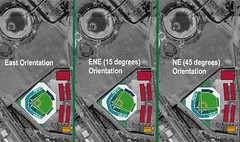
The orange/gold block on the bottom is a 300-room high-rise hotel. Hilton, who frequently works with Lewis Wolff, may be looking to move up from the dated Oakland Airport Hilton, and this site would be much more of a destination than the current Hilton is.
Integration with the stadium would be in the form of a large outfield plaza with a gate in center. The concept is similar to what is being planned for the new Busch Stadium. Nominal amounts of surface and/or garage parking would be required.
The advantage of a plan like this is that it completely transforms the streetscape on one side of Hegenberger. New developers could be spurred to develop on the other side. The Pak n Save supermarket across the street could be in line for an upgrade, or it could transform into a more upscale Safeway, who happens to be Pak n Save's parent company.
There are more than a few disadvantages. First is the fact that Hegenberger Gateway presents built-in competition. HG will also be a litmus test for the potential of retail in the Coliseum area. If retail space doesn't get filled up and if impressive sales figures don't come over the next year or two, fewer companies will be interested in placing a presence in East Oakland.
Then there remains the issue of cost. If someone were to want to develop all of it in a short timeframe - say, 3-4 years - the price tag would be enormous. How much? The ballpark costs $280 million. The retail and housing part, maybe $300 million. The hotel, probably $100 million. Garages - another $10 million. So the total cost of this project would come close to $700 million! And that doesn't even count whatever infrastructure improvements would be pledged by the City. (These figures come from published costs of other similar projects.)
Success would be a double-edged sword. Gentrification of the area would lower crime rates, bring better quality services and drive up property values, but it could also drive up rents, forcing lower income residents out of the market. San Francisco's SoMa neighborhood is the most notorious example of this phenomenon.
Going back to funding, one-shot building is probably not the way the project would be approached. Instead, the stadium and perhaps either the big-box retailer or the hotel would act as anchors to attract further privately-funded development.
Oakland City Councilmember Larry Reid has shown interest in spurring development in the Coliseum area via a new ballpark. Reid will have to carry the torch for any ballpark project, regardless of the size. No matter how much Wolff wants to control the process, he will need someone on the inside to go to bat for him. I have a hard time believing that a new ballpark won't require some sizable amount of public funding.
The large red block at the top is a "big box" retailer, such as Target. Target or Kohl's would be prime candidates, since both are expanding aggressively, and neither currently serve Oakland. Target even has an unusual situation where two stores in San Leandro are only about a mile apart, making one a potential relocation candidate. (Note: These companies are just examples based on their profiles - they aren't endorsements of a particular store or its products.)
The 4 long blocks are for mixed-use retail/housing. The look would be similar to Santana Row in San Jose or Bay Street in Emeryville - open air shopping "district" with ground floor retail/restaurants and housing above it on 2-5 stories.
The orange/gold block on the bottom is a 300-room high-rise hotel. Hilton, who frequently works with Lewis Wolff, may be looking to move up from the dated Oakland Airport Hilton, and this site would be much more of a destination than the current Hilton is.
Integration with the stadium would be in the form of a large outfield plaza with a gate in center. The concept is similar to what is being planned for the new Busch Stadium. Nominal amounts of surface and/or garage parking would be required.
The advantage of a plan like this is that it completely transforms the streetscape on one side of Hegenberger. New developers could be spurred to develop on the other side. The Pak n Save supermarket across the street could be in line for an upgrade, or it could transform into a more upscale Safeway, who happens to be Pak n Save's parent company.
There are more than a few disadvantages. First is the fact that Hegenberger Gateway presents built-in competition. HG will also be a litmus test for the potential of retail in the Coliseum area. If retail space doesn't get filled up and if impressive sales figures don't come over the next year or two, fewer companies will be interested in placing a presence in East Oakland.
Then there remains the issue of cost. If someone were to want to develop all of it in a short timeframe - say, 3-4 years - the price tag would be enormous. How much? The ballpark costs $280 million. The retail and housing part, maybe $300 million. The hotel, probably $100 million. Garages - another $10 million. So the total cost of this project would come close to $700 million! And that doesn't even count whatever infrastructure improvements would be pledged by the City. (These figures come from published costs of other similar projects.)
Success would be a double-edged sword. Gentrification of the area would lower crime rates, bring better quality services and drive up property values, but it could also drive up rents, forcing lower income residents out of the market. San Francisco's SoMa neighborhood is the most notorious example of this phenomenon.
Going back to funding, one-shot building is probably not the way the project would be approached. Instead, the stadium and perhaps either the big-box retailer or the hotel would act as anchors to attract further privately-funded development.
Oakland City Councilmember Larry Reid has shown interest in spurring development in the Coliseum area via a new ballpark. Reid will have to carry the torch for any ballpark project, regardless of the size. No matter how much Wolff wants to control the process, he will need someone on the inside to go to bat for him. I have a hard time believing that a new ballpark won't require some sizable amount of public funding.
15 March 2005
Insight into Wolff's dealings
Lewis Wolff made his money (estimated family holdings of $1.5 billion) as a real estate developer, dealing primarily in hotel construction. In fact, his first venture into the hotel market was the Holiday Inn in San Jose, which eventually became a part of a much larger development in downtown San Jose called Park Center Plaza. Though he will have responsibilities that come with his new title as managing partner of the A's, it is expected that he'll continue to keep his day job.
Wolff is currently working on a large hotel project in downtown L.A. near Staples Center and the L.A. Convention Center, where the City is pouring tons of money into redevelopment. Wolff's hotel deal is one to watch, because at $350 million its price tag runs close to the what a new ballpark would cost. The project is also being funded in part by a large tax subsidy, which could cover over half the cost. Wolff and partner Richard Ackerman are concerned that the tax revenue, which would be generated by an incremental raise in hotel occupancy tax, may not fully cover its share:
Wolff is currently working on a large hotel project in downtown L.A. near Staples Center and the L.A. Convention Center, where the City is pouring tons of money into redevelopment. Wolff's hotel deal is one to watch, because at $350 million its price tag runs close to the what a new ballpark would cost. The project is also being funded in part by a large tax subsidy, which could cover over half the cost. Wolff and partner Richard Ackerman are concerned that the tax revenue, which would be generated by an incremental raise in hotel occupancy tax, may not fully cover its share:
I'm not sure how commonplace corporate sponsorships of things as trivial as meeting rooms or sheets are, but such arrangements are very much at home in the world of sports venue construction. The best example of successful corporate sponsorships in America is SBC Park, though every new stadium and arena shows evidence of this type of activity. If you are one of those "purists" who disliked SBC Park for its commercialization, you're not going to like the new A's ballpark, especially if it ends up being largely funded by private sources. Don't be surprised if the place ends up being the illegitimate child of Times Square and Kauffman Stadium. Someone has to pay the bills.But hotelier Lew Wolff and financial partner Richard Ackerman, a principal at Apollo Real Estate Advisors, said last week that more revenue must be generated in order to cover its future loan payments on the $350 million project.
“We are scraping every possible revenue source so that if something goes wrong in the next couple of years we’ll be able to ride out any storm,” Ackerman said. “We’re trying to hedge our risk on an immense project by being very cautious.”
To that end, the developers have retained Anschutz Entertainment Group, majority owners of the Staples Center, to help fill the 55-story hotel with lucrative corporate sponsorships.
Ballpark mock-up
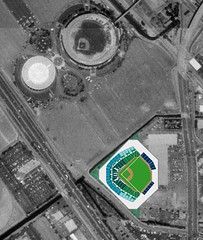
This is a roughly scale projection of what a new 40,000-seat ballpark would look like on the new property. Notice how it's a good deal larger than the 8.5 acre parcel owned by the JPA. Mixed development would occur beyond the outfield walls along Hegenberger Road.
In the next mockup, I'll add a possible development model.
In the next mockup, I'll add a possible development model.
Subscribe to:
Posts (Atom)