


It's only occurred to me recently that I'd do well to have a Frequently Asked Questions file here, considering that this site is now three years (!) old. So without further ado, here's the very unofficial New A's Ballpark FAQ:
Overview
1. What is the current state of the ballpark project?
The project is currently undergoing environmental review, which started in December 2007. The process is expected to take 12-18 months. It was thought that the period could be shortened due to portions of a previous EIR (environmental impact report) being available, but that is no longer the case.
When initially conceived, the ballpark was projected to open in 2010. That has slipped twice, with the projected opening in 2012 or later.
2. What is the project called?
The ballpark will be named Cisco Field, after the naming rights sponsor, Cisco Systems. The residential and retail portions of the development are as yet unnamed and are referred to generically as the “baseball village.”
3. What happens after the EIR is completed?
A draft version will be distributed to Fremont’s city council and the public, upon which there will be an official comment period. Changes may be made during this period. A final EIR with public comments will be presented to council for approval/ratification. The council’s vote probably won’t occur before December 2008.
4. Will a public vote be required?
A referendum is not required, nor is it supported by the majority of the current council.
5. How much will the ballpark cost?
Current estimates have construction at $450 million.
6. What’s Fremont paying for the ballpark?
As it stands, nothing. Fremont’s role is to approve land rezoning that the A’s want (industrial-to-residential/commercial) to build 3,000+ homes on land previously owned by Cisco and ProLogis. The increase of property value for the land (225 acres) would mean increased profits from the sales of housing rights. A portion of those profits would be used to pay for the ballpark.
There is some amount of additional infrastructure that needs to be built to support the project: a school, public park(s), possible pedestrian paths, trails, or bridges. It is uncertain what the cost of such facilities will be or who will bear the cost. The cost of building streets, sewers, and running utilities is typically borne by the developer.
Cisco also has a 30-year, $120 million naming rights and technology deal with the A’s for Cisco Field.
7. How big will the ballpark be?
32-35,000 seats, not including standing room. The design calls for only two seating decks, with the press box on top of the second deck, a la PNC Park.
8. What features does the ballpark have?
The ballpark is expected to have all of the modern amenities that other new stadia and arenas have, including luxury suites, club seats, separate concourses, and a large variety of food options. One of the claims made by the A’s is that Cisco Field will be the most intimate ballpark in MLB, which stands to reason because it is so small.
The video/scoreboard in centerfield will be two-sided, which will provide views of the action from a small park just beyond centerfield.
The original project announcement mentioned a baseball museum of some sort, but this hasn’t been mentioned since.
The ballpark’s spec contains 40 luxury suites and 40 mini suites, which four or six-person boxes which are grouped three or so and share a common area behind the seats. Mini suites are being offered as an option for smaller firms or companies who can’t justify leasing a large suite yet want more privacy than a club seating section offers.
9. Who are the architects?
360 Architecture, a Kansas City-based architecture firm that opened an office in San Francisco largely for the Cisco Field project. 360 previously designed several multipurpose indoor arenas. Gensler, a large San Francisco-based firm, is the master planner for the whole development.
Retail/Commercial
10. What is the “baseball village?”
The baseball village is an adjacent, 37-acre lifestyle center with high-end retail, additional restaurants, and 600 condos and lofts, plus additional residential development to the south and west of the ballpark. A movie theater is expected. The list of retailers has not been released, but it is expected to be along similar lines to those located at San Jose’s Santana Row or Palo Alto’s Stanford Shopping Center.
11. How many housing units will be built?
2,900+ units are planned for the residential neighborhood south and west of the ballpark. Most of these units would be townhomes or flats of varying sizes. Expected average price of a unit: $675,000. They are expected to be phased in over a ten-year span.
12. Will it be a gated community?
No, but it will be more private than public. The plan’s pocket parks are expected to be owned by the community, with their maintenance paid for by HOA dues.
13. How is the housing crisis affecting the project?
At least one section of land is may have more flexible zoning than the rest. That’s because more commercial uses may be expected there: office space, an extension to the Auto Mall, other shopping centers, etc.
14. What about the school?
The A’s and Fremont Unified School District are hammering out the details of what will likely be a public elementary school within the residential section. This has proven to be necessary as district officials have projected at least 600 students. To accommodate growth, FUSD is looking for a school that can handle up to 1,000 students with future expansion. The A’s have provided their vision: a compact, multi-level urban school similar to Horace Mann School, located in downtown San Jose.
Transportation/Public Transit
15. Will BART run to the ballpark as it does to the Coliseum?
No. The closest current station is the Fremont station, which is the southern terminus of the system. It is approximately 5 miles from the ballpark site. There is a planned station, Warm Springs, near the NUMMI plant, approximately 1.25 miles east of the ballpark site. Buses or shuttles would have to run from either station to the ballpark.
16. What is the Warm Springs BART extension?
It is a 5.4-mile extension that would run south from the Fremont station to Warm Springs. It was initially part of the BART-to-Santa Clara County extension, but was decoupled due for funding and political reasons. The Warm Springs extension is not expected to be built unless the BART-to-Santa Clara County extension is also built. The latter extension faces a funding shortfall at the moment, and it is not clear how that will be made up.
17. Will other rail options be available?
Amtrak and ACE currently run on the Union Pacific line approximately 1.25 miles west of the ballpark site. There is no current station there, but a station was previously planned and would likely be built should the ballpark project move forward. A tram-style shuttle would bring train riders and fans who park in the planned adjacent parking lot to a drop-off point near the ballpark.
The state’s High Speed Rail project, if approved, would not have Fremont along its initial planned route. A Regional Rail option is possible after the first phase if funding is available. That may allow for a station at Warm Springs, alongside/in place of the planned BART station.
18. Could VTA light rail service the ballpark?
Such a line or extension is not in VTA’s plans.
19. Could a private rail solution be built between Warm Springs BART and the ballpark site?
Cost for such a solution would be at least $100 million not including land acquisition. It’s not likely.
Traffic
20. How will existing traffic problems be affected by the ballpark?
On days the ballpark is used, expect up to 10,000 cars in addition to the expected new traffic generated by the retail and residential developments. Those cars would be coming from four different freeway segments and Fremont/Newark surface streets. The most heavily impact segments would be northbound 880 and 680 leading up to the ballpark. Southbound 880 and 680 near the ballpark are not heavily impacted in the weeknight rush hour period. A percentage of fans may also come from the Peninsula over the Dumbarton Bridge. They would be dealing with commute traffic as well.
Considering the wide geographical spread of A’s fans, it’s safe to assume traffic will be spread fairly evenly among the freeway segments, with the less congested southbound 880 getting the most. The traffic/transportation study hasn’t been released, but it’s reasonable to roughly project the following:
880 South: 3,500 cars (may include some Dumbarton traffic)
680 South: 2,500
880 North: 2,500
680 North: 500
Fremont/Newark/Milpitas surface streets: 1,000 (may include some Dumbarton traffic)
Note that these would be peak figures (sellouts), and would drop proportionally with actual attendance at the ballpark.
21. What’s being done to improve 880?
A series of interchange improvements were done in the last decade or so in South Fremont in order to help area manufacturing and warehousing/distribution companies. The last piece of this is the Mission/880 interchange, which is expected to be completed in 2009. Previously, all north and southbound traffic ran into this bottleneck, which only had three lanes in each direction and no carpool lanes. When completed, the interchange will have better separated traffic from 880 to Mission/680, plus a continuous carpool lane down to Milpitas and up through San Leandro. Additionally, traffic from one side of 880 to the other will be better managed by the addition of the new Warren Avenue exit/interchange. Previously, traffic from west of 880 had to mix with commute traffic get to the area east of 880. Lastly, the new Kato Road bridge was built to better route truck traffic bound for NUMMI.
22. That won’t completely alleviate congestion, will it?
No it won’t, but A’s fans traveling in groups will find things easier with the fully extended carpool lanes. The commute nightmare is also largely a one-way affair for those on 880 and 680 north headed towards the Tri-Valley area and exurbs Tracy and Stockton.
23. What about those coming from north of 92?
Work on the biggest bottleneck, the 880/92 interchange, has begun. The project will replace two of the “cloverleaf” sections (92 West-880 South and 92 East-880 North) with flyover ramps. When completed, the interchange’s capacity will be much greater, easing the transition for affected drivers. The interchange is expected to be finished in late 2011. Unfortunately, carpool lanes aren’t expected to be built through Oakland anytime soon as 880 in the area needs seismic retrofitting and widening before carpool lanes can be built.
24. What about surface streets?
Fremont doesn’t have a typical straight grid layout among its north-south corridors. Fremont Blvd and Paseo Padre Pkwy are four-to-six lane drags that are meant to handle city traffic. Auto Mall Pkwy, the main exit near the ballpark site, was widened as part of the 880 interchange projects. It may be widened again if it’s chosen as a carpool alternate route between 880 and 680. Mowry Avenue east of 880 just got a new long lasting asphalt overlay, while Stevenson Boulevard was widened to six lanes. Boyce Road (Fremont)/Cherry Street (Newark), which together are used as an alternate route to/from the Dumbarton (84), is a four-lane road that is meant largely for industrial traffic. Cushing Pkwy, which is Boyce Road south of Auto Mall, was extended over the newly created wetlands preserve as part of the previous development agreement between ProLogis and the government. Cushing runs south to Fremont Blvd and empties into 880 south. Fremont Blvd will be extended from its southern dead end to Warm Springs Blvd and the county line, providing a complete alternate route west of 880.
Mowry, Stevenson, and Fremont will be taxed as a result of shuttles running between Fremont BART and the ballpark site. What is unknown is exactly how many shuttles will be in service pre/post-game.
25. Will there be enough parking?
The A’s project at least 10,000 spaces when the ballpark opens and have pledged to replenish spaces lost due to other construction. This will likely be part of agreement between the team and the city. An additional 10,000 spaces will be constructed for residential and non-baseball commercial use. In addition, the team will encourage fans to come early by offering validation in conjunction with patronage at one of the village’s restaurants, which would mean parking in non-ballpark spots.
In addition, spaces at other nearby office parks may be available at each company’s discretion. It is unknown how much of this parking may become available. The A's, ProLogis, and tenants at retail and office developments are working on a gameday parking plan that preserves each group's respective parking areas.
The Coliseum’s 10,000-space lot handles A’s crowds well, although up to 20% of fans may use BART and several hundred cars park at the Coliseum BART lot during games.
Environmental Concerns
26. What is the wetlands preserve?
As part of the deal to develop over 800 acres of land at Pacific Commons in Fremont, Catellus (once the real estate arm of Southern Pacific) agreed to create a new, 440-acre wetlands preserve at the south end. To foster its growth, a large amount of earth was moved from the preserve section to the commercially developed portions. The moved earth elevated the Auto Mall and nearby business district, while the preserve was intentionally created lower to make it prone to tidal flows. The aforementioned Cushing Pkwy was extended in the form of a causeway to encourage tidal flow.
The preserve appears to be thriving. Migratory and native birds are present, as are rare plants. The tidal flow system is working as intended. As part of the EIR, long term effects of the preserve’s creation will be measured and compared against initially projected effects. From this, a strategy will be created that will help preserve the wetlands. Opponents including the Sierra Club have come out against the Cisco Field project, saying that residential development next to the preserve will irreparably damage the wetlands.
27. I heard the ballpark site is in an area that is prone to future rising sea levels due to global warming/climate change. Is this true?
No. The site is very close to a large estuary within the bay and flood control channels, which could make it prone to flooding if exceedingly heavy rains are combined with rising sea level. However, the predictive model assumes a uniform one meter rise all over the world, when it is more likely that there will be a greater rise at the equator and less rise as one gets further away from the equator. The ballpark is at least 1 mile away from the projected shoreline created by the sea level rise.
Economic Impact
28. How much will the ballpark improve the A’s financial situation?
Depending on how well the ballpark sells out, I’ve conservatively projected they could net an extra $24 million per year in revenue over their current situation at the Coliseum. A recent article on the new Twins’ ballpark has a comment from a Twins official indicating that the team will gain $40 million per year once their stadium opens.
29. Will the financial boost allow the team to compete with the Red Sox or Yankees?
Not by itself. The big market teams have huge amounts of TV and radio revenue along with their revenue-producing ballparks. Unless the A’s were to move towards buying or building their own media properties, there will continue to be a major disparity in revenue between the big market teams and everyone else.
30. Will the project be as beneficial for the city/county as is being claimed by its proponents?
Claims of economic benefit have to be taken with several grains of salt. Let’s be clear. The party that clearly wins in this type of deal is the team. They get a brand new stadium without having to use much of their stadium-generated revenue to pay for it. The city wins because it doesn’t have to raise or levy new taxes in order to get it done, plus it gets a fancy new source of sales tax revenue in the process plus the prestige that comes with having a team call it home. That said it removes a major piece of valuable industrial-zoned land from availability within Silicon Valley. It also adds residents and visitors, which adds strain to an already stretched-thin city.
Jobs will come most immediately in the form of concrete construction and are not permanent. 300 housing starts a year will be a boon for homebuilders. After construction is completed, there will be a number of retail and hospitality jobs, plus stadium operations and concessions. Many of the ballpark-based, non-construction jobs will be low paying. The situation there will be close to zero sum, since those job will simply be moving from Oakland to Fremont. A number of public sector jobs – police, fire – will be added due to the development’s impact on existing city resources.
Miscellaneous
31. Has the team released any documentation about the plan?
They’ve released an economic impact report and the preliminary site plan. A traffic and transportation study will be released as part of the EIR.
32. How long is the A’s lease at McAfee Coliseum?
In 2006, the A’s and the Coliseum Authority converted three option years (2008-10) into a hard lease, adding 2011-13 as option years. The Raiders' lease ends with the 2010 season.
33. What kind(s) of architecture will be featured?
The A's have made frequent reference to older East Coast neighborhoods, especially those with brownstones. They have not released information or pictures about the ballpark's façade, though it is likely the façade will be well-integrated into the neighborhood's overall theme. One particular type of exterior material is not expected to be used: stucco.
34. What will be the team's name after the move?
The A's have held this close to the vest, only saying that the team will be the "_____ Athletics at Fremont" or something to that effect. Principal owner Lew Wolff has hinted that the name in front of "Athletics" may be leveraged for additional investment. Considering the amount of Silicon Valley power and money behind this, it's not a great leap in logic to think the team may eventually be named "Silicon Valley Athletics at Fremont."
01 May 2008


29 April 2008
2008 FCI - WTF?
The A's are off the charts, folks.
I'm not referring to the team's popularity or TV ratings, nor is it an attendance phenomena. Remember this chart?

This year's Fan Cost Index by Team Marketing Report has the A's average ticket price for 2008 at:
$29.20
It's way off the above chart, a whopping 22.3% increase over 2007 ($23.88). That's good enough for third highest in MLB, behind the Yankees and Cubs.
The increase contributed to an overall FCI of $206.80, 11.5% over 2007 and good for 10th in baseball. That's higher than most teams with recently built ballparks, including the Nationals ($195.50), Padres ($201.72), and Giants ($183.74). The Giants actually posted a FCI drop of 0.7% relative to last season - but only because they were allowed to go back and adjust prices after the season was over.
But is $29.20 right? Compared to last year, several seating sections received $4-6 ticket hikes, whereas roughly one-third of the stadium has only a $1 increase. There's premium game pricing for the Yankees, Red Sox, and Giants, but that's only 11 out of 79 games (Tokyo doesn't count). There's also the addition of the all-you-can-eat seats, but even that only equates to a $1-1.50 hit. (I've sent Team Marketing Report a request for clarification but have not received a response.)
If one were to follow simple supply-demand rules, a ticket price hike (whatever the final number) would appear to be a major cause for the significantly reduced attendance this year (see sidebar). Reduced expectations and a revamped roster with few big names haven't helped, neither have the oddly cooler temperatures observed for A's homestands as opposed to Giants' games. Now that the team is leading the division and Frank Thomas has returned, there should be some uptick from the bandwagoners and youth, along with warmer weather. However, I don't think they'll catch last year's total or eclipse 2 million unless they go on a massive winning streak or run away with the division - thoughts that were unheard of in the winter.
I'm not referring to the team's popularity or TV ratings, nor is it an attendance phenomena. Remember this chart?
This year's Fan Cost Index by Team Marketing Report has the A's average ticket price for 2008 at:
$29.20
It's way off the above chart, a whopping 22.3% increase over 2007 ($23.88). That's good enough for third highest in MLB, behind the Yankees and Cubs.
The increase contributed to an overall FCI of $206.80, 11.5% over 2007 and good for 10th in baseball. That's higher than most teams with recently built ballparks, including the Nationals ($195.50), Padres ($201.72), and Giants ($183.74). The Giants actually posted a FCI drop of 0.7% relative to last season - but only because they were allowed to go back and adjust prices after the season was over.
But is $29.20 right? Compared to last year, several seating sections received $4-6 ticket hikes, whereas roughly one-third of the stadium has only a $1 increase. There's premium game pricing for the Yankees, Red Sox, and Giants, but that's only 11 out of 79 games (Tokyo doesn't count). There's also the addition of the all-you-can-eat seats, but even that only equates to a $1-1.50 hit. (I've sent Team Marketing Report a request for clarification but have not received a response.)
If one were to follow simple supply-demand rules, a ticket price hike (whatever the final number) would appear to be a major cause for the significantly reduced attendance this year (see sidebar). Reduced expectations and a revamped roster with few big names haven't helped, neither have the oddly cooler temperatures observed for A's homestands as opposed to Giants' games. Now that the team is leading the division and Frank Thomas has returned, there should be some uptick from the bandwagoners and youth, along with warmer weather. However, I don't think they'll catch last year's total or eclipse 2 million unless they go on a massive winning streak or run away with the division - thoughts that were unheard of in the winter.
24 April 2008
Dodger Stadium improvement plans announced
Dodgers owner Frank McCourt announced his long-awaited plans for Dodger Stadium. McCourt was assisted by a Vin Scully-narrated promotional video. 3-D models and renderings abound.
The largely outside-the stadium project will cost $500 million on top of the $250 million spent inside the stadium over two years ago. They have the buzz words down, talking up the Stadium's transformation into a "lifestyle destination for all of Los Angeles for all twelve months of the year." Also emphasized is a change in the way the venue is operated to a more environmentally responsible one (no mentions of specifics other than a nod to technology).

Among the improvements:
What's going to pay for the Dodger Stadium improvements? Scuttlebutt is that McCourt will sell off development rights to pieces of surrounding land. As much as the Dodgers are advertising the great views from the stadium, some of those views will be undoubtedly altered by the stadium's ancillary expansion, as well as the presence of condos all over the nearby hillsides.
The largely outside-the stadium project will cost $500 million on top of the $250 million spent inside the stadium over two years ago. They have the buzz words down, talking up the Stadium's transformation into a "lifestyle destination for all of Los Angeles for all twelve months of the year." Also emphasized is a change in the way the venue is operated to a more environmentally responsible one (no mentions of specifics other than a nod to technology).
Among the improvements:
- Dodger Way - A new "front door" to the stadium in center field framed by a tree-lined walkway. The center field plaza would connect to a promenade featuring shops, restaurants and a Dodger Experience museum.
- Green Necklace - A landscaped, tree-lined perimeter surrounding the stadium. Fans will be able to access their seats and concessions via the Green Necklace.
- Top of the Park - Behind the highest point of the park behind home plate would be a a outdoor plaza with views of the Los Angeles skyline, Santa Monica bay, the San Gabriel mountains and the field of play inside Dodger Stadium
What's going to pay for the Dodger Stadium improvements? Scuttlebutt is that McCourt will sell off development rights to pieces of surrounding land. As much as the Dodgers are advertising the great views from the stadium, some of those views will be undoubtedly altered by the stadium's ancillary expansion, as well as the presence of condos all over the nearby hillsides.
18 April 2008
Forbes new valuations out: A's worth $323 million
For a commissioner, Bud Selig makes a pretty good CEO.
League revenue is up again, this time 9.3% over last season. That's actually down from the last three seasons, when they typically had 14% gains. Revenue is still impressive and will only go up through the end of the current CBA. Yield like that would be an excellent investment for those looking for a mid cap. Of course, MLB is entirely private so no one outside the Lodge could entertain such notions. Regardless, it's impressive.
The A's experienced an 11% jump, from $292 million to $323 million. They continue to ride the revenue sharing gravy train, as local revenue pales in comparison to most of their brethren. The welfare check should only become bigger next season as early attendance figures from the first two weeks portend a low season-end total. Forbes' summary of the A's financial situation is incorrect in that it identifies TIF as a funding mechanism for the ballpark. TIF requires bond money be raised. They're not doing that in Fremont. Instead, privately generated proceeds from the sale of housing rights will help foot the bill.
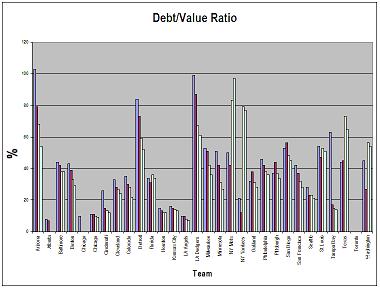
I'm surprised that this year's edition didn't cover the debt issue. Quite possibly, the toughest task for Selig was to whip owners into shape by getting them to spend less. Over the last four years, teams have dropped from a collective 39.7% in debt to 32.7%, and that includes the two new stadia being built for the NY teams.
click for a larger chart
Look at the values on a team-by-team basis, and you'll see a major trend downward for most of them. The old 60-40 debt rule may be obsolete, but it still informs club executives on how to run their teams, just as 50-60% of revenue is comfortable salary "guideline" for the teams.
Nowadays, there's a simplification of the debt rule: teams can't be in hock over 10 times the average EBITDA over the past two seasons. Notice that the A's current valuation is exactly 10 times that of their average operating income from that period? I doubt it's a coincidence. Moreover, the first $36.5 million in debt grandfathered from previous years doesn't count, so if you're Fred Wilpon or Frank McCourt and you borrowed heavily to buy your teams, it's not that bad. And as an incentive to upgrade to new digs, any team incurring stadium debt gets to bump up to 15 times EBITDA for up to 10 years after the facility is complete. The difference between 10 and 15 times doesn't sound like much. It's only $75 million. Since income is expected to rise thanks to the massive payroll drop, so will that debt ceiling. Look for this:
League revenue is up again, this time 9.3% over last season. That's actually down from the last three seasons, when they typically had 14% gains. Revenue is still impressive and will only go up through the end of the current CBA. Yield like that would be an excellent investment for those looking for a mid cap. Of course, MLB is entirely private so no one outside the Lodge could entertain such notions. Regardless, it's impressive.
The A's experienced an 11% jump, from $292 million to $323 million. They continue to ride the revenue sharing gravy train, as local revenue pales in comparison to most of their brethren. The welfare check should only become bigger next season as early attendance figures from the first two weeks portend a low season-end total. Forbes' summary of the A's financial situation is incorrect in that it identifies TIF as a funding mechanism for the ballpark. TIF requires bond money be raised. They're not doing that in Fremont. Instead, privately generated proceeds from the sale of housing rights will help foot the bill.
I'm surprised that this year's edition didn't cover the debt issue. Quite possibly, the toughest task for Selig was to whip owners into shape by getting them to spend less. Over the last four years, teams have dropped from a collective 39.7% in debt to 32.7%, and that includes the two new stadia being built for the NY teams.

click for a larger chart
Look at the values on a team-by-team basis, and you'll see a major trend downward for most of them. The old 60-40 debt rule may be obsolete, but it still informs club executives on how to run their teams, just as 50-60% of revenue is comfortable salary "guideline" for the teams.
Nowadays, there's a simplification of the debt rule: teams can't be in hock over 10 times the average EBITDA over the past two seasons. Notice that the A's current valuation is exactly 10 times that of their average operating income from that period? I doubt it's a coincidence. Moreover, the first $36.5 million in debt grandfathered from previous years doesn't count, so if you're Fred Wilpon or Frank McCourt and you borrowed heavily to buy your teams, it's not that bad. And as an incentive to upgrade to new digs, any team incurring stadium debt gets to bump up to 15 times EBITDA for up to 10 years after the facility is complete. The difference between 10 and 15 times doesn't sound like much. It's only $75 million. Since income is expected to rise thanks to the massive payroll drop, so will that debt ceiling. Look for this:
- $30 million in earnings each year in the two years prior to the ballpark opening
- Multiply that figure by 15 to get max debt load, $450 million (which equals the projected ballpark construction cost)
There is, of course, the matter of player salaries. They're the biggest expense and so they factor in. However, that fat $36.5 million deductible comes in handy, especially as a team's payroll drops to approach that figure. Again, the rule is not a hard and fast rule like the NFL's salary cap, with Selig or Bob DuPuy getting all punitive every winter. Referring back to the chart, it appears to be set up so that when teams are forced to go into major debt like the Yanks or Mets, the other fiscally responsible teams help soften the blow. In that sense, MLB and other leagues are akin to conglomerates, with each team acting as a single business unit. When a major profit center (Yanks/Mets) has to invest to invest in a new plant (stadium), the other units tighten up in response. After all, it's the company's overall health, not a business unit's, that gets trumpeted by Selig. As the new plants open and become amortized, others take their turns.
Call it MLB's "Circle of Life."
17 April 2008
Opening Day pushed back to at least 2012
A new article by the Argus' Matthew Artz confirms a circulating rumor: the environmental impact review process will go the whole nine yards, pushing its completion until the end of the year. Nothing can proceed until the study is completed, reviewed, and voted upon. Tack on the normal construction time, and it makes 2011 unlikely. The A's were hoping that portions of the previous Pacific Commons study could be used, but the presence of the old document makes the review more complicated, requiring a comparison of projected changes to actual changes.
Those of you looking for a political angle may look at the study's availability after the November general election, when incumbent Bob Wasserman will face off against four-time former mayor Gus Morrison and councilman Steve Cho. Without even a draft, there isn't much substance to debate. That's not to say that Morrison won't feature the anti-ballpark stance prominently, it's just that he won't have any specifics to point to unless he wants to put together his own independent study. Meanwhile, proponents will have the Economic Impact study from last year as ammunition, which I covered in several posts last spring.
A simple economic angle also can't be dismissed. By pushing the opening back a year, investors may be hoping that they'll be an additional year removed from the recession and the housing market drop.
Those of you looking for a political angle may look at the study's availability after the November general election, when incumbent Bob Wasserman will face off against four-time former mayor Gus Morrison and councilman Steve Cho. Without even a draft, there isn't much substance to debate. That's not to say that Morrison won't feature the anti-ballpark stance prominently, it's just that he won't have any specifics to point to unless he wants to put together his own independent study. Meanwhile, proponents will have the Economic Impact study from last year as ammunition, which I covered in several posts last spring.
A simple economic angle also can't be dismissed. By pushing the opening back a year, investors may be hoping that they'll be an additional year removed from the recession and the housing market drop.
16 April 2008
The teams need elbow room on TV
Last week, we hit one of those so-called "perfect storm" situations that can occur with scheduling. On the main CSN channel, the A's and Jays were locked up in a tight, late inning battle in Toronto. Waiting in the wings was the first playoff game between the Sharks and Flames. And the Giants were playing the Padres on the side stage, CSN Plus.
The A's game ran a not-so-tidy 3:31, forcing the Sharks game to start without a TV broadcast. Instead of doing a picture-in-picture or split screen, CSN chose to keep the A's game on while providing delayed updates on the Sharks game. Even though there was no HD broadcast of the A's game while the Sharks game was to be in HD, the Sharks game could not be carried in HD until CSN switched feeds. Only after Bobby Crosby's bases-clearing double and the final A's out in the top of the 9th did the switch occur. Just as the switch happened, the Ryan Clowe scored for the Sharks over six minutes into the first period. Unfortunately, the Sharks were down 2-0 leading up to that point. It was quite a debacle as angry Sharks fans called CSN to vent their frustration.
There are really three issues here. First is the production choice made. AFAIK it's pretty much the same staff from the FSN days with some promotions and attrition thrown in, but it mostly feels the same. Hopefully they've learned from this. Second is the HD problem. If there is an SD away baseball game and an HD home hockey game, why can't they split it so that the HD channel carries the HD broadcast? I'm not up on the technical side but it doesn't sound that difficult. At least the folks with the HDTVs - the bars and the regular folks who've plunked down a couple grand for a flat panel - can be taken care of. There is a long term issue of having only a single HD channel to begin with, but I'll get to that later. Third, and most important, is that the juggling act that CSN does with the four area teams needs to stop. It was confusing from the first day that FSN Plus launched with its dozens of different channels on different systems. I'm sure that Comcast is attempting their best given the circumstances. But the situation as it stands is untenable. If you're a subscriber of Comcast's digital cable service or the sports packages on one of the satellite companies, you're paying a premium for this. It's just not a good way to do business.
If you're wondering how the Bay Area fares compared to other similar markets, you might be surprised to find out that we are entirely unique in that in this market there is a single regional sports network, majority owned by the predominant local cable provider. So it shouldn't surprising that when the Giants bought a stake in the new CSNBA, someone would object - the Warriors and owner Chris Cohan. Especially because Cohan in a previous life was a local cable operator, which probably means he knows something about the business.
Take a look at the chart below. I've mostly included other markets with two baseball teams, because they're the only ones with similar scheduling dynamics. In LA, there are two full-fledged channels with exclusivity agreements for the three major teams there, leaving the lesser teams to battle for scraps. It's not a perfect situation, but at least it lends stability for Angels, Dodgers, and Lakers fans. In NYC there are no less than four independent RSNs, all of which are owned in large part by their respective teams. While this makes it tough to push cable providers to include all of these RSNs in their limited space, at least it allows the market to determine the outcome. In Chicago, the two baseball teams are helped enormously by splitting games on the Superstation WGN and CSN Chicago. And in a still-puzzling, archaic move, the Wirtz family continues to not broadcast the majority of Blackhawks home games, freeing up space on the local RSN. In Baltimore and DC, MLB and O's-created MASN carries the two baseball teams, while the local Comcast RSN sued MLB and the O's because they felt they had the right to negotiate a deal and were blocked from doing so when MASN was launched. Currently, CSN Mid Atlantic carries the winter sports.

Comcast appears to be addressing the Bay Area's logjam by adding yet another CSN Plus channel, called CSN Plus 2. There's currently a placeholder for it at channel 412 if you're on digital cable, plus DirecTV and Dish also have it. Perhaps they're waiting to broadcast on it until next season or until more of the smaller cable systems pick it up, which is not a given. Having yet another Plus channel is only going to create more confusion.
That leaves one major issue looming: What about HD? Having two standard definition Plus channels does nothing to add HD offerings when in the coming years the local teams will do nothing but expand their HD schedules. This is a real quandary for Comcast, as they are stuck with real bandwidth limitations that restrict how quickly they can add HD channels. The normal convention is that on what we would consider an analog channel, there is space for two HD feeds and even an additional SD feed should Comcast choose to compress the signal a bit. For instance, the HD feeds for both KPIX and KTVU are carried on channel 78, while KBCW and KNTV are on 79. Contrast that with a possible 10 SD channels that can be placed in that same space. Comcast is stuck with this until the analog-to-digital switch is done and the old bandwidth is freed up. For them, the switch won't all happen next February as consumer concerns will draw out the transition another year or two.
As recently as yesterday I said that the best situation for the A's would be to team up with the Sharks on their own RSN. In light of the Warriors' frustration, perhaps they are a better partner. Consider that there's only a two-week overlap in regular season schedules between MLB and NBA, and the fact that both leagues' postseasons are carried exclusively on big national networks. They could easily work around any potential conflicts. They would need Comcast to get a taste in order to get Comcast to carry the channel. At least with a new RSN, it's a stable home and a chance to build a brand, as opposed to being just another part of the Bay Area sports menagerie. Obviously, I'd be remiss if I didn't mention that the A's would be in more control over their own finances and advertising revenue.
Change is afoot. Hopefully we won't have to wait too long to see it.
The A's game ran a not-so-tidy 3:31, forcing the Sharks game to start without a TV broadcast. Instead of doing a picture-in-picture or split screen, CSN chose to keep the A's game on while providing delayed updates on the Sharks game. Even though there was no HD broadcast of the A's game while the Sharks game was to be in HD, the Sharks game could not be carried in HD until CSN switched feeds. Only after Bobby Crosby's bases-clearing double and the final A's out in the top of the 9th did the switch occur. Just as the switch happened, the Ryan Clowe scored for the Sharks over six minutes into the first period. Unfortunately, the Sharks were down 2-0 leading up to that point. It was quite a debacle as angry Sharks fans called CSN to vent their frustration.
There are really three issues here. First is the production choice made. AFAIK it's pretty much the same staff from the FSN days with some promotions and attrition thrown in, but it mostly feels the same. Hopefully they've learned from this. Second is the HD problem. If there is an SD away baseball game and an HD home hockey game, why can't they split it so that the HD channel carries the HD broadcast? I'm not up on the technical side but it doesn't sound that difficult. At least the folks with the HDTVs - the bars and the regular folks who've plunked down a couple grand for a flat panel - can be taken care of. There is a long term issue of having only a single HD channel to begin with, but I'll get to that later. Third, and most important, is that the juggling act that CSN does with the four area teams needs to stop. It was confusing from the first day that FSN Plus launched with its dozens of different channels on different systems. I'm sure that Comcast is attempting their best given the circumstances. But the situation as it stands is untenable. If you're a subscriber of Comcast's digital cable service or the sports packages on one of the satellite companies, you're paying a premium for this. It's just not a good way to do business.
If you're wondering how the Bay Area fares compared to other similar markets, you might be surprised to find out that we are entirely unique in that in this market there is a single regional sports network, majority owned by the predominant local cable provider. So it shouldn't surprising that when the Giants bought a stake in the new CSNBA, someone would object - the Warriors and owner Chris Cohan. Especially because Cohan in a previous life was a local cable operator, which probably means he knows something about the business.
Take a look at the chart below. I've mostly included other markets with two baseball teams, because they're the only ones with similar scheduling dynamics. In LA, there are two full-fledged channels with exclusivity agreements for the three major teams there, leaving the lesser teams to battle for scraps. It's not a perfect situation, but at least it lends stability for Angels, Dodgers, and Lakers fans. In NYC there are no less than four independent RSNs, all of which are owned in large part by their respective teams. While this makes it tough to push cable providers to include all of these RSNs in their limited space, at least it allows the market to determine the outcome. In Chicago, the two baseball teams are helped enormously by splitting games on the Superstation WGN and CSN Chicago. And in a still-puzzling, archaic move, the Wirtz family continues to not broadcast the majority of Blackhawks home games, freeing up space on the local RSN. In Baltimore and DC, MLB and O's-created MASN carries the two baseball teams, while the local Comcast RSN sued MLB and the O's because they felt they had the right to negotiate a deal and were blocked from doing so when MASN was launched. Currently, CSN Mid Atlantic carries the winter sports.
Comcast appears to be addressing the Bay Area's logjam by adding yet another CSN Plus channel, called CSN Plus 2. There's currently a placeholder for it at channel 412 if you're on digital cable, plus DirecTV and Dish also have it. Perhaps they're waiting to broadcast on it until next season or until more of the smaller cable systems pick it up, which is not a given. Having yet another Plus channel is only going to create more confusion.
That leaves one major issue looming: What about HD? Having two standard definition Plus channels does nothing to add HD offerings when in the coming years the local teams will do nothing but expand their HD schedules. This is a real quandary for Comcast, as they are stuck with real bandwidth limitations that restrict how quickly they can add HD channels. The normal convention is that on what we would consider an analog channel, there is space for two HD feeds and even an additional SD feed should Comcast choose to compress the signal a bit. For instance, the HD feeds for both KPIX and KTVU are carried on channel 78, while KBCW and KNTV are on 79. Contrast that with a possible 10 SD channels that can be placed in that same space. Comcast is stuck with this until the analog-to-digital switch is done and the old bandwidth is freed up. For them, the switch won't all happen next February as consumer concerns will draw out the transition another year or two.
As recently as yesterday I said that the best situation for the A's would be to team up with the Sharks on their own RSN. In light of the Warriors' frustration, perhaps they are a better partner. Consider that there's only a two-week overlap in regular season schedules between MLB and NBA, and the fact that both leagues' postseasons are carried exclusively on big national networks. They could easily work around any potential conflicts. They would need Comcast to get a taste in order to get Comcast to carry the channel. At least with a new RSN, it's a stable home and a chance to build a brand, as opposed to being just another part of the Bay Area sports menagerie. Obviously, I'd be remiss if I didn't mention that the A's would be in more control over their own finances and advertising revenue.
Change is afoot. Hopefully we won't have to wait too long to see it.
15 April 2008
Quakes' soccer stadium deal announced
The "soccer village" is coming closer. Joshua Molina of the Merc reports that a team of developers and the city of San Jose have reached a deal for the developers to buy the bulk of the old FMC site from the city, upon which an 18,000-seat soccer-specific stadium and surrounding retail/commercial/hotel space would be built. Some specifics:
Remember, this is a two-part deal. This part only covers the site on which the stadium and ancillary stuff would be built. To pay for the stadium, Wolff is pushing for rezoning of the Edenvale site in South San Jose, where 1,500 townhomes would be built. Looking at the FMC piece only, it's a good deal for the city that forces the developer to have some skin in the game, even defraying the city's "carrying costs" for a while. The Edenvale portion is what will create a burden on public services, but it's not fundamentally any different than what Fremont will encounter with the baseball village. Awesome for the Quakes.According to terms of the deal, Wolff and his partners would pay $132 million for 66 acres of the former FMC manufacturing plant. Of that, about 18 acres will be set aside for the 18,000-seat soccer stadium and parking.
The city bought the land in 2005 for $81 million.
Wolff and his team have until 2010 to pay the city the bulk of the sale price. In the interim, they have agreed to pay interest that San Jose will accrue on the bonds it sold to buy the property - as much as $12 million over the next two years. And Wolff must extend the city a $3 million letter of credit that would be payable if he walks away early from the deal.
09 April 2008
Come for the food, stay for the baseball
As both local teams have ratcheted down on-field expectations this season, they've focused on a different means of getting folks out to the old ballyard - the food. The entire first week of Giants broadcasts have been full of plugs about new meal and dessert choices. One particularly brutal scene was earlier this week, when Jon Miller and Dave Flemming were nearly buried alive by dishes of strawberry shortcake when that particular subject came up.
The A's haven't been any better. They're pushing the all-you-can-eat section like it's the next great prescription drug. And during the radio booth's recent sampling of Kinder's barbecue, it seemed like an entire inning of play-by-play was lost. I can only hope that now the teams have the message out they won't have to needlessly flog the public with it. Some of us are just trying to listen to or watch a ballgame, y'know?
Then again, there are even better reasons to go to a game that have little to do with consumption. On Sunday I sat in the RF bleachers, Section 147. The game was well-pitched, the setting pleasant, the crowd rather sparse - except for the bleachers. On certain days when the bleachers are packed and you have the right people there, each of those little upper bleacher sections becomes a neighborhood. Yes, that same neighborhood feel that stadium designers ascribe to is already there. It's a design accident, really. Football stands these days are designed to prevent views of the field from the concourse. Instead they build up more seating rows right up to the next level of seats/suites. Given the right conditions, one of these sections turns into a happy little fan ecosystem, like a sunken ship will turn into a new reef.
So there we were, a bunch of strangers enjoying a game, some Indians fans, a maligned BoSox fan, some families. A couple of tikes were going up and down the aisle. Suddenly a fan at the back gave one of the kids a dollar. The child proceeded to do the robot, which thoroughly entertained everyone in the section. He did it again for others. Everyone laughed, many pictures were taken, all went home with smiles on their faces (even though the A's lost). I didn't see anyone with takeaway boxes from Kinder's. Few knew the names of the players on the field. It didn't matter. That's not to say that this phenomenon happens all the time or even frequently. Most weeknights those seats aren't filled. If it happened more often more would know about it. And more would go.
It's my hope that the A's and 360 recognize that the neighborhood concept doesn't occur just because you design a stadium a certain way. It takes certain fans, perhaps some decent weather, and a good ballgame. It's not something you can bottle.
One other thing disturbed my about Sunday. It appeared that an effort to start the Wave came from the LF bleachers. WTF? BleacherDave?
The A's haven't been any better. They're pushing the all-you-can-eat section like it's the next great prescription drug. And during the radio booth's recent sampling of Kinder's barbecue, it seemed like an entire inning of play-by-play was lost. I can only hope that now the teams have the message out they won't have to needlessly flog the public with it. Some of us are just trying to listen to or watch a ballgame, y'know?
Then again, there are even better reasons to go to a game that have little to do with consumption. On Sunday I sat in the RF bleachers, Section 147. The game was well-pitched, the setting pleasant, the crowd rather sparse - except for the bleachers. On certain days when the bleachers are packed and you have the right people there, each of those little upper bleacher sections becomes a neighborhood. Yes, that same neighborhood feel that stadium designers ascribe to is already there. It's a design accident, really. Football stands these days are designed to prevent views of the field from the concourse. Instead they build up more seating rows right up to the next level of seats/suites. Given the right conditions, one of these sections turns into a happy little fan ecosystem, like a sunken ship will turn into a new reef.
So there we were, a bunch of strangers enjoying a game, some Indians fans, a maligned BoSox fan, some families. A couple of tikes were going up and down the aisle. Suddenly a fan at the back gave one of the kids a dollar. The child proceeded to do the robot, which thoroughly entertained everyone in the section. He did it again for others. Everyone laughed, many pictures were taken, all went home with smiles on their faces (even though the A's lost). I didn't see anyone with takeaway boxes from Kinder's. Few knew the names of the players on the field. It didn't matter. That's not to say that this phenomenon happens all the time or even frequently. Most weeknights those seats aren't filled. If it happened more often more would know about it. And more would go.
It's my hope that the A's and 360 recognize that the neighborhood concept doesn't occur just because you design a stadium a certain way. It takes certain fans, perhaps some decent weather, and a good ballgame. It's not something you can bottle.
One other thing disturbed my about Sunday. It appeared that an effort to start the Wave came from the LF bleachers. WTF? BleacherDave?
31 March 2008
$611 million gets you mixed reviews
The Nats didn't sell out last night's home opener extravaganza against Huddy and the Braves (announced attendance: 39,389), but fans who attended raved about the new facility. Not that RFK was any kind of garden spot, but the as-yet-not-corporately-named ballpark is at the very least the kind of baseball venue DC fans haven't had since Griffith Stadium was demolished over 40 years ago.
Washington Post architecture critic Philip Kennicott gave the Nats' new digs a C+ grade, repeatedly pointing out how HOK and the Nats missed out on making the ballpark a signature element in the District's Southeast. Ever since conceptual drawings and flyovers were released to the public, the whole package has looked rather underwhelming. We knew going in that value engineering would be stamped all over the place. Now that it's built, it's interesting to see how that value engineering has manifested itself.

Does this look like a ballpark façade? Or the exterior of the Westfield Valley Fair expansion?
A typical ballpark will have some 1200 linear feet of frontage along its grandstand. Depending on the height of the building there could be some 60-90,000 square feet of façade. That's a lot of area upon which an architect can make a statement. Some have chosen to make continuous use of the same materials (red brick being predominant), giving a ballpark a classic, monolithic feel. Others may go a more contemporary route by breaking up the space, letting the eye focus on specific elements. There's some glass here, some different colors of concrete (not limestone) throughout. I'm tentatively scheduling a trip in September to check the stadium out, along with revisits of many of the East Coast parks. I'll reserve judgement in full until then.
Kennicott puts it more succinctly:
It's exactly this sort of camouflage that I worry about with Cisco Field. Renderings have noticeably excluded views of the grandstand façade, instead pushing the seating bowl and the public space between the outfield and the shopping center. It's one thing to integrate the ballpark into the neighborhood. It's another to make it disappear completely into the neighborhood. Ownership has an opportunity to make a striking visual statement without worrying about appeasing next-door neighbors (most downtown ballparks), or dealing with a specific historical context (new Yankee Stadium). Whether it's "retro" or "contemporary," Cisco Field should stand out from the rest of the neighborhood. It's the anchor. It's meant to draw attention to itself, to attract visitors. Unlike the Nats' ballpark, Cisco Field is going to be low-slung. There's a good chance no one will know it's there except for the light standards or perhaps the scoreboard. How about making a bigger statement? It will be a work of Lew Wolff's legacy, after all.
A few things bothered me when I looked at the Washington Post's ballpark slideshow:
Washington Post architecture critic Philip Kennicott gave the Nats' new digs a C+ grade, repeatedly pointing out how HOK and the Nats missed out on making the ballpark a signature element in the District's Southeast. Ever since conceptual drawings and flyovers were released to the public, the whole package has looked rather underwhelming. We knew going in that value engineering would be stamped all over the place. Now that it's built, it's interesting to see how that value engineering has manifested itself.
Does this look like a ballpark façade? Or the exterior of the Westfield Valley Fair expansion?
A typical ballpark will have some 1200 linear feet of frontage along its grandstand. Depending on the height of the building there could be some 60-90,000 square feet of façade. That's a lot of area upon which an architect can make a statement. Some have chosen to make continuous use of the same materials (red brick being predominant), giving a ballpark a classic, monolithic feel. Others may go a more contemporary route by breaking up the space, letting the eye focus on specific elements. There's some glass here, some different colors of concrete (not limestone) throughout. I'm tentatively scheduling a trip in September to check the stadium out, along with revisits of many of the East Coast parks. I'll reserve judgement in full until then.
Kennicott puts it more succinctly:
It's hard not to focus on the economic aspects of this architecture, because so many of the unfortunate architectural decisions are essentially economic decisions. The ballpark -- like most shopping malls, airports, sports facilities and, alas, many new museums -- belongs to what we might call the architecture of distraction. We don't tend to think of these buildings in architectural terms, as having form or line, balance or symmetry, shape or presence. Rather, it's all about program, circulation and keeping boredom at bay. The public judges these structures in terms of their amenities, their bathrooms, their cleanliness and their overall convenience.
It's exactly this sort of camouflage that I worry about with Cisco Field. Renderings have noticeably excluded views of the grandstand façade, instead pushing the seating bowl and the public space between the outfield and the shopping center. It's one thing to integrate the ballpark into the neighborhood. It's another to make it disappear completely into the neighborhood. Ownership has an opportunity to make a striking visual statement without worrying about appeasing next-door neighbors (most downtown ballparks), or dealing with a specific historical context (new Yankee Stadium). Whether it's "retro" or "contemporary," Cisco Field should stand out from the rest of the neighborhood. It's the anchor. It's meant to draw attention to itself, to attract visitors. Unlike the Nats' ballpark, Cisco Field is going to be low-slung. There's a good chance no one will know it's there except for the light standards or perhaps the scoreboard. How about making a bigger statement? It will be a work of Lew Wolff's legacy, after all.
A few things bothered me when I looked at the Washington Post's ballpark slideshow:
- Behind the back row of the upper deck is simple, unfinished chain link fence. Ugh.
- The roof (at least from the bottom) looks like plain corrugated steel decking. Double ugh.
- Green outfield walls are played out.
Despite the heavy criticism, the Nats' ballpark is a massive improvement. It's a few steps from the Metro (which had 7,000 less gameday users than expected). Parking and access last night weren't the nightmare many had envisioned, even with El Presidente in the house. It's a brisk walk from the Mall and the Smithsonian. It will serve District-area fans well for at least the next 30 years.
25 March 2008
In case you're wondering about attendance...
I am not counting the two games in Japan as part of this season's total. The A's are definitely getting paid by MLB and the Japanese promoter who put on the two-game "home" series, but that's not enough. The attendance isn't being generated at the Coliseum by Bay Area A's fans, so it can't count.
BTW, the Tokyo Dome was packed. And thank you, Emil Brown, for lending your veteran presence. Update 3/26 - That last sentence no longer carries a sarcastic tone.
BTW, the Tokyo Dome was packed. And thank you, Emil Brown, for lending your veteran presence. Update 3/26 - That last sentence no longer carries a sarcastic tone.
21 March 2008
Commence cross-promotion.... NOW!!!!
Now that the A's are in Japan and the reborn San Jose Earthquakes are wrapping up their own nice preseason run, it's apparently time to start marketing both Wolff/Fisher (et al) franchises together. A new 8-game A's-Quakes plan is available, in which fans would take in 5 predetermined A's games and 3 predetermined Quakes games on the 2008 calendar. Interestingly, all 3 Quakes home games are to be played at McAfee Coliseum - the 3 Coliseum dates on the current schedule. The plan looks like this for the A's:
The schedule is pretty well spaced out, probably to entice families. Prices are $160 for a single 8-pack at Plaza Level, $215 at Field Level Endzone/Outfield. At the Coliseum, the field is set up to run north-south with the touch line (sideline) running parallel with the baseball third base line. This is being done to eliminate the need to do the costly and field-damaging football configuration.
- 4/19 - A's vs. Kansas City (Travis Buck Bobblehead)
- 5/3 - A's vs. Texas (1968 A's Hat)
- 6/6 - A's vs. LA Angels (Kurt Suzuki Bobblehead)
- 6/21 - A's vs. Florida (Beerfest)
- 7/11 - A's vs. LA Angels (Fireworks)
The Quakes part looks like this:
- 4/12 - Earthquakes vs. Chicago Fire (Opening Night)
- 6/14 - Earthquakes vs. LA Galaxy
- 8/3 - Earthquakes vs. LA Galaxy (in Oakland)
The schedule is pretty well spaced out, probably to entice families. Prices are $160 for a single 8-pack at Plaza Level, $215 at Field Level Endzone/Outfield. At the Coliseum, the field is set up to run north-south with the touch line (sideline) running parallel with the baseball third base line. This is being done to eliminate the need to do the costly and field-damaging football configuration.
Nets' project faces delay
From at least a business and economic standpoint, the Atlantic Yards project in Brooklyn is one to watch as a forerunner of the A's ballpark village. While its scope and associated controversy have been far greater, Atlantic Yards still bears watching due to its basic similarities. Thanks to the economic downturn - er, recession, the first ancillary phase of the project faces delay.
Like the ballpark village, Atlantic Yards is a large mixed-use development with a sports venue as its centerpiece. Proceeds from the development are to be used to pay for a sizable portion (but not all) of the arena, called Barclays Center. Over 10,000 housing units would be built. The 22-acre site includes the 8.4-acre Vanderbilt Yards, an old depot for the Long Island Rail Road.
Barclays Center is to become the first major sports facility built in Brooklyn since the Dodgers left Ebbets Field. The tie-in is that the developer, Forest City, is run by Bruce Ratner, who a few years ago bought the NBA's New Jersey Nets. Upon completion of Barclays Center, the Nets are to move to Barclays Center and be renamed the Brooklyn Nets.
Controversies surrounding the project have been well chronicled, from the $300 million in tax-exempt bonds used and subsidies given to the always popular use of eminent domain within the long-developed borough. No place in the U.S. is like New York City in terms of how massive projects like this manage to get rammed through the public process via big machine politics. Similar issues were brought up for both of the new baseball stadia being built now.
Surprisingly, the arena is expected to push forward with construction starting early next year and opening in time for the start of the league's 2010-11 season. I suppose the thinking here is that construction costs will only go up so they might as well get started now even if the debt service piece is still uncertain. The project was originally announced in 2003, with an expected 2006 opening (overly optimistic due to process matters). Despite public pronouncements about the groundbreaking and opening dates, it's likely the opening date could slip further.
Atlantic Yards could serve as something of a harbinger for the A's ballpark village. Private financing and the flexible timeline the A's have floated can help insulate them from the recession. One or two years is plenty of time for a proper economic rebound, and that's already baked in to the plan. Should our economic difficulties continue for a protracted period, Wolff/Fisher may have to consider major changes in the project's composition. On the other hand, if it continues over the length of a presidential term we'll have a lot more to worry about than a baseball stadium.
Like the ballpark village, Atlantic Yards is a large mixed-use development with a sports venue as its centerpiece. Proceeds from the development are to be used to pay for a sizable portion (but not all) of the arena, called Barclays Center. Over 10,000 housing units would be built. The 22-acre site includes the 8.4-acre Vanderbilt Yards, an old depot for the Long Island Rail Road.
Barclays Center is to become the first major sports facility built in Brooklyn since the Dodgers left Ebbets Field. The tie-in is that the developer, Forest City, is run by Bruce Ratner, who a few years ago bought the NBA's New Jersey Nets. Upon completion of Barclays Center, the Nets are to move to Barclays Center and be renamed the Brooklyn Nets.
Controversies surrounding the project have been well chronicled, from the $300 million in tax-exempt bonds used and subsidies given to the always popular use of eminent domain within the long-developed borough. No place in the U.S. is like New York City in terms of how massive projects like this manage to get rammed through the public process via big machine politics. Similar issues were brought up for both of the new baseball stadia being built now.
Surprisingly, the arena is expected to push forward with construction starting early next year and opening in time for the start of the league's 2010-11 season. I suppose the thinking here is that construction costs will only go up so they might as well get started now even if the debt service piece is still uncertain. The project was originally announced in 2003, with an expected 2006 opening (overly optimistic due to process matters). Despite public pronouncements about the groundbreaking and opening dates, it's likely the opening date could slip further.
Atlantic Yards could serve as something of a harbinger for the A's ballpark village. Private financing and the flexible timeline the A's have floated can help insulate them from the recession. One or two years is plenty of time for a proper economic rebound, and that's already baked in to the plan. Should our economic difficulties continue for a protracted period, Wolff/Fisher may have to consider major changes in the project's composition. On the other hand, if it continues over the length of a presidential term we'll have a lot more to worry about than a baseball stadium.
18 March 2008
Fremont Symphony near bankruptcy, how about it A's?
The candidates in the upcoming mayoral election are going to talk a great deal about "quality of life" issues. The definition of "quality of life" is a loose one and can cover a variety of topics, from public safety and education to shopping and recreation to traffic and infrastructure. Political leanings tend to color discussions a bit. Institutions that we often take for granted all contribute in their own way to what we call "quality of life."
It is with that understanding that I must point out that the Fremont Symphony Orchestra is on the verge of bankruptcy. The symphony, which is been around for 44 years, is in arrears to the tune of $40,000, one-tenth of its annual budget. More on this from the Argus' Matthew Artz:
It is with that understanding that I must point out that the Fremont Symphony Orchestra is on the verge of bankruptcy. The symphony, which is been around for 44 years, is in arrears to the tune of $40,000, one-tenth of its annual budget. More on this from the Argus' Matthew Artz:
Now, we're all aware that Lew Wolff has been making the rounds in the Tri-Cities for the last year, helping raise funds for various groups. Last year the team, in conjunction with the Good Tidings Foundation, donated the newly renovated and named Eckersley Field at Washington High School in Fremont.The symphony is hoping to raise $50,000 inthe coming months — $15,000 from the city and $35,000 from the fundraiser — to pay off its debts and prepare for what would be its 45th season this fall, Treadway said.
Fundraisers account for about 20 percent of the symphony's budget, but in recent years, the events haven't met their targets, he said. Other than rising musician fees, symphony costs and revenues have remained relatively stable.
The symphony went into debt during the 2006-07 season when it added shows, but didn't raise enough money to pay for them, symphony Executive Director Dyane Hendricks said.
I'm also aware of the fact that there are supporters of Cisco Field within the symphony ranks. I've spoken to one proponent who has talked with a gleam in his eye about the symphony doing outdoor performances at the public park just beyond centerfield. You know, the one with the two-sided scoreboard?
I wouldn't mind shuffling over to Cisco Field on a future 4th of July, taking in a ballgame and a concert by FSO. Nope, it wouldn't be bad at all.
13 March 2008
Ex-mayor Morrison to run for Fremont mayor
Former Fremont mayor Gus Morrison (D), who is the most outspoken critic of the Cisco Field project, threw his hat in the ring for the upcoming mayoral race. Morrison will be running against incumbent Bob Wasserman (D), and councilman Steve Cho (R), both of whom are in favor of the plan.
It's a shrewd move by Morrison, whose previous critiques about the project were generally drowned out by the A's massive and highly effective PR campaign within the city limits. Now the mayoral election promises to bring the issue to the forefront, with a good measure of debate regarding the project's merits.
Morrison served five terms as mayor and was termed out, leaving the path open for Wasserman, his successor (whom he supported). Morrison also supported councilman Bob Wieckowski in his political rise, which is ironic considering Wieckowski's initial support of Cisco Field. Morrison is well known for his anti-development stance in the Fremont hills.
Timing is the key here. The EIR process started last December and there's no specific timeline for producing a draft. It may come in the summer, it may occur in the fall. Without the EIR, the debate becomes mostly high-level and philosophical without much data. That may or may not be where some think the debate should stay. It certainly makes it more difficult for Fremont citizens to make their own determination.
Just in case you're keeping score:
Note: The word "initially" is used as a placeholder until the EIR draft is released and the final EIR is voted upon.
It's a shrewd move by Morrison, whose previous critiques about the project were generally drowned out by the A's massive and highly effective PR campaign within the city limits. Now the mayoral election promises to bring the issue to the forefront, with a good measure of debate regarding the project's merits.
Morrison served five terms as mayor and was termed out, leaving the path open for Wasserman, his successor (whom he supported). Morrison also supported councilman Bob Wieckowski in his political rise, which is ironic considering Wieckowski's initial support of Cisco Field. Morrison is well known for his anti-development stance in the Fremont hills.
Timing is the key here. The EIR process started last December and there's no specific timeline for producing a draft. It may come in the summer, it may occur in the fall. Without the EIR, the debate becomes mostly high-level and philosophical without much data. That may or may not be where some think the debate should stay. It certainly makes it more difficult for Fremont citizens to make their own determination.
Just in case you're keeping score:
- Mayor Bob Wasserman supports the plan initially and does not believe a referendum is necessary.
- Vice Mayor Bill Harrison supports the plan initially and does not believe a referendum is necessary.
- Councilman Bob Wieckowski supports the plan initially and does not believe a referendum is necessary.
- Councilwoman Anu Natarajan supports the plan initially and does not believe a referendum is necessary.
- Councilman Steve Cho supports the plan initially but believes a referendum is a good idea. (He also thinks the project would be voter-approved.)
- Former Mayor Gus Morrison does not support the plan.
Note: The word "initially" is used as a placeholder until the EIR draft is released and the final EIR is voted upon.
11 March 2008
Work on the site
I drove by the Cisco Field site today and noticed a bunch of trucks sitting in the middle of a field, pretty close to where home plate would be located. One of the trucks was a drilling rig of some sort, and several guys in hard hats were congregating around it. My guess is they're doing some kind of soil and/or water samples on the site for the EIR work. Progress is made in small steps...
07 March 2008
A tale of two arenas
In Seattle, a rich tradition of pro basketball is close to an end. The SuperSonics, who have been in Seattle for over 40 years, have threatened to leave the last few years unless a new arena or an upgraded KeyArena surfaces with better lease terms.
The previous Seattle Center Coliseum held only 14,448, which today would be considered a paltry figure but wasn't so small when it was originally built (today's arenas typically seat 17-19,000). Stories about the leaky roof abounded. The venue lacked any "modern" amenities or upscale luxuries. Yet it was unique, intimate, and serviceable for its time.
When the new KeyArena was unveiled as a redone Seattle Center Coliseum, it was much heralded. Instead of building from scratch, the floor was dug 35 feet deeper and a new seating configuration arose, making it far more basketball-specific than it was previously. A level containing 57 luxury suites was sandwiched between the new upper and lower levels. Club seats were added. Fans had visions of a burgeoning dynasty as they watched Gary Payton and Shawn Kemp lead their Sonics to the NBA finals in 1996. Most importantly, the deal was believed to be fiscally responsible as the debt on the renovation was expected to be serviced by team revenue sources and naming rights, not taxes.
Unfortunately, even with the renovation KeyArena was behind other newer venues. The New Arena in Oakland, formerly the Oakland Coliseum Arena, one-upped KeyArena. The New Arena was renovated with a similar philosophy: keep the shell, dig down a few stories, make it more basketball-specific. Out of its renovation the capacity shot up from 15,025 to 20,000+. Two new levels of suites were added, as were thousands of club seats and additional concourses.
Inside the arena, the new Warriors didn't quite deliver in their new digs. Mired in their post Nelson/Webber malaise, the team didn't become competitive until nearly a decade later. Unlike KeyArena, there was no immediate naming rights sponsor to help defray some of the $121 million renovation cost. By the turn of the millenium, it appeared as though the W's were stuck. Stuck with a bad team, with a bad lease, in an empty arena. High rental rates had many acts look south to San Jose Arena.
All of this makes it even more amazing that in 2008, the Warriors are remarkably successful. The team is arguably the most exciting in the league. The arena, now dubbed Oracle Arena or "The Oracle," is now considered one of the loudest and most boisterous in the league. While there haven't been any threats to move the team in the last decade, it's clear that the future couldn't be anymore solid for the franchise than it is now.
In Seattle, apathy and disaffection are at an all-time high. The Sonics, lottery-bound again, are a proverbial dead franchise walking as the front office focuses entirely on youth and rebuilding. The new owner from Oklahoma City thinly disguised his desires to move the team to his hometown, where a new facility and fanbase awaited. Efforts by NBA commish David Stern to bully, er, broker a deal failed. Stern proclaimed that a new franchise would not come to Seattle in the wake of the Sonics' departure. Worst of all, the responsible renovation deal became a good deed that did not go unpunished, as both the Mariners and Seahawks ended up with palatial new stadia funded largely by massive amounts of public funds.
This week, an ultra-rich Seattle group headed by Microsoft CEO Steve Ballmer and Costco CEO Jim Sinegal pitched a proposal to buy the one-step-out-the-door Sonics and pay for further expansion for KeyArena. Meanwhile, Oklahoma City voters approved $121 million in renovations for the five-year old Ford Center. Owners are expected to vote on the move in late April. Come 2011, the Seattle SuperSonics may be no more.
The previous Seattle Center Coliseum held only 14,448, which today would be considered a paltry figure but wasn't so small when it was originally built (today's arenas typically seat 17-19,000). Stories about the leaky roof abounded. The venue lacked any "modern" amenities or upscale luxuries. Yet it was unique, intimate, and serviceable for its time.
When the new KeyArena was unveiled as a redone Seattle Center Coliseum, it was much heralded. Instead of building from scratch, the floor was dug 35 feet deeper and a new seating configuration arose, making it far more basketball-specific than it was previously. A level containing 57 luxury suites was sandwiched between the new upper and lower levels. Club seats were added. Fans had visions of a burgeoning dynasty as they watched Gary Payton and Shawn Kemp lead their Sonics to the NBA finals in 1996. Most importantly, the deal was believed to be fiscally responsible as the debt on the renovation was expected to be serviced by team revenue sources and naming rights, not taxes.
Unfortunately, even with the renovation KeyArena was behind other newer venues. The New Arena in Oakland, formerly the Oakland Coliseum Arena, one-upped KeyArena. The New Arena was renovated with a similar philosophy: keep the shell, dig down a few stories, make it more basketball-specific. Out of its renovation the capacity shot up from 15,025 to 20,000+. Two new levels of suites were added, as were thousands of club seats and additional concourses.
Inside the arena, the new Warriors didn't quite deliver in their new digs. Mired in their post Nelson/Webber malaise, the team didn't become competitive until nearly a decade later. Unlike KeyArena, there was no immediate naming rights sponsor to help defray some of the $121 million renovation cost. By the turn of the millenium, it appeared as though the W's were stuck. Stuck with a bad team, with a bad lease, in an empty arena. High rental rates had many acts look south to San Jose Arena.
All of this makes it even more amazing that in 2008, the Warriors are remarkably successful. The team is arguably the most exciting in the league. The arena, now dubbed Oracle Arena or "The Oracle," is now considered one of the loudest and most boisterous in the league. While there haven't been any threats to move the team in the last decade, it's clear that the future couldn't be anymore solid for the franchise than it is now.
In Seattle, apathy and disaffection are at an all-time high. The Sonics, lottery-bound again, are a proverbial dead franchise walking as the front office focuses entirely on youth and rebuilding. The new owner from Oklahoma City thinly disguised his desires to move the team to his hometown, where a new facility and fanbase awaited. Efforts by NBA commish David Stern to bully, er, broker a deal failed. Stern proclaimed that a new franchise would not come to Seattle in the wake of the Sonics' departure. Worst of all, the responsible renovation deal became a good deed that did not go unpunished, as both the Mariners and Seahawks ended up with palatial new stadia funded largely by massive amounts of public funds.
This week, an ultra-rich Seattle group headed by Microsoft CEO Steve Ballmer and Costco CEO Jim Sinegal pitched a proposal to buy the one-step-out-the-door Sonics and pay for further expansion for KeyArena. Meanwhile, Oklahoma City voters approved $121 million in renovations for the five-year old Ford Center. Owners are expected to vote on the move in late April. Come 2011, the Seattle SuperSonics may be no more.
05 March 2008
How non-binding is non-binding anyway?
The Santa Clara City Council approved adding a plebiscite on the 49ers' stadium proposal to the November ballot. However, the vote is non-binding, as in the City Council doesn't have to base its decision on the results of the vote. Even with that,
Because of the non-binding nature of the vote, I'm moving my opinion of the 49ers stadium project, which was previously a 50-50 shot, to 60% likely.
"I will follow the vote of the people, and that is binding," said Mayor Patricia Mahan.Such statements are cold comfort for stadium opponents. Even so, the City and the team have to agree to a deal before the proposal ends up on the ballot. I doubt that they won't come to some kind of agreement, so expect the period from July to November to be an all-out PR blitz on the citizens of Santa Clara.
Because of the non-binding nature of the vote, I'm moving my opinion of the 49ers stadium project, which was previously a 50-50 shot, to 60% likely.
28 February 2008
Please fix your gaze on our nation's capital
Apologies in advance to those outside the United States.
Something's stirring in DC. I'm not referring to the continuing Clemens-Waxman staredown, or the purported stonewalling of Arlen Specter by the NFL. There's a new ballpark in the District, and it's causing more than a little upheaval.
The still-unnamed, $611 million, publicly-funded stadium is getting its finishing touches prior to its opening, which is only one month away. There's a good deal of apprehension about what will happen when the Nats start playing ball in their new digs, and for good reason. It appears that the Nats will be getting by with the bare minimum of parking at the site while leveraging the excellent but potentially overtaxed Metrorail system to get up to 50% of all stadiumgoers to and from the ballpark.
For those not familiar with Metro, it's a third-rail based system that's about the same length (trackwise) as BART, but with more standardized equipment (standard gauge tracks) and cool modern station design (platforms actually light up as trains approach). It also has three times the riders of BART, many of whom come from the Maryland and Northern Virginia suburbs to work in the District daily.
The Navy Yard station is only one block from the northern edge of the ballpark, though it's serviced by only one Metro route, the Green line. The west entrance to the station is being expanded and new escalators have been added to accommodate up to 15,000 people per hour. Previously, the entrance could handle only 5,000. Getting everyone in and out on trains shouldn't be too difficult as WMATA has plenty of experience with crush crowds from their previous work with RFK Stadium and Verizon Center. It promises to be somewhat time-consuming as each trainset is only a pair of cars holding up to 350 total including standees (DC riders please correct me on this if I am mistaken - I'm recalling from memory).
Metro promises to be full of fans who park at or near a station further away and take the subway in. That's a pretty good plan since parking is going to be scarce around the ballpark. Two garages, holding a total of 1,200 spaces, have had their spaces signed away to the team and its highest of high-roller customers. The Nats are working on an additional 4,000 spaces in the vicinity. The catch? Those spaces are only being promised to season ticket holders. Area residents have their own on-street parking restrictions (PDF map). Casual fans will either have to endure a frustrating hunt for expensive parking, or park and take a shuttle from RFK, which is over 2 miles away through what will probably be gnarly traffic. At least parking and the shuttle are supposed to be free.
Speaking of shuttles, the RFK shuttle won't be alone. WMATA is beefing up buses to handle fans who want to use a non-subway alternative to Union Station and other more central locales. Still others who are looking to avoid the crush at Navy Yard may take a different line to another station about a mile away from the ballpark, then hoof it in.
As the area around the ballpark gets more developed parking options should increase. For the time being managing this situation on a daily basis should be at the very least quite challenging. There's one interesting indicator of how difficult it could be: the Nats don't have a single midweek day game at home on this season's schedule.
Something's stirring in DC. I'm not referring to the continuing Clemens-Waxman staredown, or the purported stonewalling of Arlen Specter by the NFL. There's a new ballpark in the District, and it's causing more than a little upheaval.
The still-unnamed, $611 million, publicly-funded stadium is getting its finishing touches prior to its opening, which is only one month away. There's a good deal of apprehension about what will happen when the Nats start playing ball in their new digs, and for good reason. It appears that the Nats will be getting by with the bare minimum of parking at the site while leveraging the excellent but potentially overtaxed Metrorail system to get up to 50% of all stadiumgoers to and from the ballpark.
For those not familiar with Metro, it's a third-rail based system that's about the same length (trackwise) as BART, but with more standardized equipment (standard gauge tracks) and cool modern station design (platforms actually light up as trains approach). It also has three times the riders of BART, many of whom come from the Maryland and Northern Virginia suburbs to work in the District daily.
The Navy Yard station is only one block from the northern edge of the ballpark, though it's serviced by only one Metro route, the Green line. The west entrance to the station is being expanded and new escalators have been added to accommodate up to 15,000 people per hour. Previously, the entrance could handle only 5,000. Getting everyone in and out on trains shouldn't be too difficult as WMATA has plenty of experience with crush crowds from their previous work with RFK Stadium and Verizon Center. It promises to be somewhat time-consuming as each trainset is only a pair of cars holding up to 350 total including standees (DC riders please correct me on this if I am mistaken - I'm recalling from memory).
Metro promises to be full of fans who park at or near a station further away and take the subway in. That's a pretty good plan since parking is going to be scarce around the ballpark. Two garages, holding a total of 1,200 spaces, have had their spaces signed away to the team and its highest of high-roller customers. The Nats are working on an additional 4,000 spaces in the vicinity. The catch? Those spaces are only being promised to season ticket holders. Area residents have their own on-street parking restrictions (PDF map). Casual fans will either have to endure a frustrating hunt for expensive parking, or park and take a shuttle from RFK, which is over 2 miles away through what will probably be gnarly traffic. At least parking and the shuttle are supposed to be free.
Speaking of shuttles, the RFK shuttle won't be alone. WMATA is beefing up buses to handle fans who want to use a non-subway alternative to Union Station and other more central locales. Still others who are looking to avoid the crush at Navy Yard may take a different line to another station about a mile away from the ballpark, then hoof it in.
As the area around the ballpark gets more developed parking options should increase. For the time being managing this situation on a daily basis should be at the very least quite challenging. There's one interesting indicator of how difficult it could be: the Nats don't have a single midweek day game at home on this season's schedule.
25 February 2008
Updated Ballpark Transit Comparison
Some of you had been asking what happened to transit comparison table I put together a year ago. Well, I inadvertantly deleted it during the summer while doing some site maintenance. I took the recent down period to construct a new version of the table, so here it is in its renewed glory (click on either graphic to view a larger version):


The legend above doesn't have an explanation for the "Setting" column. I left it off to cover it in the post. I think it's important to make certain distinctions regarding the various environments that the different ballparks inhabit. In doing this, I came up with three specific categories: Downtown, Urban, and Suburban. Here's what they mean:
The hollow X's indicate transit options that are planned or are under construction. In Phoenix, the first leg of its light rail line is due to open this December. Seattle's light rail is scheduled to open in 2009. Fremont's Warm Springs BART station would open a few years after Cisco Field and would require a shuttle for access. The south Fremont train station may be up and running sometime before that, it would also require a shuttle.
At some point I'll add a column showing the percentage of fans that use public transit in its various forms.

The legend above doesn't have an explanation for the "Setting" column. I left it off to cover it in the post. I think it's important to make certain distinctions regarding the various environments that the different ballparks inhabit. In doing this, I came up with three specific categories: Downtown, Urban, and Suburban. Here's what they mean:
- Downtown: Refers to a specific neighborhood within a city that serves as its CBD, or Central Business District. A downtown usually includes an already pre-existing dense, vibrant neighborhood that serves as a central focal point for retail and entertainment. Downtown will usually have a major transit hub or similar facility within walking distance of the stadium. This is important as the locale and its proximity to the transit hub may reduce the need for transfers on public transit. The ballpark site may have limited parking immediately adjacent but other independently operated facilities serve the public, filling demand.
- Urban: Covers a large and somewhat disparate group. In all cases, the site is somewhat centrally located within a market or region. However, the ballpark is not located within the designated downtown area, which usually means a transfer is required for a sizable portion of the fanbase. In some cases, an extensive parking facility may be onsite or adjacent (examples: US Cellular Field, McAfee Coliseum, Miller Park). Alternately, there may be an active legacy neighborhood for which the ballpark serves as an anchor (Wrigley Field, Yankee Stadium, Fenway Park).
- Suburban: This type of venue is usually surrounded by many acres of parking. Public transit availability is not generally a major factor for its fanbase. The site is often far from an established CBD or other established neighborhood, making trips the ballpark an in-and-out affair. Some ballparks straddle the line between Urban and Suburban due to their location (central to the populace), and (re)development occurring in the area adjacent to the site.
The hollow X's indicate transit options that are planned or are under construction. In Phoenix, the first leg of its light rail line is due to open this December. Seattle's light rail is scheduled to open in 2009. Fremont's Warm Springs BART station would open a few years after Cisco Field and would require a shuttle for access. The south Fremont train station may be up and running sometime before that, it would also require a shuttle.
At some point I'll add a column showing the percentage of fans that use public transit in its various forms.
20 February 2008
Stepping up in Florida
In a recent St. Pete Times update on the Rays' downtown ballpark proposal, I noticed the following passage:
On the other side of the swamp, details are trickling out about the Marlins' ballpark financing plan. The Sun-Sentinel has come out in favor of the plan, its argument being, "If it doesn't get done with this deal it won't get done at all." Now that's a sales pitch for ya.
This caught me off guard. I'm trying to find out more about this. UPDATE: I got a clarification from the writer, Aaron Sharockman. MLB now allows teams to pay teams to put in their contribution against revenue sharing upfront. My take on this is presumably, a team could choose to amortize this over several years so that it hits as part of the "stadium operating expenses" revenue sharing deduction.The money would come from a private team loan, Rays senior vice president of development Michael Kalt said. The Rays previously had planned to pay the city $10-million a year in rent payments to cover a third of the $450-million stadium cost.
Changes in Major League Baseball revenue and accounting rules allowed the Rays to reconsider how they paid their part of ballpark construction.
On the other side of the swamp, details are trickling out about the Marlins' ballpark financing plan. The Sun-Sentinel has come out in favor of the plan, its argument being, "If it doesn't get done with this deal it won't get done at all." Now that's a sales pitch for ya.
13 February 2008
Anything new? Not really
Between commercials on the Ronn Owens Show (archive), the banter between host and guest and the Q&A bits with callers felt like a simple PR exercise, something of a Hey! We're still alive and working! session. There were nearly as many calls from fans wanting answers about the offseason personnel moves as there were about the ballpark.
As expected, Owens didn't challenge Wolff much, preferring to follow up when callers gave their questions. One caller in particular asked Wolff why the A's would leave Oakland for Fremont if they were clearly getting a better stadium deal in Oakland. Wolff replied that the team would in fact be getting a better deal in Fremont because, as stated here previously, the revenue from the ballpark village would help pay for the ballpark. I don't understand why the detractors continue to have difficulty comprehending this.
A few San Jose-based callers chimed in. One was so bold as to suggest that Wolff pull an Al Davis and simply move the team to San Jose, territorial rights and MLB be damned. Of course, we've seen what happened when Steve Schott tried to do that exact thing - it didn't end in success. The issue of MLB's antitrust exemption came up, and when Owens challenged Wolff to explain what it was, Wolff demurred.
Other "highlights":
As expected, Owens didn't challenge Wolff much, preferring to follow up when callers gave their questions. One caller in particular asked Wolff why the A's would leave Oakland for Fremont if they were clearly getting a better stadium deal in Oakland. Wolff replied that the team would in fact be getting a better deal in Fremont because, as stated here previously, the revenue from the ballpark village would help pay for the ballpark. I don't understand why the detractors continue to have difficulty comprehending this.
A few San Jose-based callers chimed in. One was so bold as to suggest that Wolff pull an Al Davis and simply move the team to San Jose, territorial rights and MLB be damned. Of course, we've seen what happened when Steve Schott tried to do that exact thing - it didn't end in success. The issue of MLB's antitrust exemption came up, and when Owens challenged Wolff to explain what it was, Wolff demurred.
Other "highlights":
- Wolff said that the development team and city officials are in talks everyday regarding the traffic management plan, which is part of the EIR. When asked by a caller about a BART solution, he surprisingly didn't mention yesterday's good news regarding the Warm Springs extension. Instead he gave the same pat answer as he's done previously.
- Owens asked Wolff if the residential portion would be a gated community. He said it would not. The initial conceptual drawings seem to confirm this.
- Wolff showed Owens a new concept noisemaker that looks like a baseball and when opened, sounds (and looks) like a trumpeting elephant. Owens commented that it wasn't annoying enough. I sense a jump-the-shark moment for noisemakers...
- The name issue is still up in the air, and Wolff again suggested that financing may help decide the name. While I certainly don't think it will mean a corporate-named team (AFAIK this is not allowed under the ML Constitution) there's still a great possibility of "Silicon Valley" or "San Jose" due to Valley powers throwing their support behind the project.
- Speaking of San Jose, Wolff said the city is encouraging the Quakes to move forward with the FMC site. The Quakes are back this season, with SCU's Buck Shaw Stadium serving as their main temporary home. The Quakes will also play thrice at McAfee Coliseum during the 2008 season.
12 February 2008
Wolff on Ron Owens show tomorrow + BART Warm Springs closer
Tomorrow, Lew Wolff will make another appearance on KGO host Ronn Owens' show at 11 a.m. (correction: originally had this at 10 a.m.) A link for the streaming archive and a dissection of the discussion will follow.
Good news on the BART front (thanks James): The Argus's Matthew Artz reports that the $747 million Warm Springs BART extension is closer to fruition, thanks to some generosity among local transportation agencies and local lobbying.
Good news on the BART front (thanks James): The Argus's Matthew Artz reports that the $747 million Warm Springs BART extension is closer to fruition, thanks to some generosity among local transportation agencies and local lobbying.
The combined $160 million would significantly close the project's $225 million shortfall. The remaining $65 million could come from state infrastructure bonds approved by voters last year, city officials said.
"BART to Warm Springs is closer to reality right now that it's ever been," Councilmember Bob Wieckowski said. He was in Washington, D.C., last week lobbying Bay Area representatives for an extra $30 million to cover expected cost overruns.
If all goes according to plan, the extension would open in 2013, 1-2 years after the expected opening of Cisco Field. Of course, there would still be the issue of getting fans the remaining 1.25 miles from the Warm Springs BART station to the ballpark, but that's a lot easier to figure out than 5 miles to the existing Fremont station.
11 February 2008
Maybe we really live in Missouri
The Silicon Valley/San Jose Business Journal has a piece this week covering the A's strategy of selling season tickets at the Coliseum in order for fans to secure rights at Cisco Field. Skepticism abounds, as this excerpt illustrates:
While longtime season-ticket holders have some discretion over choice of seating, those with the most fan capital often choose seats in the immediate infield behind first base, says Aaron Dragomir, an inside sales supervisor for the A's.
Still, some potential South Bay seat holders are skeptical and "want to see a shovel in the ground" in Fremont before they'll commit to buying tickets in Oakland, Dragomir says.
"We have a big contingent of fans who are literally waiting for us to break ground," he says.
A's fans from all over the Bay Area and twice-stilted South Bay baseball aficionados remember recent history all too well, which explains public reticence about the ballpark. Sounds good but show me, is what they're saying. And they're absolutely right.
31 January 2008
Winter 2008 Progress Report
As the skies cleared up earlier this week, I got a quick glance of the light dusting of snow on Mount Hamilton and the hills east of San Jose. I figured that was my cue to dust off the progress graphics and post them anew. With no further ado, here are the five non-New York projects in motion and their relative statuses.

The EIR is in full swing and the site is acquired and largely cleared. Nothing else to report right now.

How's this for confusion: A report released a week ago by the District of Columbia shows that the Nats ballpark is $43 million over budget, whereas a report released yesterday by a local labor union claims that the project is on time and on budget. The difference? Rising land acquisition costs thanks to eminent domain actions. Nevertheless the ballpark will, despite my misgivings, open April 7, less than two years from the original groundbreaking. That's good news for the A's, since they've got a shot to finish construction in a similar or even lesser timeframe - important if the approval process is extended for one reason or another. The big problem facing the Nats: Parking. Even though they expect up to 50% of the fanbase to use Metro to the nearby Navy Yard station, the team has counted only 5,000 parking spaces in the vicinity.

Construction of the downtown, open air ballpark began last May. Aside from squabbles about the price of the ballpark's land (sensing a theme here?), they appear to be on schedule. The Twins were, in a sense, winners in a game of public financing roulette. They and the University of Minnesota football team were able to score new venues last year, leaving the Vikings out for the time being. Both the Vikes and Twins were frequently considered relocation threats in the past, now only the NFL franchise is a candidate. Last year's bridge collapse appears to have squelched any talk of a new stadium for the Vikings. It's just too bad that the Twins "needed" a sales tax hike to fund their new digs, a point of regression when it comes to stadium financing. They also did an endaround past a normally mandated public vote in the process.

Next Tuesday marks a crucial step in the Marlins' quest for a stadium at the Orange Bowl (not their first choice of sites). That's when the city of Miami and Miami-Dade County may vote on a binding agreement to build a stadium with the team (the vote has been twice delayed already). The agreement may or may not be ready in time for the vote. While the pols scramble to get the deal in place, the deal faces greater scrutiny as it's only part of a massive $3 billion development plan. Former Philadelphia Eagles owner and longtime area businessman Norman Braman filed a lawsuit against the city and county over the plan, claiming that the scheme misappropriates millions of taxpayer dollars while not involving the public in the process.

Speaking of public scrutiny, various St. Petersburg-area groups are all taking a look at the Rays' downtown St. Pete plans. The Rays, chained to a watertight lease at Tropicana Field, have offered to get the land at the Trop developed, if the proceeds can help them escape the lease and move to the site of their spring training home, Progress Energy Park (a.k.a. Al Lang Field). The old park would be demolished and it its place would rise an open air stadium with a sail-like retractable roof to protect fans and players from the elements (well, except Florida heat). Concerns are coming in from downtown business and residents who worry about parking, and environmentalists who are concerned about extending construction into Tampa Bay, thereby threatening a manatee habitat. So far no local pols have visibly approved the plan, which seemed to come out of nowhere in late November.
The EIR is in full swing and the site is acquired and largely cleared. Nothing else to report right now.
How's this for confusion: A report released a week ago by the District of Columbia shows that the Nats ballpark is $43 million over budget, whereas a report released yesterday by a local labor union claims that the project is on time and on budget. The difference? Rising land acquisition costs thanks to eminent domain actions. Nevertheless the ballpark will, despite my misgivings, open April 7, less than two years from the original groundbreaking. That's good news for the A's, since they've got a shot to finish construction in a similar or even lesser timeframe - important if the approval process is extended for one reason or another. The big problem facing the Nats: Parking. Even though they expect up to 50% of the fanbase to use Metro to the nearby Navy Yard station, the team has counted only 5,000 parking spaces in the vicinity.
Construction of the downtown, open air ballpark began last May. Aside from squabbles about the price of the ballpark's land (sensing a theme here?), they appear to be on schedule. The Twins were, in a sense, winners in a game of public financing roulette. They and the University of Minnesota football team were able to score new venues last year, leaving the Vikings out for the time being. Both the Vikes and Twins were frequently considered relocation threats in the past, now only the NFL franchise is a candidate. Last year's bridge collapse appears to have squelched any talk of a new stadium for the Vikings. It's just too bad that the Twins "needed" a sales tax hike to fund their new digs, a point of regression when it comes to stadium financing. They also did an endaround past a normally mandated public vote in the process.
Next Tuesday marks a crucial step in the Marlins' quest for a stadium at the Orange Bowl (not their first choice of sites). That's when the city of Miami and Miami-Dade County may vote on a binding agreement to build a stadium with the team (the vote has been twice delayed already). The agreement may or may not be ready in time for the vote. While the pols scramble to get the deal in place, the deal faces greater scrutiny as it's only part of a massive $3 billion development plan. Former Philadelphia Eagles owner and longtime area businessman Norman Braman filed a lawsuit against the city and county over the plan, claiming that the scheme misappropriates millions of taxpayer dollars while not involving the public in the process.
Speaking of public scrutiny, various St. Petersburg-area groups are all taking a look at the Rays' downtown St. Pete plans. The Rays, chained to a watertight lease at Tropicana Field, have offered to get the land at the Trop developed, if the proceeds can help them escape the lease and move to the site of their spring training home, Progress Energy Park (a.k.a. Al Lang Field). The old park would be demolished and it its place would rise an open air stadium with a sail-like retractable roof to protect fans and players from the elements (well, except Florida heat). Concerns are coming in from downtown business and residents who worry about parking, and environmentalists who are concerned about extending construction into Tampa Bay, thereby threatening a manatee habitat. So far no local pols have visibly approved the plan, which seemed to come out of nowhere in late November.
28 January 2008
Coliseum redux, football style
As the 49ers continue to pursue their preferred Santa Clara site, the Raiders have been focusing mainly on the Coliseum, despite their brief (and largely fruitless) discussions with Dublin officials. Regardless of what anyone thinks of the Coliseum deal, Al Davis, or the politicians involved, the Coliseum remains the most feasible place for the Raiders to get any kind of stadium deal done. Here's why.

The new structure would look similar to Heinz Field in Pittsburgh. The overlay above keeps the old Coliseum structure to show how odd the sightlines are for football from the old bowl. The only advantage it has over any new stadium its low profile. The design could eventually evolve into something more like what the 49ers are proposing, though having nearly 100 suites in the eastern section defeats the purpose.
It's hard to say how long it would take to build. Certainly not three or four years as new stadia typically take. Not 10 months as what happened with Stanford Stadium. Probably 24 months thanks to the site's readiness. Process should be quicker too because any EIR work would reflect the same use as the previous structure. That hidden process time and cost cannot be underestimated.
It would be difficult to conceive of the Raiders playing in the Coliseum in the interim. Demolishing the old bowl while leaving Mt. Davis intact would leave only 22,000 seats in place, and to make construction faster builders couldn't be interrupted by the occasional game or other events. It was doable for the 1995 construction, but not for a project this massive. The Raiders won't be welcome at an old or rebuilt Memorial Stadium on the UC Campus. No chance of playing at Stanford Stadium, and Spartan Stadium's far too small. So are the area ballparks.
That leaves Candlestick as the only venue large enough to hold the Raiders. Sounds blasphemous to be sure, but as both the 49ers and Raiders move forward with their plans, they may find themselves in the unusual position of needing each other. The Santa Clara site has at best a 50/50 shot since it will likely need a true citizens' vote in November, not an "advisory" vote that the 49ers were gunning for. Should that proposal lose, the team would be forced back to SF, only to face a city that has no public funds to pledge for a new stadium.
Meanwhile, the NFL will at some point tire of California's inability to get a new stadium built anywhere in the state. Unlike the situation in LA, it can't allow another exodus of teams because there aren't new stadia in other markets just waiting for football teams to move there. It can help the teams' relative plights by encouraging both teams to work together and by pledging a junior version of the Meadowlands plan for a renovated Coliseum. It's a proposal that won't tax the other 30 owners much, and it would allow the league to focus its resources on the remaining three potentially itinerant teams, the Chargers, Vikings, and Bills. From a local practical standpoint, both teams would have a far easier way to pay off the requisite bonds since both teams' stadium revenues would contribute.
There is, of course, a matter of pride. Both teams and their fans would have to come to grips with major territorial issues. The Raiders would have to deal with playing in the 'Stick temporarily, while the 49ers would deal with a far more permanent transition. That said, there is a point where pride has to give way to more practical concerns. Those who really want to see their teams stay in the area in the most financially responsible manner should consider such a plan.
- LA can't get it together. Numerous groups with billionaires at their respective helms have cropped up from time to time to declare their viability for an LA expansion franchise. Often their talk would result in further discussions with LA pols, which would result in nothing. At times there would be two groups competing simultaneously. Multiple sites would come up as well, all of which would end up dead thanks to cost or pre-existing political conditions. While the NFL would love to place a team in LA, there's no indication they'd be willing to foot the bill any higher than what was required to get the NY Giants/Jets stadium going. That would leave any LA stadium woefully short of any real cost. At the same time, any team that wanted to move to LA would need the league's financial assistance, forcing such a team to bow to the league's desires. Right now the league is perfectly fine with the increased TV revenues they get from a blackout-free market such as LA.
- Al Davis ain't selling or dying anytime soon. Davis has proven to be the NFL's version of Rasputin. He has survived legal battles. He has outlived nice guy owners such as Lamar Hunt, Wellington Mara, and Jack Kent Cooke. He continues to command from his throne, as evidenced by the current controversy involving head coach Lane Kiffin. He may be showing Nero-like tendencies, but like it or not, he's still there.
- A refurbished Coliseum is far cheaper than a new stadium. The Mount Davis addition and additional renovations, which included the Westside Club and a new baseball/football press box and all new seats, cost $120-140 million depending on who you ask. New NFL stadia being planned or under construction have price tags of $800 million at the very minimum. No renovation plan should have a cost more than half that.

The new structure would look similar to Heinz Field in Pittsburgh. The overlay above keeps the old Coliseum structure to show how odd the sightlines are for football from the old bowl. The only advantage it has over any new stadium its low profile. The design could eventually evolve into something more like what the 49ers are proposing, though having nearly 100 suites in the eastern section defeats the purpose.
It's hard to say how long it would take to build. Certainly not three or four years as new stadia typically take. Not 10 months as what happened with Stanford Stadium. Probably 24 months thanks to the site's readiness. Process should be quicker too because any EIR work would reflect the same use as the previous structure. That hidden process time and cost cannot be underestimated.
It would be difficult to conceive of the Raiders playing in the Coliseum in the interim. Demolishing the old bowl while leaving Mt. Davis intact would leave only 22,000 seats in place, and to make construction faster builders couldn't be interrupted by the occasional game or other events. It was doable for the 1995 construction, but not for a project this massive. The Raiders won't be welcome at an old or rebuilt Memorial Stadium on the UC Campus. No chance of playing at Stanford Stadium, and Spartan Stadium's far too small. So are the area ballparks.
That leaves Candlestick as the only venue large enough to hold the Raiders. Sounds blasphemous to be sure, but as both the 49ers and Raiders move forward with their plans, they may find themselves in the unusual position of needing each other. The Santa Clara site has at best a 50/50 shot since it will likely need a true citizens' vote in November, not an "advisory" vote that the 49ers were gunning for. Should that proposal lose, the team would be forced back to SF, only to face a city that has no public funds to pledge for a new stadium.
Meanwhile, the NFL will at some point tire of California's inability to get a new stadium built anywhere in the state. Unlike the situation in LA, it can't allow another exodus of teams because there aren't new stadia in other markets just waiting for football teams to move there. It can help the teams' relative plights by encouraging both teams to work together and by pledging a junior version of the Meadowlands plan for a renovated Coliseum. It's a proposal that won't tax the other 30 owners much, and it would allow the league to focus its resources on the remaining three potentially itinerant teams, the Chargers, Vikings, and Bills. From a local practical standpoint, both teams would have a far easier way to pay off the requisite bonds since both teams' stadium revenues would contribute.
There is, of course, a matter of pride. Both teams and their fans would have to come to grips with major territorial issues. The Raiders would have to deal with playing in the 'Stick temporarily, while the 49ers would deal with a far more permanent transition. That said, there is a point where pride has to give way to more practical concerns. Those who really want to see their teams stay in the area in the most financially responsible manner should consider such a plan.
21 January 2008
Grand plans abound
When Ray Ratto's Sunday column was published, I had only one immediate response posted at AN. It was short and at the time, I felt it was sufficient. Since then there have been numerous comments here I'll address it further.
There's nothing wrong with having contingencies. While Fremont appears to be moving along now that the process has gotten underway in earnest, one can't always see all of the things that could derail a project. So it doesn't hurt to continue to have an understanding of the Bay Area and even markets outside the Bay Area if Fremont doesn't come to fruition.
My confusion over Ratto's column comes from the highly convoluted machinations that would have to occur for it to even be feasible. Consider what would have to happen:
I could start to believe the above twists and turns if they didn't so thoroughly violate Lew Wolff's prevalent m.o., which is to take the path of least resistance. At Fremont he has the site, the financing method, and he's gathering the necessary political will. Just about everywhere else he's going to require public votes, massive changes to the financing, or something else that will draw out the process considerably. Lew's joked about getting this done before he dies, and his references to his own mortality are borderline creepy. However, I sense there is an element of truth to it. It may be as strong a motivator as any other factor.
The Giants have their own plans for the parking lot across McCovey Cove from AT&T Park. Their plans would allow for a similar amount of parking from the lot as they have currently, while introducing additional shopping and entertainment options. They've even teamed up with Cordish, a development firm working on the St. Louis ballpark village concept. The anchor for the plan would be a 4-5,000-seat concert hall. The closest similarly-sized venues are the outmoded Bill Graham Civic Auditorium, the outdoor Greek Theater on the UC Berkeley campus, and the SJSU Event Center. That is, of course, unless others come up with their own plans for such a venue, such as Santa Clara County or even the 49ers. The Giants will be openly bidding against many other developers, who may have different designs for the Port-controlled parcel known as Lot A. If it's working for the Red Sox and it just might work for the A's, more power to the Giants if they can pull it off.
There's nothing wrong with having contingencies. While Fremont appears to be moving along now that the process has gotten underway in earnest, one can't always see all of the things that could derail a project. So it doesn't hurt to continue to have an understanding of the Bay Area and even markets outside the Bay Area if Fremont doesn't come to fruition.
My confusion over Ratto's column comes from the highly convoluted machinations that would have to occur for it to even be feasible. Consider what would have to happen:
- Fremont plan would have to fail either by city council action or applicant withdrawal. Earliest time for that to happen would be a year from now - January 2009.
- Santa Clara (city, not county as Ratto suggests) 49ers stadium plan would also have to fail. We'll know this in November of this year. Don't forget that the Niners have threatened to take their headquarters with them wherever they go.
- Bud Selig would have to seek out punitive measures against the Giants. Ratto suggests conceding Santa Clara County territorial rights. That action would have to be taken by the owners during the next owner's meetings following points #1 and #2 above. This is despite the fact that the Mitchell Report recommends against punitive actions for "the past." ETA: Who knows?
- Santa Clara would try to pick up the pieces and negotiate with the A's on some land deal, which may or may not include the hotel tax pledged by area hotels. Santa Clara has in the past felt burned by former A's owner Steve Schott when news reports circulated that he was considering selling to Mandalay Sports Entertainment. That news irritated then-mayor Judy Nadler and others, who felt that Schott was not on the level. This effectively ended future talks. To get Santa Clara on board again, the city would have to set aside any residual bad feelings and be willing to slog through another political war - and another vote - to get any kind of ballpark deal in place. ETA: At least 18-24 months after #1 and #2.
- If San Jose were to be involved in any manner, they would have the Diridon South site and its EIR to fall back on. But that would means potentially being in a bidding war with Santa Clara. What would happen if either city required county support? Who would get it and why?
I could start to believe the above twists and turns if they didn't so thoroughly violate Lew Wolff's prevalent m.o., which is to take the path of least resistance. At Fremont he has the site, the financing method, and he's gathering the necessary political will. Just about everywhere else he's going to require public votes, massive changes to the financing, or something else that will draw out the process considerably. Lew's joked about getting this done before he dies, and his references to his own mortality are borderline creepy. However, I sense there is an element of truth to it. It may be as strong a motivator as any other factor.
The Giants have their own plans for the parking lot across McCovey Cove from AT&T Park. Their plans would allow for a similar amount of parking from the lot as they have currently, while introducing additional shopping and entertainment options. They've even teamed up with Cordish, a development firm working on the St. Louis ballpark village concept. The anchor for the plan would be a 4-5,000-seat concert hall. The closest similarly-sized venues are the outmoded Bill Graham Civic Auditorium, the outdoor Greek Theater on the UC Berkeley campus, and the SJSU Event Center. That is, of course, unless others come up with their own plans for such a venue, such as Santa Clara County or even the 49ers. The Giants will be openly bidding against many other developers, who may have different designs for the Port-controlled parcel known as Lot A. If it's working for the Red Sox and it just might work for the A's, more power to the Giants if they can pull it off.
16 January 2008
Introducing the consultants: Short and sweet
I got to last night's work session 10 minutes late. I didn't miss much. Seated in front of the council were familiar faces from Berkeley-based LSA Associates, the firm drafting the ballpark village environmental impact report. They were going over expectations and timelines for the report. Some of the important points from last night:
The San Jose ballpark EIR came under fire on multiple fronts. Critiques generally came under three categories:
- LSA had an internal kickoff meeting shortly after the city council approved the study. Since then they've been working on the EIR.
- The next two months or so will be background work.
- A "Notice of Preparation" will be circulated prior to the publishing of the Draft EIR, followed by a 30-day public review period
- The Draft EIR will be distributed, followed by a scoping session and a 45-day public review period
- Comments and responses will be included along with possible changes in the Final EIR
- Public hearings will be held, and the Final EIR will be approved or rejected by the city council.
Unlike many other EIRs which are typically done from scratch, this one will be partly based on the previous Catellus/Pacific Commons EIR, which was completed a decade ago. This may prove to be a double-edged sword as much of the work will involve evaluating various mitigation measures and effects of the original project plan. The big item is the creation of a new wetlands area - did it work as planned? And if so, what measures need to be taken to "preserve the preserve?" LSA has indicated this aspect actually makes the process somewhat more difficult. Don't expect a lot over the next several weeks.
While there wasn't much new detail coming out of the Community Specific Plan, one tidbit emerged that the council found curious: the largest residential area (2500 units) may contain some number of single family residences. When asked to elaborate, LSA said they didn't have a specific number. It also looks like the buildout will progress in the following manner:- Phase I: Ballpark, mixed-use, and school
- Phase II: Residential east of Cushing Pkwy
- Phase III: Development west of Cushing Pkwy
The San Jose ballpark EIR came under fire on multiple fronts. Critiques generally came under three categories:
- Traffic. While traffic counts were made for the area immediately surround the ballpark and the nearby freeway infrastructure, some felt that it should have also included additional neighborhoods near the ballpark site.
- Noise pollution. The sound noise curve drawn for the ballpark was considered oversimplified and should have taken into consideration more factors related to how weather as well as how fans attend baseball games.
- Neighborhood impact. A small, quiet hamlet of sorts lay across Los Gatos Creek from the ballpark site. They are already affected by increased traffic and noise from events at the nearby HP Pavilion. Many of them felt their needs weren't taken into consideration.
Point #3 may not be relevant to the Fremont discussion. The first two are entirely relevant and should be discussed and reviewed at considerable length.
There was only one speaker, and he was representing project proponents. The whole thing was wrapped up in less than an hour.
Subscribe to:
Posts (Atom)