Pages

26 August 2008

Part 2 of Wolff-AN Interview

Wolff addressed the generally underreported fact that in building AT&T Park, the Giants moved closer to the A's and into a more accessible location.

Blez: I’m going to get to the tarp and the Coliseum a little later, but how do you sell a team that is in rebuilding mode to a market that at times can be ambivalent? The Coliseum wasn’t even selling out when the A’s were the class of the AL a few seasons back. Does it take a World Series victory or even two to motivate these fans again? Or is this just a dead market?

Wolff: I do think that the proximity between us and the Giants hurts. They’ve actually moved closer to us. The six years prior to the year 2000, the Giants outdrew us by around a half a million on average per year. In 2000 they opened the new ballpark and the attendance has jumped and pretty much has stayed there. The difference is now about a million and a half although I haven’t checked it this year. That (the new venue) has something to do with it. Maybe not 100 percent.
There's more in the interview. It's pretty clear that the Giants have been successfully siphoning away A's fans from all over the Bay Area since their new digs opened. They've also made it possible for say, a Giant fan who moved from SF to the East Bay, to maintain his allegiance without making it difficult to attend games. Had the Giants stayed at the 'Stick, that fan may have either stayed home more often or chosen the A's as a local alternative. Now there's less reason to do so.

Now the A's are looking to an area that's less accessible for most of the Bay Area. I'm still curious as to what the transportation and parking will look like, given that they still feel that 15-20% of the fanbase will arrive via ways other than driving.

25 August 2008

Wolff interview on AN, possible new TV deal?

Blez posted the first part of a lengthy interview with Lew Wolff on AN today. Check it out. Nothing on the baseball village itself. Wolff said the team is working on an improved TV deal that could be done in the next six months.

p.s. Thanks for the rep, Blez!

p.p.s. Thanks to Zonis for finding the Bizjournal article about the A's talks with Comcast. The A's may be looking moving to Comcast Sportsnet West, which is currently home to the Kings. In doing so, the A's could pick up an equity share of the channel, just as the Giants have with CSN Bay Area. If the idea has some vague familiarity to frequent readers of this blog, it should since I wrote about it in May. The circumstances are slightly different, but they're still quite favorable to the A's.

p.p.p.s. I'm not an architect, though I play one on TV.

16 August 2008

Mayor Dellums sounds like a nice man

I am not an Oakland resident. I also don't claim to have any real inside knowledge of Oakland politics, so I'll leave criticism of the Dellums mayoral tenure to other corners of the interwebs. That said, Dellums' comments regarding his hope to keep the A's in Oakland read like typical rhetoric from someone who has spent way too long in Washington.
"With a deal that is as big as the deal is in Fremont, anything could go wrong," Dellums said, adding, "I want to continue to keep the door open so that we can keep the A's. The best-case scenario would be that they stay in Oakland. I would like to try to help them stay in Oakland."
That's a lot of well, nothing. Not that I blame him. Every city is playing the waiting game as the EIR and financial markets shake themselves out. Dellums is keen to keep some visibility on Oakland even if his comments are entirely non-committal.

What's not being told is that by the time the Fremont plan enters its crucial stage, Dellums will be entering big-time lame duck territory. I can only imagine what that would mean, given the cruise control nature of his first nearly two years at the helm.

The council hasn't exactly stepped up either, not even Ignacio de la Fuente. Given Oakland's difficult state, is any kind of stadium talk - whether A's or Raiders - the local political third rail?

05 August 2008

A new twist in Miami

From the 11th hour department:

The owner of the now-defunct Miami Arena, Glenn Straub, has proposed a land swap in which he would exchange his downtown Arena site for the Orange Bowl site in Little Havana. The Marlins would then build a ballpark on the Arena site and Straub could start planning for other development. The land exchange would not be a straight swap due to the sizes and relative values of the parcels. To kick up the intrigue, Straub has said he and his partners would build the ballpark and finance it themselves. There is a question as to who would own the stadium in the end, probably the city.

According to both MLB COO/President Bob DuPuy, such a solution would be impractical for numerous reasons:
"It is our view that the careful negotiations for the stadium were the product of literally years of work, among Baseball, Dade County and the City of Miami," DuPuy said. "We looked very hard at that [arena] site when we were looking at downtown sites. More land would have to be acquired. The general obligation bond of $50 million wouldn't be available, so even if the costs were exactly the same, we'd be short $50 million.

"There's difficulty there with utility buildings and power lines that would have to be relocated. There's a railroad line cutting through there that would also have to be relocated. And finally, the community is committed to developing Little Havana and the Orange Bowl site, and we want to be part of that development."

While it's true that additional land would have to be acquired, it's not a significant amount. An active railroad right-of-way runs through the block and sits immediately to the south of the arena. It would have to be rerouted around the resized ballpark site. A street that runs through the site would also have to be rerouted as well.

The big advantage of the site is that unlike the Orange Bowl, the site is right next to Miami's Metrorail service, which is like a limited version of BART. Since not much is known about the financial scope of this, it's impossible to say if it passes the smell test. Still, should Norman Braman's lawsuit against the city/county result in striking down the OB plan (via referendum), this is certainly a Plan B worth considering.

31 July 2008

Wolff: I still think it's going to happen

The Merc's Lisa Fernandez got some clarity from Lew Wolff today.

Wolff is troubled about the length of time it's taking to satisfy major property owners near the proposed 32,000-seat Cisco Field and to complete an environmental review.

"I still think it's going to happen," Wolff, a major South Bay developer, said today from his office in Los Angeles. "Otherwise I wouldn't be doing this."

Still on the EIR. Okay...

Fremont Mayor Bob Wasserman said Wolff asked him at Tuesday's A's game to talk to nearby property owners ProLogis and Pacific Commons to appease them about various concerns. Wasserman wasn't clear on the details. But he thought the obstacles concerned ownership of some land and parking. Pacific Commons operates a large retail shopping center next to the proposed A's ballpark site.

Three of the larger Pacific Commons retailers have expressed concerns with the A's parking plan, team co-owner Keith Wolff said. Although the retailers can't block the project, the team wants to make sure they're satisfied. They want clarification and mitigation, Wolff said. One possible solution, he added, is a pedestrian bridge over Auto Mall Parkway that would link the ballpark to the largest parking lot.

The first big retailers are an easy guess: Costco and Lowe's. The third is probably Kohl's. They are the closest big box stores to the village site and have vast parking lots that could be easily poached by stadium goers (*cough* Coliseum BART *cough*) if an effective parking plan were not implemented.

ProLogis, the owners of the Pacific Commons site (and sellers of the village site) have been trying to broker a deal that protects the stores' parking during games and other events. Apparently, these talks haven't been going that well. A big box store's business model is heavily dependent on free, abundant, adjacent parking. That allows shoppers to stay in the stores for lengthy periods without worrying about inconveniences such as validation or time limits. IKEA, for instance, has taken this to the extreme by purchasing their own sites and in many cases, building parking garages.

If you're a big box store, your stance is simple: Don't make me have to change anything. That probably rules out validation. Time limits probably couldn't be imposed because they have to be enforced, which costs money. Either solution may be a deterrent to shoppers, and that won't wash with the retailers. You're also not likely to run into a situation in which ballpark goers combine a game with a trip to Costco on gamedays. It's simply incompatible.

On the other hand, there are plenty of smaller businesses, such as area restaurants, that are positively interested in their proximity to the ballpark. The big box retailers, however, have the big sway. They are major sales tax providers to the city, and as such deserve to be accommodated.

What would be the best way to allay the retailers' fears? The A's may have to consider not charging for parking at all. The way the parking plan is coming together, the non-preferred lots are further away from the ballpark than the big box stores. If the A's force fans to pay to walk a greater distance, it will invite parking poachers to Pacific Commons. There still may be poachers because of those lots' proximity, but at least there won't be a monetary reason to do it. This would hurt the A's because they wouldn't be able to rake in some $12-16 million in annual parking revenues. That loss could be offset somewhat by a potentially larger number of visitors to the area. Of course, that policy could be a double-edged sword. If the place becomes too popular (Valley Fair/Santana Row), patrons could - that's right - poach Pacific Commons parking if the village parking isn't plentiful enough. That's not a likely scenario since ballpark parking at other times could serve as overflow, but you never know. Even implementing completely free parking requires patrons to be on the honor system to prevent poaching. Free parking would also not go over so well with environmentalists, as they might see it as tacit approval of driving over transit.

Moreover, the fact is that some of the ballpark parking is somewhat remote and will create pedestrian traffic. That's an intended effect, as the A's want people milling around the area before and after the game. However, there is one major intersection in the area that, if not planned properly, will cause ingress/egress delays due to massive amounts of pedestrian traffic going through there. I wrote about this last year:
Second, since Joe Fan won't get to park that close to the park, he may be forced to use the lot across Auto Mall from Pacific Commons (the uppermost "P" above). It would behoove the A's to build a pedestrian overpass over Auto Mall Parkway. A full lot there would equate to over 5,000 fans walking from the lot. Not putting in an overpass would be borderline irresponsible, as Auto Mall Parkway is 9 lanes wide in this area and only one side has a usable crosswalk. The best thing to do would be to build the overpass and stick some flexible electronic signage on it. The signage can direct traffic on event days. It can also show advertising on other days/hours.
Is this deal complex? You bet it is.

Wolff says project "in flux"

Thanks to longtime reader/commenter Anthony Dominguez, who found an important ballpark blurb buried in the bottom of today's gamewrap (Rick Hurd/Contra Costa Times):

A new venue supposedly would alleviate (attendance) issues, but Wolff acknowledged that such a prospect is closer to limbo than it is reality. Wolff said the team continues to wait for the environmental impact reports to be finished, and that the need to satisfy several constituencies has slowed the progress.

"It is now in flux," Wolff said. "All I can say is we're working hard every day, because our options if we fail, we really haven't thought about those options."

Wolff admitted that the process has frustrated him at times, but that it's been the price of trying to construct something in California. He also said any reports that intimate the team is seeking public money are misrepresented.

"We haven't asked for any money," he said. "And I'm tired of people assuming we are."

From parsing the quotes, it appears that Wolff is pointing the finger at the EIR process. We've gone over how lengthy the process is ad nauseum. There are whispers about the impact of the shuttle service the city/A's may deploy, with city officials concerned that evening drivetime could be especially difficult. I devoted a post to the difficulty of getting a shuttle working when the specific plan was released. In some of the public sessions there was a mention of a similar split of driving vs. transit/walking fans to the current situation at the Coliseum. I expressed doubts about this as I suspect that the number of fans walking from within and near the baseball village will be lower than expected. It's impossible to scrutinize at this point because the transportation study is not yet published.

Of course, it's easy to hide behind the EIR when that's expected. What I think is really hurting Wolff/Fisher right now are the real estate and greater financial markets. Not in terms of their wallets, but their ability to cobble together the village's financing plan. We all know that the Bay Area real estate market has shrunk in many locales - especially the East Bay. Not even the recently signed mortgage bailout bill is expected to completely stem the tide:

U.S. home prices continued their plunge in May, including a 23 percent drop in the Bay Area. Continued declines make banks even less willing to lend, further pressuring home prices, Tyson said, threatening even prime mortgages and credit card debt.
The biggest issue at this point is that no one knows when the economy will bottom out. How bad will it be? How long will the "official recession" last? Fear caused by current economic uncertainty slows everything down from consumer spending to housing starts. And it's those housing starts that are the linchpin to the whole deal. The financial market that Wolff/Fisher are asking to provide money for the village don't want to hear about the ballpark paying for itself. It won't, that's been proven time and time again. They want something more stable to foot the bill. Until the real estate market collapse, that was housing. Without that in place and for a reasonable interest rate, the deal is sunk.

Now it's a matter of when the turnaround occurs. At some point the Bay Area will see a very low inventory of new housing. Market forces will kick in, causing new housing to be built. The question is, when will that happen? And how much will Fremont lag behind the more resilient parts of the Bay Area (SF, Peninsula, Silicon Valley)? East Bay real estate experts I've spoken to have said the area is already turning around. But it's hard to pick out a few data points in the rest of the noise.

27 July 2008

Dodger Stadium shuttle service begins

After years of not having public transit service the Dodgers' home in Chavez Ravine, the team and city of Los Angeles launched a shuttle bus service that takes fans from Union Station to Dodger Stadium.

"Dodger Trolley," which reportedly had 500-600 riders (1% of a capacity crowd) on its inaugural night, is free and runs every 10 minutes, starting at 90 minutes before first pitch until one hour after a game ends. The trip is 2.2 miles each direction (map). That's less than half the distance from Fremont BART to Pacific Commons, but nearly twice the distance of future shuttles to either the Warm Springs BART station or the planned Pacific Commons Amtrak/ACE station.

It's a great alternative to the hilly gridlock normally experienced at Dodger Stadium, where no other transit mode is expected to build an extension in the near or distant future. It should also serve as a harbinger for Chavez Ravine's future, in which the area surrounding the stadium will be largely developed.

22 July 2008

Around the league, Dog Days edition

Major intrigue surrounds the Marlins' stadium situation, as opponent and former Philadelphia Eagles owner Norman Braman's lawsuit enters its second week. This followed an unsuccessful mediation period. Braman argues, among other thing, that the use of redevelopment money for the ballpark is illegal without a referendum. The South Florida Sun-Sentinel's Sarah Talalay has a great running tab on the case.
On Friday, case judge Jeri Beth Cohen struck down numerous smaller claims made by Braman, but not the core issue:
Miami-Dade Circuit Judge Jeri Beth Cohen said she believes it does, but is "torn" because a Florida Supreme Court ruling, which states property tax money pledged to finance bonds for more than a year for major projects are subject to a referendum, is being reconsidered and is unclear how it should be applied until it is final. In that case, Gregory Strand sued Escambia County over spending property tax money without a referendum.

"The way I read Strand, it applies to this funding scheme. However, I'm torn because of the way the court issued the opinion on how to apply it," Cohen said.
Braman contends the public has a right to vote on the financing for $3 billion in Miami projects, including a $515 million ballpark. He calls it a "shell game" for relying on property tax dollars meant for impoverished neighborhoods to pay off debt on the performing arts center to free up hotel bed taxes for the ballpark.
Braman has said throughout that he'd drop the case if Miami/Miami-Dade officials would simply put the whole development plan, which is far more extensive than just a ballpark, to a vote. If he wins the matter will undoubtedly go to appeal, where Braman has shown the willingness to keep fighting. Fish Stripes notes that a recent Miami Herald poll shows that 57% of respondents believe the ballpark is a bad investment.

Braman also talked out of school when discussing the Marlins' financial situation:
Braman attorney Bob Martinez said the document shows the team was $150 million in debt and had no equity. Braman later slipped in that he turned down the team’s request to invest because “I could not invest in a company that had $163 million…” but he was again cut off.
The issue with the Marlins has always been Loria/Samson. Ownership groups are expected to meet a certain bar in order to operate properly. $163 million in debt? That's Selig's fault. I guess Loria had Selig over a legal barrel when Expos were "contracted."
In New York the Yankees are in a battle to secure $350 million that they feel is needed to complete the new Stadium. Here's the scoop, courtesy of Newsday:
YANKEES NEED MORE STADIUM CASH

February 2008: Planned upgrades to the scoreboard, concession stands and luxury suites spark the Yankees to seek an additional $350 million in tax-exempt borrowing via the city's EDC. The problem lies in potential revision of an Internal Revenue Service regulation - a revision proposed shortly after the Yankees and Mets got IRS approval for their tax-exempt financing in 2006.

STRICTER IRS REGULATION OF PILOTS COULD NIX MORE YANKEES' BORROWING

The proposed regulation under review by the U.S. Treasury Department and IRS would impose stricter interpretation of rules governing PILOTs. The proposed regulation would require PILOTs to be closely tied to "applicable taxes" such as a real estate tax, rather than a fixed payment - in the Yankees' case, a PILOT equal to the debt service on the bonds. The change could disqualify the Yankees from benefiting from further tax-exempt government financing via PILOTs. The Yankees are trying to persuade Treasury and IRS officials to drop the proposed regulation.
Should the feds rule that PILOTs are to be restricted to specific (non-stadium) uses, it's likely that PILOTs could never be used as a financing instrument ever again. That would affect all three New York area venue projects: New Yankee Stadium, CitiField, and Barclays Center. It could also affect plans to renovate Madison Square Garden. Since it's the feds pressing the case, the restrictions would apply throughout the nation, not that many projects were looking to use PILOTs (most publicly-funded venues use sales or hotel/car rental taxes).

19 July 2008

Bobb is back! - sort of

Say what you will about former Oakland City Administrator Robert Bobb, but he sure knows how to keep himself busy. Bobb was hired back by Oakland on a three-month consulting gig. The task? To identify where Bobb's successor, now ex-City Admin Deborah Edgerly, fudged the budget. Bobb and the consulting firm he represents will get a cool $150k for the effort.

Bobb also officially wears another hat, that of President of the DC Board of Education. It's a good way to keep his profile in the District high without burdening him with a ton of responsibility.

Now for the good/bad news. Bobb has yet one more job, one that could shape his political and financial future. He's now turned into a developer - of ballparks, no less! Could this mean a ballpark in Oakland? Not quite. He's focused his attention on a different former stomping ground, Richmond, VA (not CA). Sounds like he's literally turning his success with the Nationals Park deal into capital. That's not all. The article notes that he may have designs on Richmond's mayoral job, after longtime friend Douglas Wilder (who had a stint as Virginia governor) retires.

A little background on Richmond is in order. Richmond has been the longtime home of the Braves' AAA squad since 1966, which places the team in the city longer than the A's have been in Oakland. Last year the Braves decided to move the team closer to home in Gwinnett County, GA, so they could have easier access to those prospects (the A's moved their AAA team to Sacramento in a similar move). A large factor in the decision was also the futility in which the Braves and Richmond have tried to get a new ballpark deal in place.

Bobb's development group, Robert Bobb Group LLC, is one of several firms competing for the development deal. Bobb's plan looks like this:
The group would build in its place a multi-pronged sports and retail complex, called “The Arthur Ashe Learning and Sports Megaplex,” which includes:

• A 200,000-square-foot Arthur Ashe Center featuring a 200-meter indoor track, an indoor soccer field, a 50-meter swimming pool and a 30-foot climbing wall, among other amenities.

• An 8,000-seat minor-league ballpark and adjacent 19,000-square-foot baseball training facility.

• A 6,500-seat basketball arena that would become the new home of Virginia Union University’s basketball team.

• A 60,000-square-foot tennis center for Virginia Commonwealth University, along with several outdoor courts and a 10,000-square-foot sports medicine center.

In addition to the sports facilities, Bobb’s group also proposes building a 200-bed hotel and retail shops totaling 373,700 square feet. In his proposal to the city, Bobb also claims to have a “letter of interest” from a big box retailer for a 200,000-square-foot store on the site.
The still-TBD new baseball tenant would likely be a AA club, as there are no AAA teams looking to move at this time (except perhaps Nashville, whose future stadium situation is uncertain).

Bobb appears to be building, in essence, a sports village. It's not known how much public assistance will be required for the project, but rest assured Bobb wouldn't be involved unless there were some sizable public funds at stake. That's his specialty.

As for Oakland? Well, I suppose that Bobb could, in his peek into Oakland's broken finances, throw in a well-timed quip about how all of the city's fiscal waste could've helped pay for a ballpark. Would he take over the city's temporarily-filled head bureaucrat position? Who knows? I think he sees his political future in Richmond, not Oakland. Still, this three-month gig definitely allows him to dip a toe in the local waters again.

17 July 2008

Nats Park, the Sequel

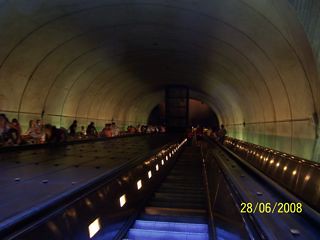
A ride on the Metro took 25 minutes from the Rosslyn Station to Navy Yard, including a transfer at L'Enfant Plaza. Before boarding the train, I took what is purported to be the third-longest escalator in the world.

The escalator ride itself took over two minutes.

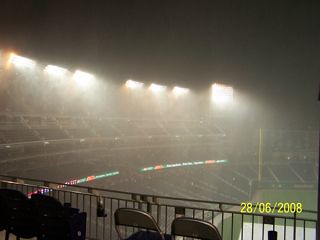
The first game's start was delayed thanks to rain that impacted me as I drove from NYC to DC. The second game's delay waited until the middle of the game.

Overall, three of the six games I attended were hit by rain delays.

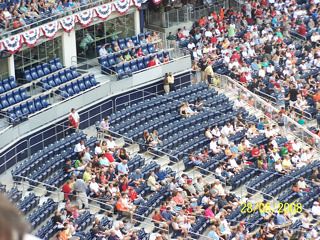
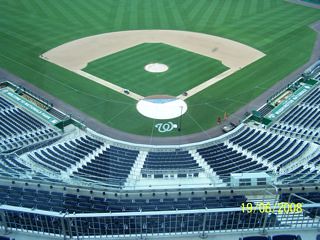
This next picture shows the press box above the lower section of the upper deck. Why did I include this? The upper deck of Cisco Field will have a similar look (minus the red).


Again, the concourses are spacious and well-planned. On the other hand, the gray beams could use a splash of color.


The Presidents Club seats have been sparsely filled at most home games this season. I suppose that makes Washington powerbrokers the most fairweather of fans.

My original assessment of Nationals Park stands: serviceable but uninspiring. I take away from the DC portion of the trip one particular observation. It's going to take a long time, perhaps decades, to make DC a baseball town again. It's not just the omnipresent Redskins that make the place a football town. When baseball left our nation's capital for the seemingly the last time in 1971, the institution that is attending baseball games - that is fandom - also left. As a result, lots of Nats attendees don't have a good sense of what it is to be a die-hard fan (not helped by the Nats' constant crappiness). The relative proximity of Baltimore only made it worse, as fans from say, Northern Virginia, had to deal with lengthy drive. If you have a family of four and you leave at 5:30 to attend a 7:05 game, you probably have to leave well before 10 if you want to get home at a decent hour. For most of that Friday night's fans the mass exodus occurred in the 6th inning.

Coincidentally, the distance from B'more to DC is approximately the same length as my drive from San Jose to Oakland. I can see this type of situation playing out in Fremont among the South Bay fans, who have been conditioned to this way of attending games for decades. When a ballpark is only 15-20 minutes away, many will have to learn to attend games the proper way (apologies to families with small children, who tend to dictate this on their own). Conversely, those further north will have to get used to allotting more drive time for games they attend. It sucks, of course it sucks. When it comes to building stadia these days, beggars can't be choosers.

07 July 2008

ESPN SportsTravel visits the Coliseum

ESPN writer Anna Katherine Clemmons has a good write up on McAfee Coliseum today. She includes the history of the place with renovations, plus a smattering of opinions on the move. There is both praise and criticism of both the fans and the venue. Worthwhile read.

About the Oakland factor:
The stadium lies off of I-880, a quick jaunt from either San Francisco (assuming Bay Bridge traffic is light, which is almost never, despite the $4 toll) or San Jose.

But since San Francisco Bay Area's namesake city of hills, hippies and sourdough already has the Giants and 49ers, this home to the A's and the NFL's Raiders tends to attract suburban fans from a smattering of outlining towns.

So much so, that at this 6:05 p.m. game between the A's and the Rangers, I couldn't find an Oakland native. I searched diligently, talking to at least 30 fans inside the stadium before finally stumbling upon a city resident sitting in the center field section eating chicken tenders and French fries 10 minutes before the national anthem.

Pro-Oakland types often say that ownership has in effect spit on them and driven them away. Some non-Oaklanders have concluded that the fandom really hasn't been there in the first place. Honestly, I think it has more to do with numbers: Oakland's population is only 1/6th of the East Bay, even less of the Bay Area's 7 million. One thing I've pondered is how many former Oakland residents attend ballgames. As the Oakland Hills has taken in transplants from San Francisco and the rest of the country, certainly many longtime Oakland residents were displaced. Some have left the flats for opportunities elsewhere, especially with the erosion of the manufacturing sector. It's likely a combination of the above factors, which is rather inconvenient for partisans looking for an easy scapegoat.

I'll be in the stands tonight, with a slightly different perspective on the Coliseum since concluding the East Coast trip.

05 July 2008

Fenway Park


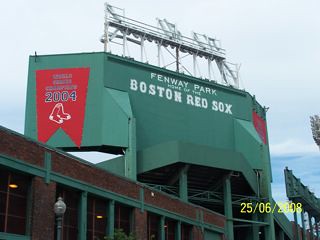
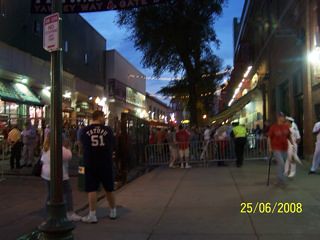
The greatest thing about Fenway Park is its lack of pretense. It wasn't designed in a way that drew attention to itself. It can't afford to be set back in its tiny block of Boston. It doesn't have artfully designed gates and entrances. Nor does it have an very distinctive exterior. It's red brick and green painted steel, of course, but that brick isn't a façade. Along the first base grandstand, it is that brick that keeps standing spectators from falling to the sidewalk below. Fenway was built in sections, expanded over time, and has evolved to become the institution it is today. Never during its 96-year history has there been the luxury of extra space.

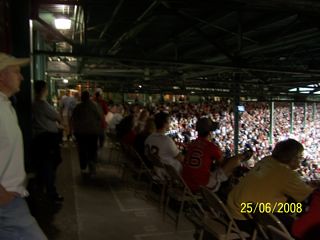
Still, the reputation of Fenway as a tight, cramped space is a bit overblown. Several years ago the City of Boston granted the Red Sox the right to use Yawkey Way as a concourse on gamedays, a la Eutaw Street at Camden Yards. On the first base side the main concourse has a decent amount of room but no place to view the game, unless you're referring to the catwalk-like area behind the grandstand along Van Ness St. Everywhere on the concourse it appears that it's busy and hectic. Yet when you walk into the seating bowl it appears that every seat is filled. What gives? It seems magical.

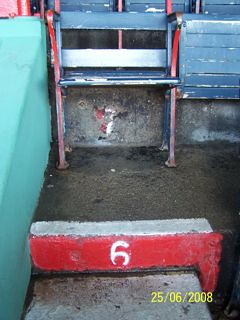
Speaking of magical, there's nothing quite like sitting in one of the wooden grandstand seats towards the rear of the seating bowl. They're comfortable and well-worn, albeit not spacious. The issue with grandstand seats isn't so much the seats themselves as it is the row/riser width. Leg room is severely limited.

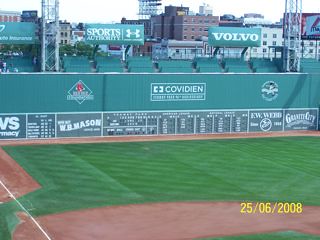
Then there's the Green Monster. It's amazing how much affinity for a place can translate into tangible monetary value. Only in Fenway would outfield seats 37 feet above the playing field be priced $160 apiece. I can't say I'm a big fan. I loved the Monster's lack of clutter prior to the Monster seats and the 2003 All Star Game. I liked the home run net and how sluggers tried to get their blasts over it. That said, little of the Monster's character has changed. Out-of-town scores still have to be changed by hand on the outside of the scoreboard. There's still a resounding clank when a ball bounds off the upper part of the Monster.

The suites and premium/club areas are all above the main seating area, giving a concourses a communal feel. This works from an aesthetic standpoint because many of those patrons, who tend to pay less attention to the game anyway, aren't in high-visibility seating areas where their lack of fan participation would look bad.

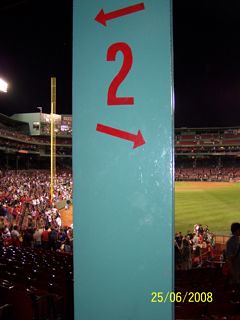
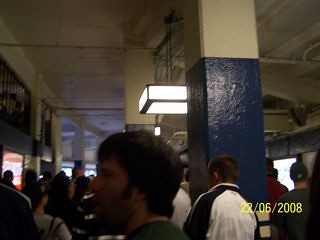
Fenway isn't without faults. No matter how much the purists debate the matter, columns suck. If you happened to be in Section 2 just 20 feet down the row from my seat, this is what your view would look like:

Thankfully, new methods of engineering cantilevers has made columns unnecessary, while allowing for more aggressive overhangs with each new ballpark.

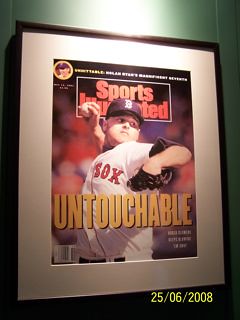
I also noticed the rather ironic framed SI cover while walking through the suite level:

And as hardcore as Red Sox Nation appears to be, they're not immune to their own brand of shameful idiocy. Witness the video I captured:

26 June 2008

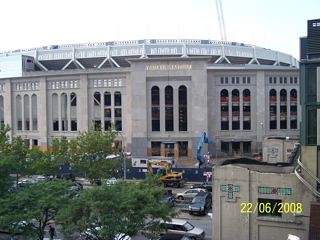
Yankee Stadium

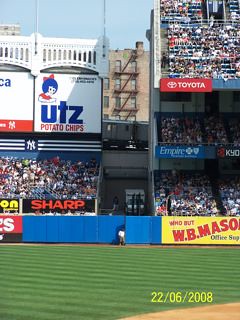
It's hard to accept change. Especially if you're a Yankee fan. I attended Saturday's Reds-Yanks tilt with a die-hard Yankee fan, and he's not alone in his reticence about the stadium situation. This is the last year of the House that Ruth Built, and while the current incarnation bears little resemblance to previous versions, there's still something magical about this place. It may sound irrational, but fans are right in wondering whether the Yanks' unprecedented success here will move to a new place - even if it is within spitting distance of the old one.

The Yankees have been selling out nearly every game and it shows in the price of scalped tickets. We had bleacher tickets, but we heard a storm was coming so we looked to upgrade to something under a roof. We ended up paying $70 per seat extra ($20 premium), but it was worth every penny.

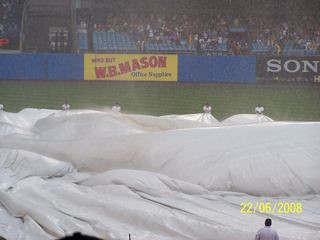
We don't deal with rain delays much in California, which made this particular one quite entertaining. Gale force winds and sideways rain made tarping the infield a bit of an adventure. Worst of all, we were told by people we met after the game that were sitting in the bleachers that during the rain delay, security staff prevented people from getting onto the concourse for safety reasons. Oh yeah, and they don't allow alcohol in the bleachers, so we were able to get our overpriced drink on in the main reserve area as well.

My buddy's house is somewhat upstate and west of the Hudson River. Because of the alcohol factor, we decided to take the train in. Trains west of the Hudson run parallel with Manhattan and terminate at Penn Station (Madison Square Garden). From there we took the B uptown, which dropped us off at the Stadium. No sweat, and by far the best transit situation in baseball (yes, better than the Giants due to frequency of service).

There's nothing wrong with the seating bowl, save for the lack of suites and club areas. The seats are wide and spacious. The place holds 57,000 but actually has some intimacy because the decks are stacked on top of each other with good overhangs. It's once you get out of the seating bowl that the deficiencies show. Concourses and ramps are terribly cramped. Available space limits the number and types of concession stands.

That won't be the case at the New Yankee Stadium, which will be replete with a true façade. Upper deck seats will be further away, and prices will be completely ridiculous. One nice thing that will come out of it: MTA is building a new Metro North train station for fans coming from the Hudson River Valley and Connecticut.

24 June 2008

Citizens Bank Park

Going into this trip, I was the most wary of the visit to Citizens Bank Park. The 43,000 seat park, which replaced the old Vet in South Philly, has been derided as a Johnny-come-lately bandbox. As another HOK project, I had fairly low expectations of the place. At the end of the night, I found myself pleasantly surprised by the experience.

Set in the massive South Philly Sports Complex, Citizens Bank Park is not a downtown ballpark. Yes, it has mass transit (light rail) servicing it, but it's quite clear that the vast majority of its fans arrive by car. And if you came from across the river in Jersey as I did, your choices are limited. Like the Coliseum, CBP is set amongst a vast sea of parking. Yet once come off the Walt Whitman Bridge and descend onto surface streets, there is abundant on-street parking that is predictably free.

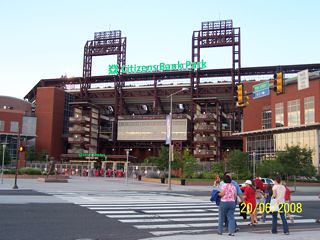
I entered through the third base gate (pictured above). The gate's immense nature is only a hint at how large and spacious the place is. HOK and local architectural firm Ewing Cole Cherry Brott took advantage of available space. Friday's game against the visiting Angels was a packed sellout, but I didn't feel a crush of fans typical of a sellout.

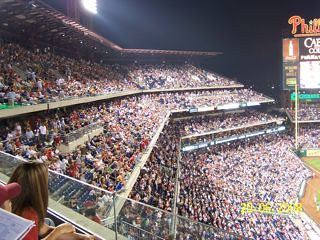
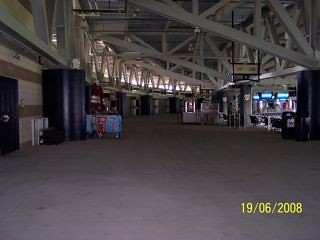
Unlike most other new ballparks, the suite level is hung directly above the field level. The suite level is exclusive but not closed off from the rest of the stadium. This allows for an incredibly high ceiling along the field level concourse. The club level is above the suites and has its own sealed concourse.

Like the plan for Cisco Field, the upper deck is split into two smaller decks. Doing this provides views of the field from the upper concourse, which is quite good despite the distance from the field. Standing areas with drink rails are all over the place. There's plentiful wheelchair-accessible seating. I'm not sure if HOK came up with the open upper concourse idea, but it's prevalent in their latest designs and they deserve a ton of credit for implementing it.

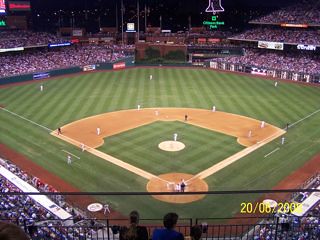
This picture was taken from one of the staircases that leads from the upper concourse to the upper tier. It's a lot of steps to get from the concourse to the upper deck, though not more than from the old upper concourse to the view level of the Coliseum. The execution on a whole is similar to the rebuilt Stanford Stadium.

I had a seat on the second row of the upper tier (section 421). It felt a good deal higher than a similar seat in Oakland. The view was still good. One quirk in the design is the straight, not rounded, backstop. It's little more than an affectation and it makes the place seem that much more boxy and angular. The horizontal line you see cutting through the photo is the top of a plexiglas retaining wall, a line that is actually transparent in live viewing. Notice how for the lower tier of the upper deck, the first row has a stronger metal rail.

I'm not a big fan of the pricing structure at CBP. As part of an ugly trend occurring all over MLB, the Phillies are pricing any kind of field level seat as a fairly expensive premium. In older ballparks, it was generally accepted that seats in foul territory would have a premium whereas fair territory seats - typically bleachers - were cheapies. Nowadays, bleachers are something of a relic. Perhaps Cisco Field can buck this trend to some degree, but I'm not counting on it.

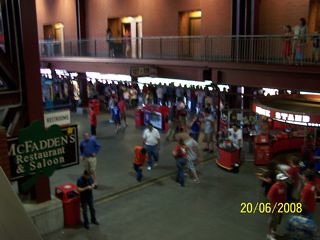
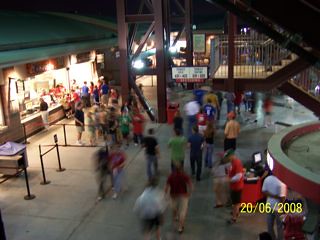
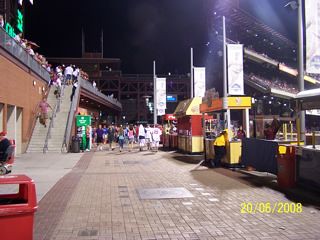
Speaking of the outfield, I had to visit Ashburn Alley before I left the venue. As mentioned in the last post about Camden Yards, Ashburn Alley is CBP's answer to Eutaw Street. There's an entry gate directly behind it in centerfield. There's a great deal of standing room areas. Restaurants and concessions line the alley, including a Tony Luke's cheesesteak stand (I skipped it and went to the actual Tony Luke's only a few blocks away after the game). It even has a second tier for more standing room and concessions. Despite the high level of activity, it all felt a bit too manufactured, and not terribly authentic. It's the same worry I have about Cisco Field, whose architects (360/Gensler) have their work cut out for them in this regard.

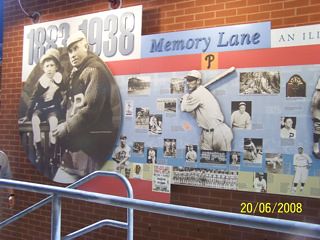
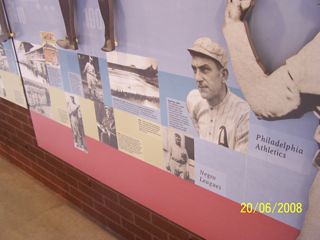
Despite the manufactured air, one feature of Ashburn Alley made it well worth visiting. Behind the batter's eye in center is a monument to Philadelphia baseball. Not just the Phillies, mind you. Both the Philadelphia A's and Negro League players and teams get nods. The exhibit is set up in two large timelines, the top being the Phillies, the middle for the A's, and the bottom for the Negro Leagues.


If you ever visit CBP, this is a must see. With that, I think it's time for me to mention that Lew Wolff brought up the idea of a baseball museum in his initial presentation for the Coliseum North plan, and we haven't heard anything about it since.

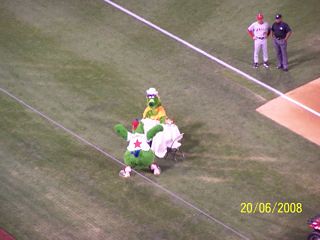
Lastly, what visit to a Phillies game would be complete without a mention of the Phanatic? During a break, both male and female Phanatics showed up on the field to enact Philly soul legend Billy Paul's classic "Me and Mrs. Jones." The show included some humorous albeit suggestive belly thrusting on the male Phanatic's part. At the climax, the male took a running start, leaping over the table at which the female was sitting, tackling her in the process.

Also, Philly's always had the best between-inning music selections of any ballpark, bar none. Overall, a pretty darned good place to see a game.

Next post: my final visit to Yankee Stadium.

20 June 2008

Camden Yards

I first visited Camden Yards over a decade ago, when the joint was still new and jumping and the O's were perennial contenders in the AL East. In the intervening years, the team has taken a nosedive and the novelty of having a great downtown ballpark has worn off. This season, the O's have averaged only 27,532 fans per game. After the Nats ballpark tour yesterday, I journeyed up to Baltimore to catch a game and see what other changes were made.

When Oriole Park opened, it put another HOK-designed project, New Comiskey Park, to complete shame. It had open concourses, easy circulation, and that oh-so-retro look. Nowadays, it suffers a bit compared to the newest parks but for the most part still holds it own. That's reflected in the fanbase, much of which is young and comes mostly to hang out.

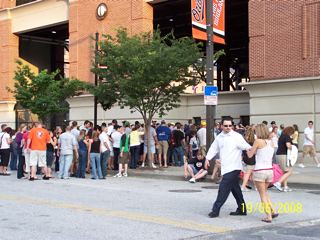
The picture above was taken at 7:36 p.m., over a half hour into the O's-Stros duel. It took me another 20 minutes to get a ticket. By the time I got inside the north Eutaw St gate, it was the middle of the third. The kids in line with me didn't appear to care much for the action on the field, although half the crowd adorned Nick Markakis jersey shirts. The final announced crowd was 31,480, nearly 10,000 more than average. Some of that boost may have been attributable to the team's recent success. The O's were on the verge of a three-game sweep going into Thursday night.

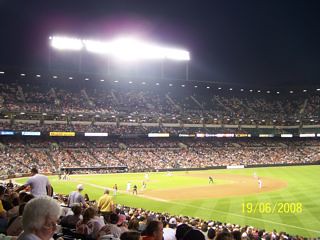
This picture pretty much sums Camden Yards. At the bottom is the field level concourse. Unlike most new ballparks, the tunnels/vomitories from the concourse empty into the middle of the field level seating. You can see the back of the upper section cantilevered over the concourse. The net effect is that fans on the concourse are cut off from the action. It's odd that only baseball really emphasizes the idea of the open concourse, the other three major sports all sport venues with concourses separate from the action. Yet the open concourse really enhances fan experience, that's why even upper decks are getting the treatment.

Now compare the Camden Yards concourse, above, to Nats Park's lower concourse.

Massive difference in ambient light, right? This tends to make the concourse feel a bit claustrophobic, especially when there's a lot of foot traffic. At Camden Yards, not so much. There's always an available refuge area at the outer edge of the concourse, which happens to be at street level. Is one really that much better than the other? I can't say. Both have readily apparent pros and cons. PETCO Park tried to have it both ways by having concourses split so that they're open on both sides with a block of services in between. I find it a bit confusing.

Also, take a look at the structural work. At Camden Yards, the steel beams are smaller but in greater quantity. At Nationals Park they use massive beams and trusses that are set further apart. Is the newer treatment more practical, or more for effect? It gets a big shrug from me. To the same end, Nats Park has huge concrete columns supporting the truss system.

The thing I appreciate the most about Camden Yards is its use of materials. All stadium have mixtures of precast concrete and steel, along with some kind of external treatment. While HOK has really emphasized steel in its most recent parks, Camden Yards is different in that it gives equal treatment to both materials, as well as the brick façade.

The ramp landing above shows this philosophy. The brick isn't a thin layer as it is at AT&T Park, it's either one or two full bricks deep. It even wraps around so that it's exposed to fans using the ramp. Not to be forgotten, there's a steel form there to remind everyone what's really carrying the load. It's that sense of shared purpose that makes Camden Yards so good, so unique. Sometimes I wonder what's happened to HOK's parks since then. It can't just be a budgetary issue, can it?

Eutaw Street is the element that every ballpark since then (that has had available space) has tried to copy. It's perfect in terms of execution. Perhaps it's too good. The green canopy in the middle left is the oft-mentioned Boog's BBQ stand. The line for it stretched almost completely to the gate at the far left. Chances are if you were in the line you were waiting for 30 minutes just to order. I'm sure it's good, but really what are they doing? Par-cooking then heating up the food? Is that what they're waiting for?

I've been working with a small smoker recently, and much of the time there is no comparison between merely grilled food and truly barbecued (via smokehouse/smoker) food.

Tonight I'm off to Citizens Bank Park, home to the Phillies' answer to Eutaw Street, Ashburn Alley.

19 June 2008

Nationals Park: Cute from afar, far from cute

A while back I expressed my disappointment at the use of lackluster materials in the Nationals Park façade. Since my flight came into Dulles a little after midnight, I had a chance to quickly drive over to the ballpark in the morning after catching half a wink. It's worse than I thought.

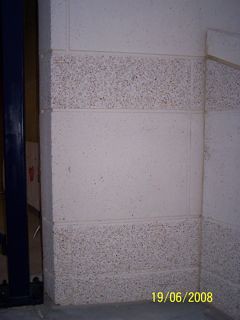
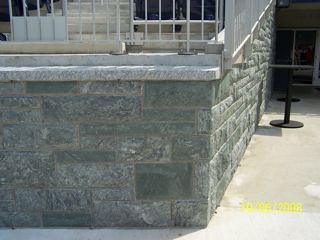
What you're seeing here the wall next to a vehicle service entrance. It has alternating concrete and aggregate. This pattern repeats itself throughout the exterior and provides contrast. No problem if you're looking at it from a distance. Up close, not so great. It doesn't look like it's going to wear or weather well. And unfortunately, there is one place where actual stone is used...

...the tunnel to the dark, swanky, and very exclusive Lexus Club.

Years from now Nationals Park will be looked upon as a serviceable, bland venue from the outside. Thankfully, fans will pay a lot more attention to what happens on the inside. Inside, it looks alright. They're still tying up some loose ends, as evidenced by an engineering crew maintaining an office within the stadium.

It's not fair to dismiss HOK and Joe Spear for the firm's ubiquitous ballpark design, but they have patterns just like a bad poker player. The fact that they've built so many of these things only magnifies the criticism.

Nationals Park shares much with Cincinnati's Great American Ballpark, from the seemingly overbuilt structural steel to the split/uneven upper deck distribution. It certainly pushes the "neighborhood" concept that many (including the A's) are trying to capture. Unfortunately, I think neighborhoods have to come about organically. They can't be forced.

Sight lines are good from just about everywhere. Opposing team broadcasters have set about whining their entire stays in DC. To that I can only say that the same thing happened at PNC Park when it opened, and you don't hear that much about the problem anymore - though Nats Park's press box is much higher.

The Mitsubishi scoreboard looks good. In a puzzling bit of advertising wizardry, Amtrak is the sponsor on all in-house displays. Now I'm not sure if that's only when there isn't a game on. If that's the case it's a curious way to get eyeballs.

The field level concourse is enormous and easy to navigate. They've used the space well to spread out food and entertainment offerings, right down to a large, multi-attraction children's area in RF.

I will be returning to Nationals Park on the 27th and 28th for games against the Orioles. I'll look at transportation and parking, along with understanding how the design elements work practically in service of the fans. FWIW it took 40 minutes to take the Metrorail's Green Line train between the Navy Yard station (1/2 block from Nationals Park) and the Greenbelt station, which is in Maryland beyond the Beltway and College Park, the home of the University of Maryland. It also took 3 minutes from L'Enfant Plaza.

Tomorrow, I'll write the nightcap from the 19th: a visit to a game at Camden Yards.

15 June 2008

49ers Santa Clara vote may slip to 2009

Ah, process.

Santa Clara's city council is considering pushing the stadium financing plan's deadline back seven months, which would make a November vote impossible. The next likely election is a special election in mid-to-late 2009, in which a much lower turnout would be expected than the upcoming general election. Usually this is good for stadium proponents as they can expect and gear up a greater percentage of turnout from their supporters than their opponents.

Even with that there's still the EIR that has to be completed. While far less complicated than the Cisco Field/baseball village EIR, there's still a year's worth of work there. Proponents still claim that a 2012 opening is still possible, but they're cutting it really close.

One potentially troubling item comes from councilmember and stadium skeptic Jamie Mcleod, who states:
...the 49ers have pledged only to cover cost overruns for one year after the team's 2012 completion target.
No big deal if they get it done on time and do some value engineering in the process. Because they might value engineer the first time around, they might use up a lot of that annual stadium improvement fund quickly, lest the 49ers stadium turn into Edward Jones Dome.

04 June 2008

Election recap

San Francisco voters passed Proposition G while nixing Proposition F. Prop G asked for voter approval of Lennar's vast Hunters Point development. Prop F would have added that half of the new housing to be built had to be affordable housing. As part of the development plan, Lennar has set aside a site for a new 49ers stadium to replace the 'Stick, while also ponying up $100 million towards construction.

Meanwhile, competing statewide anti-eminent domain Propositions 98 and 99 were also on the ballot. Prop 98 lost, while Prop 99 won. The upshot is that the state now has a real, though limited, set of restrictions against eminent domain. Homeowners will be protected against property seizures intended for use by private parties (developers). However, this really only brings us back to the original purpose of eminent domain: seizure of property for public use (roads, etc.). A city or county could continue to seize property to build, say, a stadium, and as long as the final product were publicly owned it would still pass muster. Whoop-de-do!

28 May 2008

Upcoming ballpark trip

Circumstances have allowed me to move my planned trip to Nationals Park from August to June. Along with DC, I'll be traveling north to take in games at Baltimore's Camden Yards, Philadelphia's Citizens Bank Park, Yankee Stadium, and Fenway Park. If time allows, I'll be heading with some friends to Cooperstown as well. The trip is planned for June 19-29.

Here's the tentative schedule I've planned:
  • June 19: Nationals Park tour; Pirates vs. Orioles @ Camden Yards
  • June 20: Angels vs. Phillies @ Citizens Bank Park
  • June 22: Reds vs. Yankees @ Yankee Stadium
  • June 23: Baseball Hall of Fame
  • June 25: Diamondbacks vs. Red Sox @ Fenway Park + tour
  • June 27: Orioles vs. Nationals @ Nationals Park
I've been to all of the cities before and all of the ballparks except for DC and Philly, but not in a quasi-academic capacity. If possible, I'll try to get inside looks at both the new Yankee Stadium and CitiField. I'm not taking in a game at Shea, I figure once is enough.

Any suggestions for other baseball/sports-related places or events? FWIW I'm trying to cram in the NBA Draft (June 26) into the trip. I went to the 2003 (Lebron James) draft, and it was great pageantry. I'd love to do the NFL draft at some point too.

22 May 2008

Tampa Bay Rays Stadium Review Session

Wow, was that frustrating. Consider this: the Tampa Bay Rays are trying to do much the same thing the A's are doing except for the following:
  • Over half of the stadium will be publicly financed
  • The public part is largely dependent on valuations and revenue streams that are not even close to guaranteed
  • There are contributions from both St. Petersburg and Pinellas County, thus requiring approvals from both parties
  • The Rays are trying to cram the whole approval process into 6-8 months
  • There is a referendum in November
I have to say I appreciate the Rays' positioning of several public sources of revenue (sale of land and development rights, parking revenues) as not public. It's cagey and if the St. Petersburg City Council were born yesterday, they may have bought it. Instead, they're chock full of questions for city staff and team officials that alas, couldn't be answered.

The key part of the deal at this point is the shuffling of parking revenue from some 4,000 parking spaces in and around the downtown St. Pete area, within 3/4 mile of the ballpark site. Follow me on this. The Rays prepay a long-term lease on 2,000+ spaces downtown. The city takes that money and contributes that towards ballpark construction, around $35 million. There are also suggestions that a $1 parking fee be charged during games to create another $20 million for the project. Out of this discussion came concerns that there weren't enough spaces to handle this revenue model, and that the city would be liable if there were a parking revenue shortfall.

I don't understand why this thing is being rushed through like this. I'd like to give Rays' owner Stuart Sternberg the benefit of the doubt, but too often important details are missed when the process is rushed like this. Fremont and the A's are devoting the better part of two years to their project, this one merits a timeframe approaching that.

At least I got one thing out of the three-hour session, courtesy of councilmember Jeff Danner:
A lot of what I hear is "All you have to do is put out the referendum and let the people decide." But that's gonna be two questions, fifty words, and I've got a stack a foot high of what we're deciding. We're expected to do a lot more than that.
I've never heard a more effective argument against ballot box planning.