Pages

08 October 2008

Fremont election coverage

This week's East Bay Express has an article on the three (four?) -man race for Fremont mayor, and how it maps out in terms of the baseball village issue. The piece was penned by Robert Gammon, who also co-wrote the excellent "How we got to this point" article from two years ago. This comes on the heels of Wes Bowers' coverage (Fremont Bulletin) of a candidate forum from two weeks ago.

During the initial discussions about the plan, both Mayor Bob Wasserman and Councilman Steve Cho painted themselves as supportive of it, though Cho distinguished himself in remarking that a public vote would be a proper thing to do. He also said at the time that he felt that voters would support the plan. Wasserman and the other council members did not support a referendum, declaring that they didn't support ballot box planning.

The third mayoral candidate is former Mayor Gus Morrison, who was termed out prior to Wasserman assuming the reins. Morrison has been to date the most vocal critic of the plan, even after a one-on-one with Lew Wolff.

Morrison's interest anti-growth stance has been well documented in Fremont. There's an interesting wrinkle to it, captured in this quote:
"Originally downtown was supposed to be equidistant between 880 and 238. We had a plan for a life center when I left office the only life center between Oakland and Santana Row and it sort of died after I left," he said. "Now the A's want to come along and build a project with a life center the only one between Oakland and Santana Row and we can't have two. There seems to be a conflict."
So is the issue so much about the development in general, or where the development is located? There's no chance of the A's looking to downtown Fremont even though it has BART, because the area is 2 miles of traffic lights away from either 880 or 680. Are there business interests who'd prefer to push such a development downtown? Is that realistic?

He's not alone in his disapproval. Local Sierra Club chapter leader, Vinnie Bacon, is running for city council. Bacon has also been against the project from the beginning. Two city council spots are up for election, and those could also have a huge effect on the plan's status. Cho's term is up at the end of the year, as is Councilman Bob Wieckowski, a noted plan supporter.

A look at the LWV roster of candidates for the two council seats shows a laundry list of interests: public safety, budget/revenue matters, growth, business development. Another council candidate, Alan Stirling, is obviously anti-stadium when he said this:
"Not one sports stadium in the history of this country has been built without public money," he said. "You have to look at your money when looking at this process. (Teams) have walked away from deals when public money wasn't offered."
I can name a stadium that was built without public money: Stanford Stadium. And it was built in record time, by a developer who knew what he wanted, and partnered with public and private entities to get it done. The quote above smacks of vague generalism, and isn't reflective of the current political/economic environment in California, and to a finer point, the Bay Area.

I can't say I know much about any of the other candidates. Planning commissioner Suzanne Chan and Larry Montgomery are supporters of the plan. Curiously, Montgomery supports building a convention center adjacent to the baseball village. As a San Jose resident, I'm an outsider to the process and have my own home issues to worry about (BART to San Jose).

The desirable outcome for plan supporters would be to have incumbents Wasserman and Wieckowski to keep their seats and leave the final seat up for grabs. Even if Bacon were to get the final seat, that would leave the Mayor and four out of five councilmembers as supporters of the plan. The nightmare scenario for the Wolffs would have Morrison winning and Bacon displacing Wieckowski.

06 October 2008

CSN West name change

While looking through my Comcast onscreen program guide this weekend, I noticed a channel name change. Digital channel 400, which was previously abbreviated CSNW (Comcast SportsNet West), is now CSNCA. As you might guess, that CA stands for California, making the new name Comcast SportsNet California.

Curious about this, I immediately hit the CSN home page to see what happened. The CSN West page is still up, but it has been updated with a new logo to reflect the name change. All of the corporate scrubbing will assuredly follow suit soon.

There's nothing in the press releases section or anywhere else about the name change. The Wikipedia entry for CSN shows that the reference to the name change was edited on Friday.

Was the change precipitated by the A's possible TV deal with CSN? Perhaps, but I'm guessing "No" because I don't see any conceivable difference in brand recognition between CSN West and CSN California. Instead, it may be that the launch of Comcast SportsNet Northwest in the Seattle area prompted the change, in order to avoid confusion. CSNNW had already been operating in Portland for some time, so there's a hole in that theory there. Whatever the case, I'll try to find out later today. Interestingly, CSNNW is not carried by either DirecTV or Dish. According to this press release, some Sharks games will be carried by CSNNW.

This isn't major news. Still, look for a November press release announcing the deal between CSNCA and the A's.

02 October 2008

Tarps and wires and catwalks, oh my

You may notice that, on some of the wide shots of Tropicana Field during the Rays-Pale Hose series, there are tarps on the uppermost seats along the first and third base lines. This is despite the fact that this is the Rays' first ever postseason adventure. Local opinion has largely been for removing the tarps, which would add 6,000 seats to the Trop's current 36,048. The team's position on the matter is that should they reach the World Series, then and only then would the tarps be removed to expose the nosebleeds.

25 September 2008

State to allocate $239 million for BART-to-SJ extension

Gary Richards, a.k.a. Mr. Roadshow, reports that the California Transportation Commission is expected to approve $239 million in additional state funding for the Silicon Valley BART extension. In the process, $91 million is being moved from the Dumbarton Rail project to the BART extension.

The last bit of funding completes the state responsibility. It's now up to Santa Clara County voters to approve Measure B, which is meant to cover operations costs of the extension (it does not claim to guarantee covering those costs). Should the measure pass, the matter would go to the Federal Railroad Administration, which would have to authorize matching funds to pay for $750 million in construction costs. Previously, the FRA didn't support the project in part because of the lack of a method to cover operations costs. The FRA's 2004 decision forced VTA and BART extension supporters to go back to the drawing board in hopes of getting the line built.

Richards ends the article with this appraisal:

But the 2000 measure centered on BART won with a 71 percent approval, by far the biggest margin of victory of five transportation taxes that have gone before voters since 1976. And this week's money boost gives BART backers a head of steam heading into the election.

"Big projects need momentum," said Metropolitan Transportation Commission spokesman Randy Rentschler. "And BART is picking up big momentum."

From a regional transit perspective, losing funding for the Dumbarton Rail project hurts. I sense that priorities shifted a bit when the High Speed Rail commission chose the Pacheco alignment over Altamont, which would likely have required a revamped or all new Dumbarton rail bridge to cross the bay.

November 4th is shaping up to be the biggest election day in a generation.

Memorial Stadium retrofit solution

Carolyn Jones, who has recently covered the A's stadium beat, has her sights set slightly north in her new article. This time the stadium in question is Cal's Memorial Stadium, which as longtime Bay Area residents know, sits smack-dab on top of the Hayward Fault.

Lost in all the hubbub about the new, adjacent athletic training center and the oak grove that it is displacing, is the sobering fact that the old stadium was in poor shape in the event of The Big One. For the Bears to continue playing there into the distant future, a retrofit is needed.

Thankfully, it appears that a group of seismic engineers has figured out a way to do it for about the cost of Mt. Davis (not adjusting for inflation). Here's the description of the major part of the solution:
At Memorial Stadium, the sections directly on top of the fault will be cut into three large free-floating blocks. The blocks will be separated from the surrounding structure by five feet of open space, which will give the blocks room to wobble and twist - but not topple - in the event of an earthquake.
Normally stadia have simple expansion joints in decks and walls to handle various types of jostling. This takes that idea to the extreme. By cutting gaps in the two fault-affected stadium sections and splitting each one into three independent pieces, the edifice is being split into two "halves" with what could be considered free-floating end sections sitting on plastic. The free-floating ends could slide around when an earthquake hits, while the two halves would move in accordance with their respective plates.

$150 million won't just pay for a few saws and plastic sheeting. There's a regular retrofit too along the western side:
The western half of the stadium will undergo a standard retrofit, with bracing, sheer walls and an extra layer of concrete coating the interior. The concrete will have breaks at either end over the fault, so if the stadium cracks it will crack in a designated and relatively clean way.
This is important because unlike the eastern side and the old Stanford Stadium, this side is not built into a hill. It's old, decaying reinforced concrete with access tunnels and vomitories.

I for one am glad to hear about this simple, sensible plan. At a time when numerous Division I-A/Bowl Subdivision teams are building bigger and more expensive expansions onto their existing stadia, it's nice to see that UC is working to preserve the current experience while fulfilling a great need in seismic safety.

Now the remaining question is: Will Jeff Tedford still be there when the retrofit is done?

21 September 2008

A little advice to Lew: Change the tone

The Rusty Simmons-penned article about Lew Wolff's Q&A session with the A's booster club and Ray Ratto's follow-up brought me back to the old adage: If you can't say anything nice, don't say anything at all. That brings up the following exchange:

Q: What will transit options be in Fremont?

A: Instead of just saying, 'If you don't have a BART station, you can't survive,' we're trying to figure out if we can. If we can, we will. If we can't, we won't. Of course, then we wouldn't be in California any more.

The media and fans have been focused on that last, cringeworthy sentence. It hides a fundamental problem in his response. Assuming that the mayoral race and EIR come through, he's going to build it without an adjacent BART station. It's not a matter of someone telling him the team won't survive without it. There's no way to determine that until the ballpark is built and operational. BART's importance ranks behind the development plan and financing, corporate sponsorships, and ongoing patronage from the existing fanbase, which overwhelming comes by car, not BART.

It really comes down to a few facts about the situation. First, there's nothing that can be done until election day with the mayoral election, which I suspect sticks in Lew's craw more than he's outwardly indicating. Then there's the EIR, which won't happen until late November or December. There's little else to discuss, whether it's a move out-of-state or to San Jose, since massive obstacles confront both possibilities.(FWIW, I haven't seen many yard signs advertising mayoral candidates in Fremont.)

As long as the waiting game continues to be played, he might as well have a more open, ongoing dialogue with the existing fanbase. Explain why the move needs to happen - and yes, that means being truthful about the Silicon Valley overtures. Talk about how the team will make every effort not to abandon the loyal hardcore fan, and then follow that up with action. As alluring as the South Bay is, the South Bay is not enough all by itself. Just as the East Bay isn't enough by itself.

Wolff's been making great strides building good PR in Fremont, but I sense that not enough care and feeding has happened elsewhere. It's akin to the current presidential campaigns, whose efforts are almost entirely focused on a handful of "battleground" states, but not to states where the base is expected to turn out en masse.

Perhaps the most important issue is for Wolff to keep his foot out of his mouth. A couple more comments like that and he'll venture into Jeff Loria territory, and that is truly poisonous for all. Well, maybe not for columnists like Ratto, for whom controversy is their stock and trade.

19 September 2008

Goodbye, McAfee

Say it with me now: Oakland-Alameda County Coliseum.

Feel better? You might knowing that the stadium whose original name, above, was changed to Network Associates Coliseum and then McAfee Coliseum, is reverting back to the original after McAfee's naming rights contract ended yesterday. And to think that I unknowingly attended that final game. I didn't even get a souvenir!

While the naming rights, at $1.3 million per year, were a pittance compared to newer facilities, that money couldn't have hurt with the bottom line, especially considering the outstanding debt on the facility. I was told once years ago that had the A's moved out, McAfee had early termination rights. McAfee's shares have grown fairly steadily since the dot-com bust, but their disinterest in renewing the deal says a ton about how ineffective it was for their marketing efforts. It'll be interesting to see what happens with future broadcasts and the mention of the stadium's name. Will those bright red "McAfee" logos on the backs of the scoreboards be repainted soon or after the football season is over?

As for a naming rights successor - I wouldn't count on it.

Block these dates out: June 12-24

I've had the pleasure of going on several ballpark sojourns in my day. It started during college breaks, as it has for many. When you're a broke college student on the west coast, you can only get so far even if you're camping and gas is cheap (circa 1996). The adventures extended well into post-education life. I even have a pretty good routine down for scheduling business trips to coincide with sporting events of different types.

In these troubling financial times, it might be easy to be dissuaded from taking such a ballpark trip in the near future. It is, after all, the era of the staycation. However, next year there will be a unique period in which California fans will have an opportunity to take in a veritable cornucopia of baseball experiences - all practically within the state of California. We can thank MLB's schedulers, who have released next year's schedule in time to start planning.

Next year's interleague schedule has the AL West facing their counterparts in the NL West once again. During the second period of interleague play in mid-June, all five California teams will play each other in a sort of unintentional round robin. It's the scheduling equivalent of a total eclipse. From June 12 through June 24, the schedule looks like this within California:

From this an A's fan could fashion a pretty nice road trip focused entirely on A's road games. It could get more interesting by throwing in one of the Freeway Series games. If you wanted to make it really cool (and you had the time), insert a few minor league games to boot. We already know about the Sacramento River Cats and the Fresno Grizzlies. Las Vegas will continue to field a AAA team, though it's not yet known what affiliation it will carry - other than the fact that it won't the be the Dodgers, whose AAA team will once again live in its rightful home, Albuquerque. Vegas' Cashman Field may not be swank or even modern, but as a one-time temporary home for the A's, it could merit a visit. Besides, it's Vegas, right?

To make the minors more exciting, Reno is building a new stadium for the old Tucson Sidewinders (Diamondbacks affiliate). The team will start play there in April. Add that to the mix along with Stockton's Banner Island Ballpark, and you've got two weeks of baseball bliss without having to fly anywhere or drive more than 8 hours at any point along the trip, most often much less. Minor league schedules haven't been released yet so inclusion of minor league cities is speculative for now. As that information is released we'll have a better idea of what is feasible. Fortunately, the schedule allows for some flexibility.

The itinerary:
  • A's @ Giants, 6/12-14. If you're like me, you tend to avoid the A's-Giants series unless a large group gathering (read: casual fans) makes it worthwhile. As Yogi once said, "Nobody goes there anymore. It's too crowded."
  • TBD @ River Cats, 6/14 or 6/15. Hopefully the big league team stays healthy enough that the River Cats don't bear an uncanny resemblance. While you're there look for the AAA championship trophy.
  • TBD @ Reno team, 6/15 or 6/16. One more reason to head to the Reno-Tahoe area in the summer. The ballpark site is downtown. You could even take Amtrak's California Zephyr train from the Bay Area and walk to the ballpark.
  • TBD @ Las Vegas team, 6/16 or 6/17. The team is getting rid of the 51s moniker with new ownership. Side note: the former owner was Mandalay Entertainment (film producers, not casino), a group that was interested in buying the A's in 1999.
  • A's @ Dodgers, 6/16-18. Even if you've been to Dodger Stadium multiple times in your life and it's old hat, the place still has a magical quality to it. Maybe you'll catch a game on a relatively smog-free day.
  • A's @ Padres, 6/19-20. I'll go out on a limb and predict it'll be a low scoring affair. Even when accounting for the aggregate score of all three games.
  • Dodgers @ Angels, 6/21. Catch another rivalry game despite your hate of both teams.
  • TBD @ Grizzlies, 6/22. With any luck the River Cats and Grizzlies games will involve the two teams playing each other. Chukchansi Park is a nice, modern ballpark.
  • TBD @ Stockton Ports, 6/23. Might as well, it's on the way home.
  • Giants @ A's, 6/24. It's unusual to schedule any Giants-A's series during the weekdays, but that's what's happened here. I suspect that this game will be a 12:35 PM tilt as is customary on Wednesdays. That might allow for a switch at the end of this trip. After the end of this game, you might be able to drive out to Stockton to catch the Ports game.
Again, this is all contingent on the scheduling of the AAA teams. Still, at least two of the four teams should have schedules that can accommodate the trip. It's also possible to switch Las Vegas and Fresno if scheduling conflicts warrant it. A trip like this can be done cheaply (couchsurfing) or expensively (long hotel stays). The NorCal and SoCal segments can be separated. I'm looking forward to next summer, when I can take the whole trip myself.

17 September 2008

What's in a stadium name?

The Minnesota Twins announced the naming rights sponsor for their new outdoor ballpark: Target. The deal is for 25 years. Financial terms weren't announced, but it's likely the deal is worth at least $100 million for that period.

If you're wondering why Target Field sounds familiar, that's probably because the downtown arena named Target Center is just across Interstate 394 from the ballpark site. The two venues will be linked by an above ground (and freeway) public area called Target Plaza. A series of pre-existing parking garages also stand above the freeway.

I was curious as to how many other companies have their names scrawled on multiple venues. So I did a quick search on Wikipedia to get the lists of American arenas and stadia. When I culled the list, an interesting pattern emerged: companies with multiple naming rights deals are generally in the telecommunications, transportation, and financial services industries. To wit:

AT&T
  • AT&T Bricktown Ballpark (Oklahoma City)
  • AT&T Center (San Antonio)
  • AT&T Field (Chattanooga)
  • AT&T Park (San Francisco)
  • Jones AT&T Stadium (Lubbock, TX)
Alltel
  • Alltel Arena (North Little Rock)
  • Alltel Center (Mankato, MN)
  • formerly Alltel Stadium (Jacksonville)
American Airlines
  • American Airlines Center (Dallas)
  • AmericanAirlines Arena (Miami)
Bank of America
  • Bank of America Arena (Seattle, U of W)
  • Bank of America Stadium (Charlotte)
Citi
  • Citibank Ballpark (Midland, TX - A's AA affiliate)
  • Citi Field (Queens)
FedEx
  • FedExField (DC-area)
  • FedExForum (Memphis)
Fifth Third Bank
  • Fifth Third Field (Dayton)
  • Fifth Third Field (Toledo)
  • Fifth Third Ballpark (Comstock, MI)
  • Fifth Third Arena (Cincinnati)
Ford
  • Ford Arena (Beaumont, TX)
  • Ford Center (Oklahoma City)
  • Ford Field (Detroit)
PNC
  • PNC Field (Moosic, PA)
  • PNC Park (Pittsburgh)
Qwest
  • Qwest Arena (Boise)
  • Qwest Center Omaha (Omaha)
  • Qwest Field (Seattle)
Reliant
  • Reliant Arena (Houston)
  • Reliant Stadium (Houston)
Target
  • Target Center (Minneapolis)
  • Target Field (Minneapolis)
Toyota
  • Toyota Center (York, PA)
  • Toyota Center (Houston)
  • Toyota Center (Kennewick, WA)
  • Toyota Park (Bridgeview, IL)
U.S. Cellular
  • U.S. Cellular Arena (Milwaukee)
  • U.S. Cellular Center (Cedar Rapids, IA)
  • U.S. Cellular Coliseum (Bloomington, IL)
  • U.S. Cellular Field (Chicago)
Verizon
  • Verizon Center (Washington, DC)
  • Verizon Wireless Arena (Manchester, NH)
Wachovia
  • Wachovia Arena (Wilkes-Barre, PA)
  • Wachovia Center (Philadelphia, PA)
  • Wachovia Spectrum (Philadelphia, PA)
Wells Fargo
  • Wells Fargo Arena (Tempe, AZ)
  • Wells Fargo Arena (Des Moines, IA)
There's the potential for diluting the brand by slapping a corporate name on multiple venues, but the strategy is clear: target specific markets or regions that you can either claim as your homestead or venture into new markets where you can try to gain a foothold. In American Airlines' case, they dealt with two markets where they have huge hubs. Wachovia and Comcast focused on their relative strength in Pennsylvania (though Comcast got a package deal with they ponied up for both the new and old arena). AT&T inherited deals made by its former corporate name, SBC. All told, the value of the deals named above approach $1 billion.

Over in the Tri-State area, the Yankees and the New Jersey Sports and Exposition Authority are grappling with naming rights issues. The Yankees are under pressure to preserve the name Yankee Stadium, despite the $1.3 billion price tag. Across the Hudson, the Authority recently fielded an offer from German insurance giant Allianz. Area Jewish groups protested the possible deal due to Allianz' WWII-era Nazi ties, forcing the deal to be nixed. Coincidentally, Allianz has its name on a massive stadium in Munich, Allianz Arena. Its architect, Herzog & de Meuron, also drew up the Beijing National Stadium, a.k.a. the "Bird's Nest."

10 September 2008

Reconstructing the Coliseum

To follow up on Monday's Raiders/Coliseum post, I put together a few mock-ups that show how the renovation would progress. To set it up, we'll make the following assumptions:
  1. The A's begin construction of Cisco Field by the end of 2010.
  2. Cisco Field fully signals the Raiders and the Coliseum to fully pursue an extension.
  3. The NFL either wants an expansion team or a franchise other than the Raiders to move to LA, thereby locking the Raiders out of stadium financing, or they don't want a team there at all thanks to LA market TV ratings and revenues.
  4. The A's open Cisco Field in April 2012.
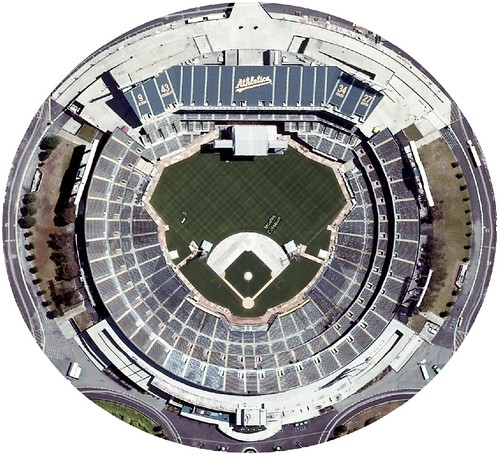
Let's start off the the good ole' Coliseum the way it looks now (courtesy Google Maps, pic taken prior to a Stones concert?):

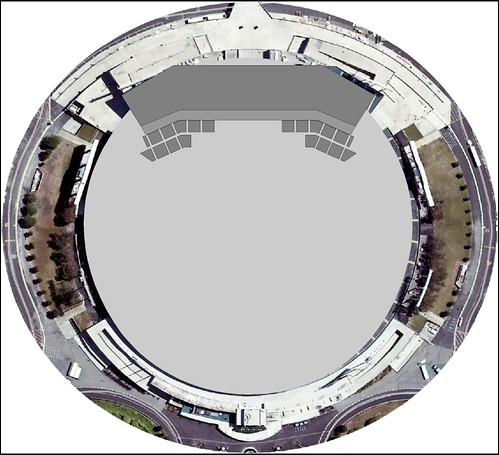
Now let's look at how it would look if the original bowl were demolished and the portable seats removed, leaving only the permanent portion of Mt. Davis.

Next, new permanent lower level seats would be built around three-quarters of the field. The old portable Mt. Davis seats would be re-utilized on the other side of the field as temporary seating while the rest of stadium is under construction. New locker rooms and team facilities would be built on the roughly 50,000 square feet under the yellow sections, while back-of-the-house stuff would be placed beneath the blue sections. Since the old press box would be gone, a new one would be built within the third level of suites in Mt. Davis. New temporary capacity would be around 47,000 only for the 2012 season.

The final phase would involve the removal of the portable seats, which could have a future purpose - additional on-demand seating. Notice the large gray area beyond the blue end zone sections? There's plenty of room for concessions, restrooms, and additional seating, up to 5,000 seats.

The red area shows new permanent lower level seating, which would have behind it a level of suites (a la the suites behind the bleachers). In addition, a new West Side Club (teal sections) would be built as a near mirror image to the East Side Club. Above the club seats would be a slightly cantilevered level of luxury suites and third deck. This third deck would be lower than the Mt. Davis third deck because it would have one less level of suites. New ramps would be placed along the wings of the concourse.

One last thing. Beyond the gray circle on the left and right are the current scoreboards. They look pretty far away from the action, don't they? They could be pulled in and lined up immediately behind the end zones seats, which will have a couple of benefits. Not only could the supports and framework be reused, the displays will appear crisper and larger simply because they'll be nearly 100 feet closer to the action. There's space in each frame for a single ultra wide HD screen of 23' x 70', nearly as large as the display at AT&T Park.

Final capacity would be around 63,000, the current NFL sweet spot.

Marlins one step closer to ballpark

The soap opera-esque story of the Marlins' efforts to get a ballpark took a positive turn Tuesday. Well, it was positive for the Marlins, perhaps not so much for the citizens of Miami-Dade County. Judge Jeri Beth Cohen, who was presiding over Norman Braman's lawsuit regarding the legality of the stadium deal, threw one the last remaining arguments of the case: that the stadium did not serve a public good. That may not sound like much, but that's important when it comes to securing public financing.

One issue remains, the most important one. Braman wants to see the ballpark put to a referendum. That ruling is expected after September 15. He has also indicated that he will appeal the case all the way to the Florida Supreme Court, although if he loses on this remaining count (he's lost the other six so far), the Marlins and Miami would be free to proceed unfettered.

08 September 2008

Raiders revisited

Chris Thompson of the East Bay Express has a lengthy piece on the Raiders' past and possible future in (and out) of Oakland. While the article doesn't draw any specific conclusions on the Raiders' stay in Oakland, their future there appears to be only slightly above bleak.

Last January I posited an idea that the Coliseum, once the A's moved out, could be renovated to become a properly updated (new) NFL facility. Considering the cost of a brand new stadium ($800 million or more and rising every year), renovation is not an idea that should be dismissed too quickly.

I mentioned in my previous post on this subject that the EIR process could be shortened thanks to the existing use of the stadium. However, there are challenges for a renovation. Let's start with a timeline, assuming the A's move into Cisco Field in 2012.
  • September 2011 - Raiders begin final season in "old" Coliseum
  • October 2011 - A's play final game
  • December 2011 - Raiders play final game
  • January 2012 - Renovation begins
  • August 2012 - Raiders begin playing in temporary facility
  • August 2013 - Raiders begin playing in completed, renovated Coliseum
The plan would be somewhat like the construction of Mt. Davis, except that everything else around Mt. Davis would be torn down and rebuilt. There may even be a chance that the Raiders could play the 2012 season in a partly finished Coliseum. I'll explain this later.
Building anything on the current Coliseum footprint is challenging due to the shared nature of the venues. The plaza between the arena and stadium is not particularly wide and underneath it is a vast amount of back-of-the-house facilities. There's the old Exhibit Hall, part of which is now used as the Raiders' locker room. VIP and player parking flanks the plaza. Anything new would have to minimize disturbance of the plaza and the arena.

When Mt. Davis was built, the existing plaza's utility was maintained. The lower deck of Mt. Davis has a handful of risers and seats. Most of it was left blank to accommodate the baseball field. Football seats on portable sections are brought in before games. This situation misses out on a large amount of potentially available space. Thus, the first move would be to place permanent seats in the lower deck and build it out underneath. Locker rooms and supporting facilities could all be stashed underneath.

Next, start tearing down the old Coliseum, sections x01-x10 and x24-x33. The recent trend among football stadia is to minimize the number of end zone seats, so building one deck of new infill seating sections in each end zone should not be difficult. Suites and club sections would not be necessary and would be suboptimal anyway.

That leaves the last part of the original bowl, sections x11-x23. These contain the West Side Club, press box, A's clubhouse, and additional functions. In this case, pull out all of the lower level seats. They're too low and not pitched enough for football, so they desperately need replacing. Then start building in permanent lower level seats, like the ones put in to finish Mt. Davis. It'll take some work to "connect" them to the existing concourse but it can be done. The concrete supports for the upper levels, which are built into the vomitories, would have to be preserved.

This is where the timeline could be split. With the new seating sections in place, the Raiders might be able to play 2012 in the partly upgraded stadium. During the next offseason, the remainder of the renovations could begin. The issue there is the structural work that will be required. If it's lengthy (cast in situ concrete) then there's no way 2012 could be played there. If not it the split schedule might work. The upper decks would be removed and replaced with two levels of suites with press box, a full-length club level, and a large upper deck (like Mt. Davis but not as tall).

The cost? Well, the land's already paid for. There's demo and some new foundation work, but far less than would be expected for a new stadium. Wild guess is $500 million, far cheaper than a new place, yet with all of the location advantages and volume parking that come with the Coliseum.

05 September 2008

A's begin to address traffic concerns

An article in today's Fremont Bulletin (Wes Bowers) notes that on Wednesday, Wolff Urban Development Sr. VP Paul Menaker spoke at length at the Fremont Rotary Club about the state of the Cisco Field and ballpark village project. Most of the news relates to traffic and parking management. There's nothing to report on public transit, other than the A's are in talks with every transit district that services Fremont and the surrounding area. Menaker noted that BART service to the Warm Springs station is scheduled to begin in 2015. Construction of the Warm Springs extension is slated to begin next year, with the Santa Clara County extension to follow pending approval of a countywide sales tax hike in November.

Menaker's discussion appears to have centered around infrastructure. While area freeway interchanges are plenty beefy, the A's propose additional lanes and even another on-ramp to accommodate the projected 10,862 auto trips for each game. I'll go point-by-point on several of the new developments:
To accommodate autos, Menaker said parking would be sited in various designated areas on the east side of I-880. He added parking had originally been slated to be in the Fountains Business Park.
That's a major departure from the original development plan. The area east of 880 is far more developed than the project area, which makes me wonder if the A's have acquired even more properties in Fremont. They'd also have to get the fans across the freeway safely, which would require either a long pedestrian bridge over the Nimitz or more shuttles. It's a bit of a headscratcher until there are more details. It's not stated how much parking would go in that area. 10%? 20%? 50%?

Saying the A's also know this will increase congestion in Fremont, Menaker said the team will make a number of improvements to existing roadways, including adding a second westbound turn lane from Stevenson Boulevard to Boyce Road.

A third westbound lane will be installed on Auto Mall Parkway from Cushing Parkway to Noble Way, and an additional offramp from I-880 to Auto Mall Parkway will be built.

A second right turn lane from Fremont Boulevard to Cushing Parkway will be installed, but only used on game days, he said.

He added various traffic light improvements will also be made, and also only apply on game days.

I believe that's Nobel Way, not Noble Way. The combined effect of these changes will be to make the additional traffic run more smoothly - though it may be as much aimed at the new residential and commercial traffic as it is the ballpark. The onramp is an intriguing proposition, though I have no idea where it would go.

As motorists near the stadium, there will be permanent signage directing where they can and cannot park. He said the team would pay for all aspects of traffic management, including traffic and security officers.

"Everything we do in parking management will be to keep people from parking in Costco's lot and Pacific Commons," Menaker said, adding the team will pay for security personnel, monitors, and enforcement which he called security zones.

As for parking, the A's are proposing a validation scheme for shoppers and employees. Previously I expressed skepticism about validation and remain so, simply from the notion that the big box retailers generally frown upon validation in general.

While I am impressed with the expansive nature of Menaker's traffic discussion, there remain questions about how to placate all of the various constituent groups in the area. The additional infrastructure, which the A's say they will pay for, will be expensive. I'm curious to find out how they will pay for it, as well as further traffic and parking plan details. The role of technology may be important as well, since RFID could help streamline parking management.

At this point I'm only certain of one thing: the traffic and parking study will be a bit larger than a fold-up pamphlet.

28 August 2008

Inelastic demand

In Part II of the AN/Wolff interview, out popped the most curious exchange (emphasis mine):

Blez: I’m going to get to the tarp and the Coliseum a little later, but how do you sell a team that is in rebuilding mode to a market that at times can be ambivalent? The Coliseum wasn’t even selling out when the A’s were the class of the AL a few seasons back. Does it take a World Series victory or even two to motivate these fans again? Or is this just a dead market?

Wolff: I do think that the proximity between us and the Giants hurts. They’ve actually moved closer to us. The six years prior to the year 2000, the Giants outdrew us by around a half a million on average per year. In 2000 they opened the new ballpark and the attendance has jumped and pretty much has stayed there. The difference is now about a million and a half although I haven’t checked it this year. That (the new venue) has something to do with it. Maybe not 100 percent. Secondly, Barry Bonds was a big attraction there and we didn’t have Barry Bonds. The other side of it is the demographic. Both the Giants and ourselves have a lot of water in front of us so there isn’t anyone else living there. A couple of other owners tease us that we may be the only inelastic demand team in baseball. That means that if you won the World Series, the next year would you have two and half or three million out there? In other words, our band of attendance has been approximately 1.7-2.1 million, win or lose that’s where we’ve been.
The comments thread had a nice exchange regarding inelastic demand. What does inelastic demand mean? Simply put, it's a lack of demand change for a product relative to price change. The formula for demand elasticity looks like this:

When the value (absolute value) of this coefficient is between 0 and 1, demand is considered inelastic. You're probably wondering what how the A's demand has looked recently. To that end I compiled a table showing the FCI average ticket price and annual attendance (2008 attendance projected):

You can see that from 2001 forward, the demand ratio (coefficient) has been less than 1 or less, hence inelastic. This is despite a 102% hike in ticket prices in that timeframe. The rich teams have unique market positions. The Yanks, Mets, Red Sox, and Cubs are effectively monopolies. That's how they can continuously raise ticket prices with zero effect on demand. They are the antithesis of the A's. As long as the A's are in the Bay Area, they will always be in a competitive position, not a monopoly position.

So why has this happened? We've gone over most of the reasons in great detail. The Coliseum is long-in-the-tooth, disaffection from long-time fans, the Giants moving closer and poaching casual fans, on-field performance, susbtitute entertainment options, etc. ad infinitum. Is it a reason to abandon the market? Of course not. This market is plenty big enough for six or seven major sports franchises as long as they have good venues and are located properly. In light of this, I don't expect the current business model at the Coliseum to change much in the remaining years of the lease - no untarping the third deck, no cheaper beer or concessions, no ticket price freezes. There's little impact to project from such moves, and thus little reason to make any moves.

Parsing the AN interview: Television

Let's get started.

First, on the television situation. The possible move to Comcast SportsNet West is definitely positive, but not without its downsides. The main issues here are the number of games and on which tier CSNW will be carried in the Bay Area. To illustrate the first issue, I've dragged out the table from the May post on RSN's:

The obvious inequity is that CSNW is carried on the extended basic tier in the Central Valley, while it's on the digital channel 400 in the Bay Area. It really comes down to the number of televisions that can view the channel. Not every household uses the digital converter box offered by Comcast, and for those that do, not every television will be mated to a box. So if you want to watch a game while working on a car in the garage (where there's likely no box), you won't catch the game. Or if you're a kid that wants to watch the game in his/her room but your parents don't feel you need a box, you'll have to watch elsewhere in the house. For some it will be inconvenient. For some it won't.

Then there's the matter of CSNW being on 400. 400 has always been a placeholder as there's little content to put onto the channel at this point other than second-tier college sports. However, there's a unique feature to 400 that many aren't aware of: it's not encrypted. That means even though it's digital, a converter box isn't needed as long as you have a digital TV. The rate of adoption isn't high and there's a level of frustration regarding digital TV tuners, but at least for now the box isn't needed for a digital TV. That said, once the A's are on CSNW could easily become encrypted. The bottom line is that CSNW could be encrypted or not, or it could be moved around the channel lineup.

With the MLB Network launching next year, one fewer channel slot will be available on the analog tier. The Hallmark Channel is typically one of the first to get bumped to digital. In your area this may have already occurred. There are also a number of shopping-oriented channels. QVC is considered untouchable. Jewelry Television, which is typically on Comcast systems on a leased basis, is probably the next candidate. This channel is usually on channel 410 (CSNBA+) when a game isn't being broadcast. Complicating matters are a number of community access stations on a given city's analog tier, which could vary from city to city. Comcast could even end up competing against itself, as it has equity stakes in several other channels, such as Versus and The Golf Channel. (If you want to get an idea how inconsistent the systems are in the channel lineups, go to this Comcast form and put in some valid addresses around the Bay Area. You might be surprised.)

In the end, I think Comcast will figure out a way to put CSNW on the analog tier. They might have to put it high up, say in the upper-70's along with Versus and Golf. It's not in the "sports pocket" with the ESPN's and CSNBA, but at least it would be available. The motivating factor is Comcast's stake. They want to make as much from the network as possible, and that would be an order of magnitude more difficult to do from a digital-only slot.

Two other factors have real impact. A switch like this usually carries with it a massive schedule change. The Giants inked a deal with NBC 11 to broadcast 20 games, whereas 140 went to CSNBA. It's likely a similar split would happen with the A's on CSNW. They might even go to the extreme like the Florida Marlins, eschewing over-the-air broadcasts completely. High definition also will become paramount in the coming years. KICU doesn't do HD broadcasts. I'm pretty sure the other affiliates don't either. Blame that on either the A's or the affliates, it's still pretty costly. By moving over to CSNW, broadcasting expenses become more of a sunk cost as the partners become more interested in promoting the brand. There will be some figuring of what digital space is available to carry CSNW-HD, but that's only an issue in the Bay Area and can be easily accomplished with compression techniques and additional channel movement from analog to digital.

Behind the scenes, there will be an issue of talent and staffing. CSNBA hired a bunch more people and embarked on building a local studio. Would personnel and facilities be shared among the teams despite the split?

Who loses? Well, if this were five years ago, I'd say over-the-air-only viewers. Unfortunately for them, the digital switch is already going to make their experience difficult. Many people in the Bay Area will come out of the switch getting only 6-8 channels, and KICU probably won't be one of them.

5:16 p.m.: A couple more thoughts. There shouldn't be more than a handful of scheduling conflicts each year between the A's and the Kings because the MLB and NBA regular seasons only overlap during the first two weeks of April. That translates to 6-7 possible date conflicts per year. Those games could be easily accommodated by either team's affiliate networks. Also, weekday afternoon games should be available once the deal goes through. I'm guessing that the existing broadcast deal with CSNBA, which runs through the end of the decade, would be torn up and replaced by a long term deal. The Giants supposedly were paid $100 million over 25 years in addition to their equity stake in the channel.

Later today, I'll talk about the ballpark situation.

27 August 2008

Wolff/AN Part III - Funding matter debunked?

Part III is the meaty part of the interview, with a lot more insight into the process than had been previously available anywhere. Read it.

One of the items covered is a question about the credit crunch and whether or not it affects financing of the ballpark:

Blez: I've read where people have said that this project is becoming a bit more of a nightmare because of the downturn in the real estate market. Because so much of this project was dependent on the real estate built around it, and I know that you were planning on having commercial and residential around it to fund things. Is that an accurate statement to make?

Wolff: No, for a couple of reasons. We are not foolish enough to go into any long-term project with only one option in terms of how we finance it. Somebody thinks we are, then they're wrong. So the housing element was critical and interesting, and we don't know that if by the time we get going again that it won't be booming again. We've got some other options which I'd prefer not to discuss but they're logical business options. And we have our own resources. So we're not without capital if we need to do something. Listen 3,000 townhomes don't sell in 20 minutes even in a good market. So it's a matter of how you flow funds. The best part about us is that we can say if it takes an extra five years to sell these homes, we'll bridge it now and you can take us out when that happens. You know, things like that.

I can't tell you how happy I am to be wrong on this point. It's something that I opined about many moons ago, followed by the mainstream press picking it up. It's easy to get caught up in looking at the market as a problem since frequent doom-and-gloom coverage makes it convenient to do so.

There's plenty of additional grist in the interview, whether you want to talk about the A's leaving, territorial rights, why it didn't work in Oakland, etc. Comment away.

Fantastic work, Blez.

26 August 2008

Part 2 of Wolff-AN Interview

Wolff addressed the generally underreported fact that in building AT&T Park, the Giants moved closer to the A's and into a more accessible location.

Blez: I’m going to get to the tarp and the Coliseum a little later, but how do you sell a team that is in rebuilding mode to a market that at times can be ambivalent? The Coliseum wasn’t even selling out when the A’s were the class of the AL a few seasons back. Does it take a World Series victory or even two to motivate these fans again? Or is this just a dead market?

Wolff: I do think that the proximity between us and the Giants hurts. They’ve actually moved closer to us. The six years prior to the year 2000, the Giants outdrew us by around a half a million on average per year. In 2000 they opened the new ballpark and the attendance has jumped and pretty much has stayed there. The difference is now about a million and a half although I haven’t checked it this year. That (the new venue) has something to do with it. Maybe not 100 percent.
There's more in the interview. It's pretty clear that the Giants have been successfully siphoning away A's fans from all over the Bay Area since their new digs opened. They've also made it possible for say, a Giant fan who moved from SF to the East Bay, to maintain his allegiance without making it difficult to attend games. Had the Giants stayed at the 'Stick, that fan may have either stayed home more often or chosen the A's as a local alternative. Now there's less reason to do so.

Now the A's are looking to an area that's less accessible for most of the Bay Area. I'm still curious as to what the transportation and parking will look like, given that they still feel that 15-20% of the fanbase will arrive via ways other than driving.

25 August 2008

Wolff interview on AN, possible new TV deal?

Blez posted the first part of a lengthy interview with Lew Wolff on AN today. Check it out. Nothing on the baseball village itself. Wolff said the team is working on an improved TV deal that could be done in the next six months.

p.s. Thanks for the rep, Blez!

p.p.s. Thanks to Zonis for finding the Bizjournal article about the A's talks with Comcast. The A's may be looking moving to Comcast Sportsnet West, which is currently home to the Kings. In doing so, the A's could pick up an equity share of the channel, just as the Giants have with CSN Bay Area. If the idea has some vague familiarity to frequent readers of this blog, it should since I wrote about it in May. The circumstances are slightly different, but they're still quite favorable to the A's.

p.p.p.s. I'm not an architect, though I play one on TV.

16 August 2008

Mayor Dellums sounds like a nice man

I am not an Oakland resident. I also don't claim to have any real inside knowledge of Oakland politics, so I'll leave criticism of the Dellums mayoral tenure to other corners of the interwebs. That said, Dellums' comments regarding his hope to keep the A's in Oakland read like typical rhetoric from someone who has spent way too long in Washington.
"With a deal that is as big as the deal is in Fremont, anything could go wrong," Dellums said, adding, "I want to continue to keep the door open so that we can keep the A's. The best-case scenario would be that they stay in Oakland. I would like to try to help them stay in Oakland."
That's a lot of well, nothing. Not that I blame him. Every city is playing the waiting game as the EIR and financial markets shake themselves out. Dellums is keen to keep some visibility on Oakland even if his comments are entirely non-committal.

What's not being told is that by the time the Fremont plan enters its crucial stage, Dellums will be entering big-time lame duck territory. I can only imagine what that would mean, given the cruise control nature of his first nearly two years at the helm.

The council hasn't exactly stepped up either, not even Ignacio de la Fuente. Given Oakland's difficult state, is any kind of stadium talk - whether A's or Raiders - the local political third rail?

05 August 2008

A new twist in Miami

From the 11th hour department:

The owner of the now-defunct Miami Arena, Glenn Straub, has proposed a land swap in which he would exchange his downtown Arena site for the Orange Bowl site in Little Havana. The Marlins would then build a ballpark on the Arena site and Straub could start planning for other development. The land exchange would not be a straight swap due to the sizes and relative values of the parcels. To kick up the intrigue, Straub has said he and his partners would build the ballpark and finance it themselves. There is a question as to who would own the stadium in the end, probably the city.

According to both MLB COO/President Bob DuPuy, such a solution would be impractical for numerous reasons:
"It is our view that the careful negotiations for the stadium were the product of literally years of work, among Baseball, Dade County and the City of Miami," DuPuy said. "We looked very hard at that [arena] site when we were looking at downtown sites. More land would have to be acquired. The general obligation bond of $50 million wouldn't be available, so even if the costs were exactly the same, we'd be short $50 million.

"There's difficulty there with utility buildings and power lines that would have to be relocated. There's a railroad line cutting through there that would also have to be relocated. And finally, the community is committed to developing Little Havana and the Orange Bowl site, and we want to be part of that development."

While it's true that additional land would have to be acquired, it's not a significant amount. An active railroad right-of-way runs through the block and sits immediately to the south of the arena. It would have to be rerouted around the resized ballpark site. A street that runs through the site would also have to be rerouted as well.

The big advantage of the site is that unlike the Orange Bowl, the site is right next to Miami's Metrorail service, which is like a limited version of BART. Since not much is known about the financial scope of this, it's impossible to say if it passes the smell test. Still, should Norman Braman's lawsuit against the city/county result in striking down the OB plan (via referendum), this is certainly a Plan B worth considering.

31 July 2008

Wolff: I still think it's going to happen

The Merc's Lisa Fernandez got some clarity from Lew Wolff today.

Wolff is troubled about the length of time it's taking to satisfy major property owners near the proposed 32,000-seat Cisco Field and to complete an environmental review.

"I still think it's going to happen," Wolff, a major South Bay developer, said today from his office in Los Angeles. "Otherwise I wouldn't be doing this."

Still on the EIR. Okay...

Fremont Mayor Bob Wasserman said Wolff asked him at Tuesday's A's game to talk to nearby property owners ProLogis and Pacific Commons to appease them about various concerns. Wasserman wasn't clear on the details. But he thought the obstacles concerned ownership of some land and parking. Pacific Commons operates a large retail shopping center next to the proposed A's ballpark site.

Three of the larger Pacific Commons retailers have expressed concerns with the A's parking plan, team co-owner Keith Wolff said. Although the retailers can't block the project, the team wants to make sure they're satisfied. They want clarification and mitigation, Wolff said. One possible solution, he added, is a pedestrian bridge over Auto Mall Parkway that would link the ballpark to the largest parking lot.

The first big retailers are an easy guess: Costco and Lowe's. The third is probably Kohl's. They are the closest big box stores to the village site and have vast parking lots that could be easily poached by stadium goers (*cough* Coliseum BART *cough*) if an effective parking plan were not implemented.

ProLogis, the owners of the Pacific Commons site (and sellers of the village site) have been trying to broker a deal that protects the stores' parking during games and other events. Apparently, these talks haven't been going that well. A big box store's business model is heavily dependent on free, abundant, adjacent parking. That allows shoppers to stay in the stores for lengthy periods without worrying about inconveniences such as validation or time limits. IKEA, for instance, has taken this to the extreme by purchasing their own sites and in many cases, building parking garages.

If you're a big box store, your stance is simple: Don't make me have to change anything. That probably rules out validation. Time limits probably couldn't be imposed because they have to be enforced, which costs money. Either solution may be a deterrent to shoppers, and that won't wash with the retailers. You're also not likely to run into a situation in which ballpark goers combine a game with a trip to Costco on gamedays. It's simply incompatible.

On the other hand, there are plenty of smaller businesses, such as area restaurants, that are positively interested in their proximity to the ballpark. The big box retailers, however, have the big sway. They are major sales tax providers to the city, and as such deserve to be accommodated.

What would be the best way to allay the retailers' fears? The A's may have to consider not charging for parking at all. The way the parking plan is coming together, the non-preferred lots are further away from the ballpark than the big box stores. If the A's force fans to pay to walk a greater distance, it will invite parking poachers to Pacific Commons. There still may be poachers because of those lots' proximity, but at least there won't be a monetary reason to do it. This would hurt the A's because they wouldn't be able to rake in some $12-16 million in annual parking revenues. That loss could be offset somewhat by a potentially larger number of visitors to the area. Of course, that policy could be a double-edged sword. If the place becomes too popular (Valley Fair/Santana Row), patrons could - that's right - poach Pacific Commons parking if the village parking isn't plentiful enough. That's not a likely scenario since ballpark parking at other times could serve as overflow, but you never know. Even implementing completely free parking requires patrons to be on the honor system to prevent poaching. Free parking would also not go over so well with environmentalists, as they might see it as tacit approval of driving over transit.

Moreover, the fact is that some of the ballpark parking is somewhat remote and will create pedestrian traffic. That's an intended effect, as the A's want people milling around the area before and after the game. However, there is one major intersection in the area that, if not planned properly, will cause ingress/egress delays due to massive amounts of pedestrian traffic going through there. I wrote about this last year:
Second, since Joe Fan won't get to park that close to the park, he may be forced to use the lot across Auto Mall from Pacific Commons (the uppermost "P" above). It would behoove the A's to build a pedestrian overpass over Auto Mall Parkway. A full lot there would equate to over 5,000 fans walking from the lot. Not putting in an overpass would be borderline irresponsible, as Auto Mall Parkway is 9 lanes wide in this area and only one side has a usable crosswalk. The best thing to do would be to build the overpass and stick some flexible electronic signage on it. The signage can direct traffic on event days. It can also show advertising on other days/hours.
Is this deal complex? You bet it is.

Wolff says project "in flux"

Thanks to longtime reader/commenter Anthony Dominguez, who found an important ballpark blurb buried in the bottom of today's gamewrap (Rick Hurd/Contra Costa Times):

A new venue supposedly would alleviate (attendance) issues, but Wolff acknowledged that such a prospect is closer to limbo than it is reality. Wolff said the team continues to wait for the environmental impact reports to be finished, and that the need to satisfy several constituencies has slowed the progress.

"It is now in flux," Wolff said. "All I can say is we're working hard every day, because our options if we fail, we really haven't thought about those options."

Wolff admitted that the process has frustrated him at times, but that it's been the price of trying to construct something in California. He also said any reports that intimate the team is seeking public money are misrepresented.

"We haven't asked for any money," he said. "And I'm tired of people assuming we are."

From parsing the quotes, it appears that Wolff is pointing the finger at the EIR process. We've gone over how lengthy the process is ad nauseum. There are whispers about the impact of the shuttle service the city/A's may deploy, with city officials concerned that evening drivetime could be especially difficult. I devoted a post to the difficulty of getting a shuttle working when the specific plan was released. In some of the public sessions there was a mention of a similar split of driving vs. transit/walking fans to the current situation at the Coliseum. I expressed doubts about this as I suspect that the number of fans walking from within and near the baseball village will be lower than expected. It's impossible to scrutinize at this point because the transportation study is not yet published.

Of course, it's easy to hide behind the EIR when that's expected. What I think is really hurting Wolff/Fisher right now are the real estate and greater financial markets. Not in terms of their wallets, but their ability to cobble together the village's financing plan. We all know that the Bay Area real estate market has shrunk in many locales - especially the East Bay. Not even the recently signed mortgage bailout bill is expected to completely stem the tide:

U.S. home prices continued their plunge in May, including a 23 percent drop in the Bay Area. Continued declines make banks even less willing to lend, further pressuring home prices, Tyson said, threatening even prime mortgages and credit card debt.
The biggest issue at this point is that no one knows when the economy will bottom out. How bad will it be? How long will the "official recession" last? Fear caused by current economic uncertainty slows everything down from consumer spending to housing starts. And it's those housing starts that are the linchpin to the whole deal. The financial market that Wolff/Fisher are asking to provide money for the village don't want to hear about the ballpark paying for itself. It won't, that's been proven time and time again. They want something more stable to foot the bill. Until the real estate market collapse, that was housing. Without that in place and for a reasonable interest rate, the deal is sunk.

Now it's a matter of when the turnaround occurs. At some point the Bay Area will see a very low inventory of new housing. Market forces will kick in, causing new housing to be built. The question is, when will that happen? And how much will Fremont lag behind the more resilient parts of the Bay Area (SF, Peninsula, Silicon Valley)? East Bay real estate experts I've spoken to have said the area is already turning around. But it's hard to pick out a few data points in the rest of the noise.

27 July 2008

Dodger Stadium shuttle service begins

After years of not having public transit service the Dodgers' home in Chavez Ravine, the team and city of Los Angeles launched a shuttle bus service that takes fans from Union Station to Dodger Stadium.

"Dodger Trolley," which reportedly had 500-600 riders (1% of a capacity crowd) on its inaugural night, is free and runs every 10 minutes, starting at 90 minutes before first pitch until one hour after a game ends. The trip is 2.2 miles each direction (map). That's less than half the distance from Fremont BART to Pacific Commons, but nearly twice the distance of future shuttles to either the Warm Springs BART station or the planned Pacific Commons Amtrak/ACE station.

It's a great alternative to the hilly gridlock normally experienced at Dodger Stadium, where no other transit mode is expected to build an extension in the near or distant future. It should also serve as a harbinger for Chavez Ravine's future, in which the area surrounding the stadium will be largely developed.

22 July 2008

Around the league, Dog Days edition

Major intrigue surrounds the Marlins' stadium situation, as opponent and former Philadelphia Eagles owner Norman Braman's lawsuit enters its second week. This followed an unsuccessful mediation period. Braman argues, among other thing, that the use of redevelopment money for the ballpark is illegal without a referendum. The South Florida Sun-Sentinel's Sarah Talalay has a great running tab on the case.

On Friday, case judge Jeri Beth Cohen struck down numerous smaller claims made by Braman, but not the core issue:
Miami-Dade Circuit Judge Jeri Beth Cohen said she believes it does, but is "torn" because a Florida Supreme Court ruling, which states property tax money pledged to finance bonds for more than a year for major projects are subject to a referendum, is being reconsidered and is unclear how it should be applied until it is final. In that case, Gregory Strand sued Escambia County over spending property tax money without a referendum.

"The way I read Strand, it applies to this funding scheme. However, I'm torn because of the way the court issued the opinion on how to apply it," Cohen said.

Braman contends the public has a right to vote on the financing for $3 billion in Miami projects, including a $515 million ballpark. He calls it a "shell game" for relying on property tax dollars meant for impoverished neighborhoods to pay off debt on the performing arts center to free up hotel bed taxes for the ballpark.
Braman has said throughout that he'd drop the case if Miami/Miami-Dade officials would simply put the whole development plan, which is far more extensive than just a ballpark, to a vote. If he wins the matter will undoubtedly go to appeal, where Braman has shown the willingness to keep fighting. Fish Stripes notes that a recent Miami Herald poll shows that 57% of respondents believe the ballpark is a bad investment.

Braman also talked out of school when discussing the Marlins' financial situation:
Braman attorney Bob Martinez said the document shows the team was $150 million in debt and had no equity. Braman later slipped in that he turned down the team’s request to invest because “I could not invest in a company that had $163 million…” but he was again cut off.
The issue with the Marlins has always been Loria/Samson. Ownership groups are expected to meet a certain bar in order to operate properly. $163 million in debt? That's Selig's fault. I guess Loria had Selig over a legal barrel when Expos were "contracted."
In New York the Yankees are in a battle to secure $350 million that they feel is needed to complete the new Stadium. Here's the scoop, courtesy of Newsday:
YANKEES NEED MORE STADIUM CASH

February 2008: Planned upgrades to the scoreboard, concession stands and luxury suites spark the Yankees to seek an additional $350 million in tax-exempt borrowing via the city's EDC. The problem lies in potential revision of an Internal Revenue Service regulation - a revision proposed shortly after the Yankees and Mets got IRS approval for their tax-exempt financing in 2006.

STRICTER IRS REGULATION OF PILOTS COULD NIX MORE YANKEES' BORROWING

The proposed regulation under review by the U.S. Treasury Department and IRS would impose stricter interpretation of rules governing PILOTs. The proposed regulation would require PILOTs to be closely tied to "applicable taxes" such as a real estate tax, rather than a fixed payment - in the Yankees' case, a PILOT equal to the debt service on the bonds. The change could disqualify the Yankees from benefiting from further tax-exempt government financing via PILOTs. The Yankees are trying to persuade Treasury and IRS officials to drop the proposed regulation.
Should the feds rule that PILOTs are to be restricted to specific (non-stadium) uses, it's likely that PILOTs could never be used as a financing instrument ever again. That would affect all three New York area venue projects: New Yankee Stadium, CitiField, and Barclays Center. It could also affect plans to renovate Madison Square Garden. Since it's the feds pressing the case, the restrictions would apply throughout the nation, not that many projects were looking to use PILOTs (most publicly-funded venues use sales or hotel/car rental taxes).

19 July 2008

Bobb is back! - sort of

Say what you will about former Oakland City Administrator Robert Bobb, but he sure knows how to keep himself busy. Bobb was hired back by Oakland on a three-month consulting gig. The task? To identify where Bobb's successor, now ex-City Admin Deborah Edgerly, fudged the budget. Bobb and the consulting firm he represents will get a cool $150k for the effort.

Bobb also officially wears another hat, that of President of the DC Board of Education. It's a good way to keep his profile in the District high without burdening him with a ton of responsibility.

Now for the good/bad news. Bobb has yet one more job, one that could shape his political and financial future. He's now turned into a developer - of ballparks, no less! Could this mean a ballpark in Oakland? Not quite. He's focused his attention on a different former stomping ground, Richmond, VA (not CA). Sounds like he's literally turning his success with the Nationals Park deal into capital. That's not all. The article notes that he may have designs on Richmond's mayoral job, after longtime friend Douglas Wilder (who had a stint as Virginia governor) retires.

A little background on Richmond is in order. Richmond has been the longtime home of the Braves' AAA squad since 1966, which places the team in the city longer than the A's have been in Oakland. Last year the Braves decided to move the team closer to home in Gwinnett County, GA, so they could have easier access to those prospects (the A's moved their AAA team to Sacramento in a similar move). A large factor in the decision was also the futility in which the Braves and Richmond have tried to get a new ballpark deal in place.

Bobb's development group, Robert Bobb Group LLC, is one of several firms competing for the development deal. Bobb's plan looks like this:
The group would build in its place a multi-pronged sports and retail complex, called “The Arthur Ashe Learning and Sports Megaplex,” which includes:

• A 200,000-square-foot Arthur Ashe Center featuring a 200-meter indoor track, an indoor soccer field, a 50-meter swimming pool and a 30-foot climbing wall, among other amenities.

• An 8,000-seat minor-league ballpark and adjacent 19,000-square-foot baseball training facility.

• A 6,500-seat basketball arena that would become the new home of Virginia Union University’s basketball team.

• A 60,000-square-foot tennis center for Virginia Commonwealth University, along with several outdoor courts and a 10,000-square-foot sports medicine center.

In addition to the sports facilities, Bobb’s group also proposes building a 200-bed hotel and retail shops totaling 373,700 square feet. In his proposal to the city, Bobb also claims to have a “letter of interest” from a big box retailer for a 200,000-square-foot store on the site.
The still-TBD new baseball tenant would likely be a AA club, as there are no AAA teams looking to move at this time (except perhaps Nashville, whose future stadium situation is uncertain).

Bobb appears to be building, in essence, a sports village. It's not known how much public assistance will be required for the project, but rest assured Bobb wouldn't be involved unless there were some sizable public funds at stake. That's his specialty.

As for Oakland? Well, I suppose that Bobb could, in his peek into Oakland's broken finances, throw in a well-timed quip about how all of the city's fiscal waste could've helped pay for a ballpark. Would he take over the city's temporarily-filled head bureaucrat position? Who knows? I think he sees his political future in Richmond, not Oakland. Still, this three-month gig definitely allows him to dip a toe in the local waters again.

17 July 2008

Nats Park, the Sequel

A ride on the Metro took 25 minutes from the Rosslyn Station to Navy Yard, including a transfer at L'Enfant Plaza. Before boarding the train, I took what is purported to be the third-longest escalator in the world.

The escalator ride itself took over two minutes.

The first game's start was delayed thanks to rain that impacted me as I drove from NYC to DC. The second game's delay waited until the middle of the game.

Overall, three of the six games I attended were hit by rain delays.

This next picture shows the press box above the lower section of the upper deck. Why did I include this? The upper deck of Cisco Field will have a similar look (minus the red).


Again, the concourses are spacious and well-planned. On the other hand, the gray beams could use a splash of color.


The Presidents Club seats have been sparsely filled at most home games this season. I suppose that makes Washington powerbrokers the most fairweather of fans.

My original assessment of Nationals Park stands: serviceable but uninspiring. I take away from the DC portion of the trip one particular observation. It's going to take a long time, perhaps decades, to make DC a baseball town again. It's not just the omnipresent Redskins that make the place a football town. When baseball left our nation's capital for the seemingly the last time in 1971, the institution that is attending baseball games - that is fandom - also left. As a result, lots of Nats attendees don't have a good sense of what it is to be a die-hard fan (not helped by the Nats' constant crappiness). The relative proximity of Baltimore only made it worse, as fans from say, Northern Virginia, had to deal with lengthy drive. If you have a family of four and you leave at 5:30 to attend a 7:05 game, you probably have to leave well before 10 if you want to get home at a decent hour. For most of that Friday night's fans the mass exodus occurred in the 6th inning.

Coincidentally, the distance from B'more to DC is approximately the same length as my drive from San Jose to Oakland. I can see this type of situation playing out in Fremont among the South Bay fans, who have been conditioned to this way of attending games for decades. When a ballpark is only 15-20 minutes away, many will have to learn to attend games the proper way (apologies to families with small children, who tend to dictate this on their own). Conversely, those further north will have to get used to allotting more drive time for games they attend. It sucks, of course it sucks. When it comes to building stadia these days, beggars can't be choosers.

07 July 2008

ESPN SportsTravel visits the Coliseum

ESPN writer Anna Katherine Clemmons has a good write up on McAfee Coliseum today. She includes the history of the place with renovations, plus a smattering of opinions on the move. There is both praise and criticism of both the fans and the venue. Worthwhile read.

About the Oakland factor:
The stadium lies off of I-880, a quick jaunt from either San Francisco (assuming Bay Bridge traffic is light, which is almost never, despite the $4 toll) or San Jose.

But since San Francisco Bay Area's namesake city of hills, hippies and sourdough already has the Giants and 49ers, this home to the A's and the NFL's Raiders tends to attract suburban fans from a smattering of outlining towns.

So much so, that at this 6:05 p.m. game between the A's and the Rangers, I couldn't find an Oakland native. I searched diligently, talking to at least 30 fans inside the stadium before finally stumbling upon a city resident sitting in the center field section eating chicken tenders and French fries 10 minutes before the national anthem.

Pro-Oakland types often say that ownership has in effect spit on them and driven them away. Some non-Oaklanders have concluded that the fandom really hasn't been there in the first place. Honestly, I think it has more to do with numbers: Oakland's population is only 1/6th of the East Bay, even less of the Bay Area's 7 million. One thing I've pondered is how many former Oakland residents attend ballgames. As the Oakland Hills has taken in transplants from San Francisco and the rest of the country, certainly many longtime Oakland residents were displaced. Some have left the flats for opportunities elsewhere, especially with the erosion of the manufacturing sector. It's likely a combination of the above factors, which is rather inconvenient for partisans looking for an easy scapegoat.

I'll be in the stands tonight, with a slightly different perspective on the Coliseum since concluding the East Coast trip.